Storia
The earliest record: Ser Lapo Mazzei
The family’s documented association with wine predates its establishment at Fonterutoli. On 16 December 1398, the Florentine notary, poet and wine connoisseur Ser Lapo Mazzei wrote to the merchant Francesco Datini about the payment for six barrels of wine from Chianti. This correspondence is presented as the earliest known document to refer to Chianti as a wine-producing area. Ser Lapo’s letters also reveal a sustained interest in wine quality and the restorative pleasure of good wine.
Fonterutoli and the beginning of the family enterprise
In 1435, Madonna Smeralda Mazzei established the family’s roots at Fonterutoli. The village subsequently became the centre of the family’s activity in wine and hospitality. The Mazzei family has maintained its connection with Fonterutoli for more than six centuries and describes the present business as the continuation of 25 generations of winegrowers.
Philip Mazzei: Tuscany, Virginia and the Enlightenment
Philip Mazzei was born in Poggio a Caiano, near Florence, on 25 December 1730. He pursued an unusually broad career as a physician, merchant, horticulturist, viticulturist, political writer, activist, linguist, diplomatic agent, historian and royal adviser.
During almost two decades in London, he formed relationships with Benjamin Franklin and businessmen from Virginia. Thomas Adams encouraged him to prepare plans for cultivating Mediterranean fruit and other plants in Virginia. Combining this opportunity with his interest in horticulture and viticulture, Mazzei developed a plan to transfer Tuscan agricultural and winemaking knowledge to the colony.
After obtaining finance and permission from the Grand Duke of Tuscany, Philip sailed for Virginia in September 1773 with vines, olive trees, ten vignerons and other Tuscan materials. Thomas Jefferson persuaded him to remain near Monticello and provided 193 acres on its southern side. By 1778, Philip had acquired approximately another 700 acres and named his farm Colle. He planted European vines there and participated in what is described as America’s first wine company.
Philip also became involved in the American independence movement and developed relationships with George Washington, Benjamin Franklin, Thomas Jefferson and John Adams. After the Declaration of Independence was adopted, he translated it into Italian for several newspapers. His writings circulated revolutionary and liberal ideas between Europe and America, making him an early promoter of political and economic relations between Italy and the United States.
Philip died in Pisa on 19 March 1816. In 1980, the United States commemorated him as an American patriot with the stamp “Patriot Remembered,” issued for the 250th anniversary of his birth. His viticultural legacy was later marked by Francesco and Filippo Mazzei through the planting in Virginia of selected vines originating from the family’s Fonterutoli estate.
Modernisation and expansion
Marchese Lapo Mazzei initiated a modernisation programme while remaining committed to the family’s agricultural and cultural inheritance. As president of the Chianti Classico consortium, he guided the organisation during the achievement of DOCG status. He is also remembered as a pioneer in Tuscan agriculture, wine and culture and held the title Cavaliere del Lavoro.
Filippo Mazzei subsequently gave renewed momentum to the modernisation programme. His classical education, degree in Business Administration and executive experience at Findomestic Bank SpA supported a stronger focus on wine quality and expansion into key markets.
Francesco Mazzei brought a Political Science degree and management experience at Barilla and Piaggio to the family company. Working with Filippo, he developed its commercial organisation and opened the way to further projects. This phase led to the acquisition of Tenuta Belguardo in Maremma in 1997 and the beginning of the Zisola project in southeastern Sicily in 2003.
Agnese Mazzei designed the later Castello di Fonterutoli cellar as a low-impact architectural project combining aesthetics, functionality and gravity-based movement through the building. Her work continued the family’s modernisation through architecture while retaining the connection between production and place.
The present generation
Filippo and Francesco Mazzei serve as managing directors. Giovanni Mazzei, Filippo’s eldest son, is Export Director and is also involved at Fonterutoli, Il Caggio and Villa Marcello. A younger Lapo Mazzei directs retail and direct business, applying experience in retail and customer-relationship management acquired in China. The business continues to organise its wines around the distinct identities of Castello di Fonterutoli, Tenuta Belguardo and Zisola while maintaining common family principles concerning regional varieties, terroir, sustainability and continuity between generations.
Vinificazione
Mazzei’s agricultural programme is organised around long-term ecosystem stability and biodiversity. It began at Castello di Fonterutoli and was subsequently extended to Belguardo and Zisola, with the precise certification and conversion status varying between the individual estates.
Chemical weeding and chemical top-dressing have been eliminated. Shoots, grape stalks, marc, olive pomace and horse manure are recovered and transformed into estate compost, which is returned to the land as an organic fertiliser.
Green manure is used to increase soil organic matter naturally and broaden the agro-ecosystem’s biodiversity. Species sown in alternating rows include field beans, common vetch, sainfoin, clovers, oats, barley, phacelia, mustard, pasture hawksbeard, lupin, peas and horseradish. The plants are cut after going to seed.
Biological pest control includes sexual pheromones directed particularly against the principal phytophagous pests of vines and olive trees, reducing the use of synthetic insecticides as far as possible. Terracing, land arrangement and water regulation are also used to reduce erosion, preserve the landscape, retain more water and increase organic matter in the soil.
The broader objective is to preserve local varieties as expressions of their respective regions while protecting natural diversity and the hydrogeological balance, so that the land can be transferred intact to later generations.
Filosofia
Mazzei defines itself through continuity: more than six centuries of family winegrowing renewed through 25 generations. Its declared principle is that the past should provide the foundation for future work rather than remain a static inheritance.
The family seeks new quality opportunities while keeping each place distinct. Its historic roots remain at Castello di Fonterutoli in Chianti Classico, while later work in Maremma and southeastern Sicily is intended to apply accumulated experience without erasing the individual characteristics of those territories.
Local grape varieties are treated as expressions of regional identity. Diversity, nature and the hydrogeological balance are placed alongside wine quality, with erosion prevention, water retention and sustainable agriculture understood as obligations to future generations.
Marchese Lapo Mazzei compared the family tree to a strong and generous vine because its history has remained connected to vineyards, cellars and wine. This image captures the company’s preferred balance: inherited knowledge, modern management, technical improvement and responsibility for the condition in which the land passes to the next generation.
Vini
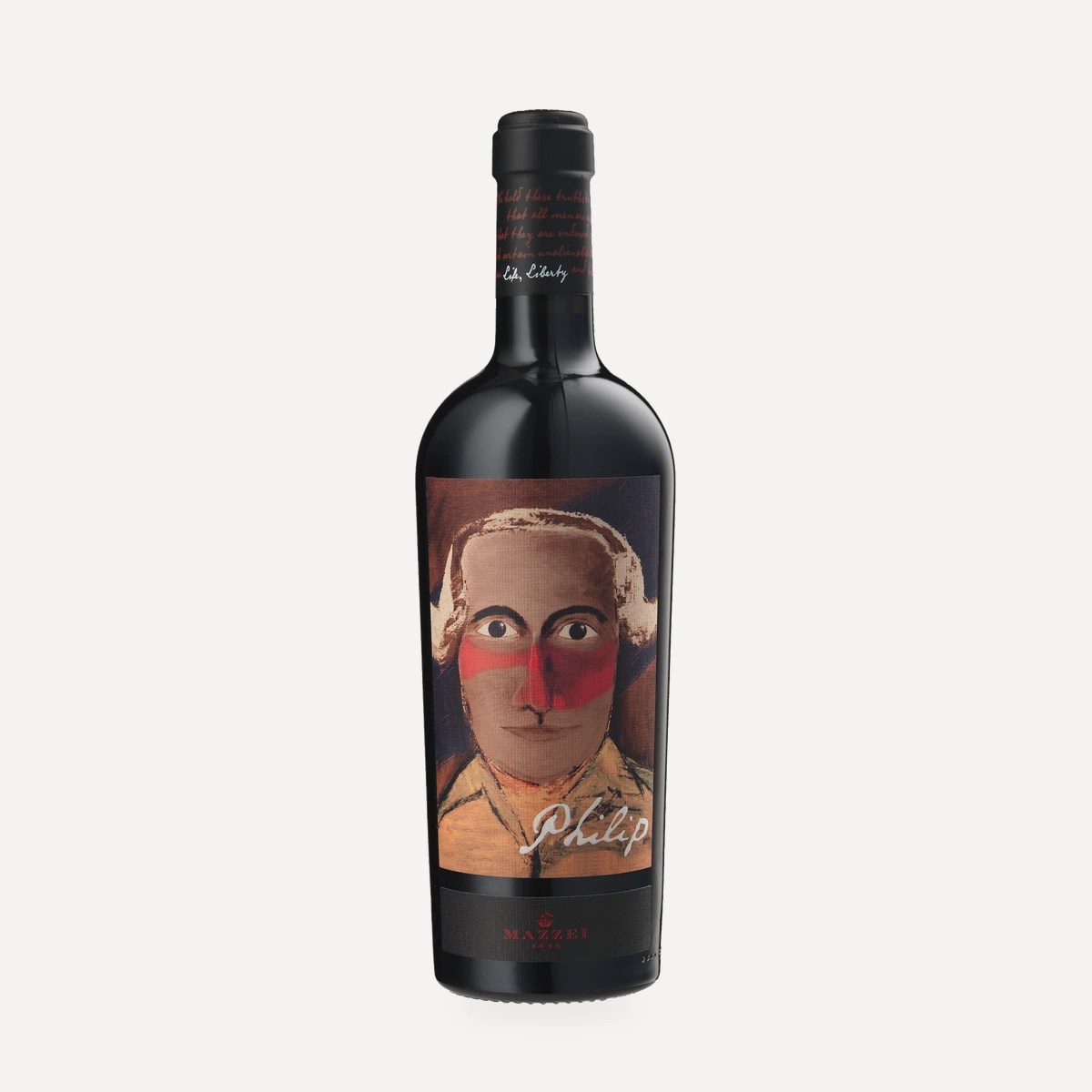
Philip Toscana IGT