Storia
Origins and the first generation — 1925
Paternoster was founded by Anselmo Paternoster in Barile, Basilicata, in 1925. The family committed itself to the late-ripening Aglianico grown on the volcanic slopes of Monte Vulture, recognizing the capacity of the local tuff-rich soils to produce structured wines with considerable ageing potential. This work helped establish Aglianico del Vulture beyond its place of origin and made Paternoster one of the region’s pioneering producers.
The estate’s historic material heritage includes the Cantina del Barone Rotondo. Originally a seventeenth-century ice house excavated in volcanic rock, it was once entrusted to Baron Nicola Rotondo. It later became part of Paternoster’s ageing and historical-cellar complex.
Generational continuity
The Paternoster family maintained its specialization in Aglianico del Vulture through successive generations. By 2016, three generations had carried forward the tradition. The founder’s great-grandson, Fabio Mecca Paternoster, grew up around the vineyards and cellar and remembered visiting during harvest to check the quantity of grapes arriving so that the cellar work could be organized. He ultimately became the estate’s winemaker and the representative of its fourth generation.
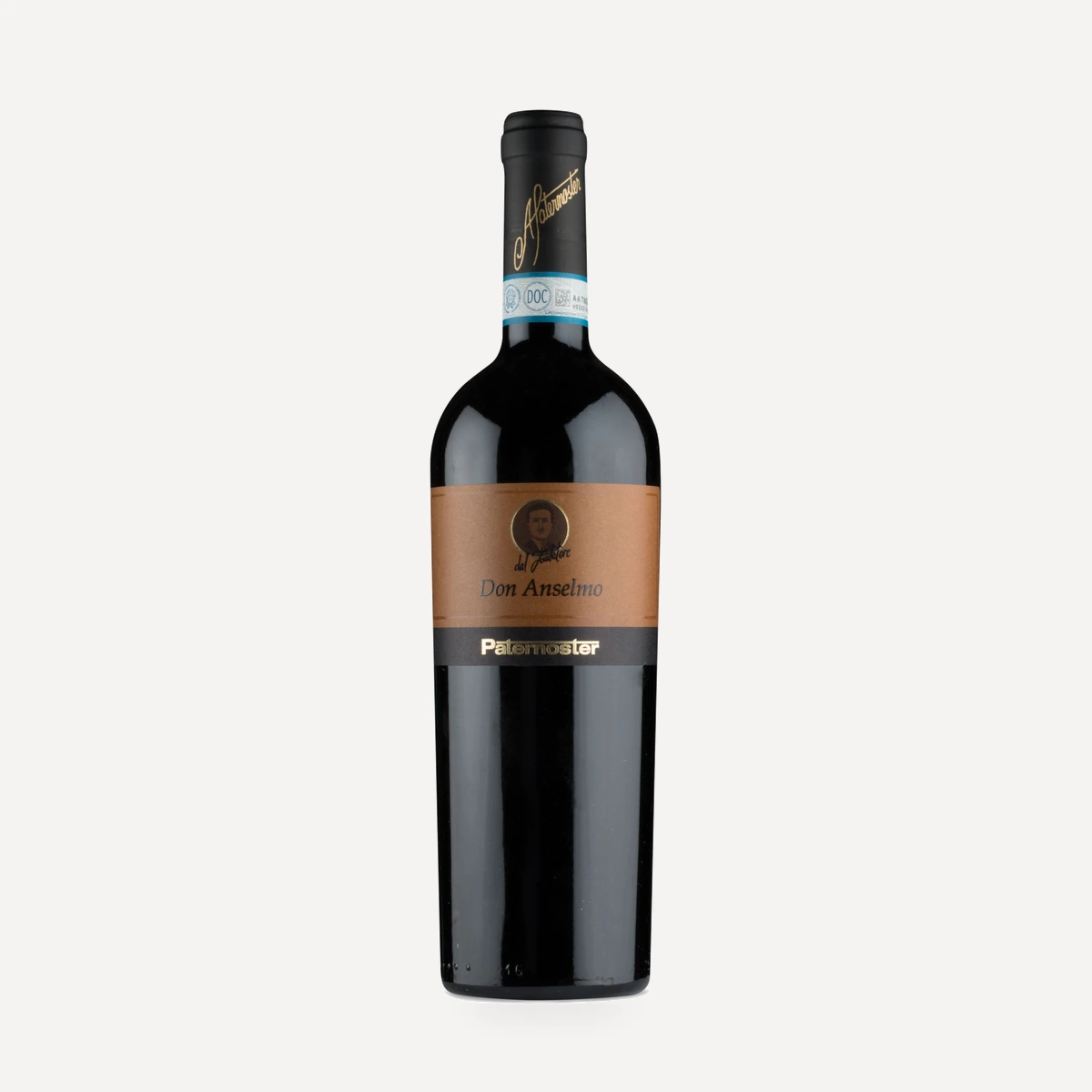
Don Anselmo was created as a memorial to the founder and as an expression of continuity between the estate’s origins and its later development. It draws on a historical four-hectare vineyard in Gelosia, within Barile, whose approximately 50-year-old vines are described as part of Paternoster’s ampelographic heritage.
Tommasi partnership — 2016
In mid-August 2016, the Tommasi family acquired a majority interest in Paternoster. The agreement was designed to strengthen the brand and commercial network, increase work in both vineyards and cellar, and place particular emphasis on organic farming and environmental sustainability. At that time the estate comprised about 20 hectares divided among several holdings in the Barile countryside, including the Don Anselmo and Rotondo crus, supported by a modern production cellar.
The initial arrangement retained the Paternoster family’s participation in management. The two families presented the project as a collaboration grounded in rigorous work, family continuity, respect for local traditions and preservation of Paternoster’s established identity. Giancarlo Tommasi subsequently worked with Fabio Mecca Paternoster on the estate’s oenological direction.
Organic development and Bariliott — 2022
The vineyard program developed under organic methods and achieved certified-organic status. By 2022 the property was described as 20 hectares in total, comprising 18 hectares of Aglianico and 2 hectares of Falanghina. The vineyards were Guyot-trained, with an average yield of 70 quintals per hectare, and annual production stood at 120,000 bottles.
In June 2022 Paternoster introduced Bariliott. Its name means “of Barile” and refers to the town where the Paternoster family originated. Created by the Tommasi family and Fabio Mecca Paternoster, it was conceived as a younger, fresher interpretation of Aglianico while preserving the estate’s historical identity. The 2021 release comprised 12,000 bottles.
Restoration and centenary projects — 2021–2025
The historic Barone Rotondo cellar was opened to visitors during Cantine Aperte in July 2021. Work toward its refurbishment was under way by the end of that year, with completion initially planned for the end of 2023.
The restored Cantina del Barone Rotondo subsequently became the Caveau dell’Aglianico and the symbolic center of the estate. The project conserved the seventeenth-century ice house carved into volcanic rock and placed it at the heart of Paternoster’s presentation of Vulture history. The Barone Rotondo wine project accompanied the restoration, using historic vineyards at 600 metres and prolonged maturation in wood, steel and bottle; its initial production was limited to 2,500 bottles.
The centenary — 2025
Paternoster marked its hundredth anniversary in 2025. The centenary joined family continuity under fourth-generation winemaker Fabio Mecca Paternoster with new investment, research and hospitality plans under Tommasi Family Estates. A broader renewal of the Barile headquarters was launched to expand wine-tourism and visitor facilities and create a center open to both residents and travellers. The project was intended to connect the Vulture more effectively with visitor flows from Matera and Puglia.
The anniversary program also included a renewed digital identity and events for the local territory, trade partners and the wider wine community. It framed the restored Barone Rotondo cellar, the new hospitality center and continued work with Aglianico as the foundations for Paternoster’s next phase.
Terroir
Paternoster is based at Barile in northern Basilicata, within the Vulture. Its approximately 20 hectares are divided among holdings on the slopes of Monte Vulture, an extinct volcano that defines the estate’s landscape. The property’s recorded position is 620 metres above sea level, while documented vineyards extend from approximately 450 to 600 metres.
The soils are variously described as black, basaltic and volcanic, with porous tuff. This volcanic material is central to Paternoster’s interpretation of Aglianico: the family associated tuff-rich soils with depth, complexity and the ability to sustain wines through decades of ageing. The estate’s account connects the porous tuff to an eruption more than 130 million years ago and to the geographical outline of the present Aglianico denomination.
Individual sites express this high-altitude setting differently. Villa Rotondo lies at 500 metres. Don Anselmo occupies four hectares at Gelosia, in Barile, at 600 metres. The historic vineyards used for the Barone Rotondo centenary project are likewise at 600 metres.
Seasonal conditions can be demanding. In 2023, intense spring rain was followed by severe summer heat; the resulting natural thinning left fewer bunches of high quality, and a warm, sunny October completed ripening. In 2025, steady development and healthy grapes led to complete phenolic maturity. Cooler conditions and pronounced day-to-night temperature differences from mid-August preserved aroma, freshness and acidity.
Vinificazione
Paternoster’s vineyards are certified organic. The estate uses Guyot training, with the 2022 figures giving an average yield of 70 quintals per hectare. In the younger Aglianico vineyards, vines were six to eight years old and the maximum yield was 7,000 kg/ha; the Don Anselmo vineyard was restricted to 3,500–4,000 kg/ha.
Harvesting is manual. Fruit for Don Anselmo is hand-picked, while the 2023 harvest account characterizes the estate’s harvest as completely manual. Vineyard decisions rely on repeated tasting and daily analysis to identify the appropriate picking date.
The estate’s environmental program includes careful resource use, avoidance of waste and recycling wherever possible. Production procedures exclude products of animal origin and materials containing allergens. Packaging measures associated with the sustainable range include 420 g lightweight bottles where specified, organic corks with FSC certification, FSC-certified label paper and recycled-paper cartons.
Vintage conditions require active adaptation. Heavy spring rain and severe summer heat complicated the 2023 growing season; natural thinning reduced the number of bunches while concentrating quality. The estate recognized that increasingly violent heat could require changes to vineyard and harvest practices. In 2025, cooler weather and strong diurnal shifts from mid-August supported aroma, acidity and freshness while the grapes completed phenolic ripening in healthy condition.
Paternoster combines a modern production cellar in Barile with historical spaces for maturation and long-term storage. The restored Cantina del Barone Rotondo—originally a seventeenth-century ice house carved into volcanic rock—now functions as the Caveau dell’Aglianico and the symbolic center of the estate.
The documented red-wine work begins with selected, destemmed Aglianico. Fermentation and skin contact take place in temperature-controlled stainless steel. Depending on the selection, maceration lasts 12–15 or 15–18 days at 25–28°C. Extraction may include periodic pumping over, daily manual punching down, pumping over three times per day during the first three-quarters of fermentation and subsequent délestage. Malolactic fermentation is carried out in stainless steel for documented younger and single-vineyard selections.
Maturation uses traditional large Slavonian-oak casks alongside French-oak barriques. Documented regimes range from 12 months in Slavonian oak for younger Aglianico to combinations of large Slavonian casks and French barriques for longer-aged wines. Don Anselmo is divided equally between large Slavonian casks and once-used French barriques for 24 months, followed by 12 months in bottle. Rotondo undergoes malolactic fermentation and 14 months in new French barriques, followed by 12 months in bottle. Synthesi combines 80% matured for 12 months in large Slavonian casks with 20% matured for 14 months in used French barriques, followed by seven to eight months in bottle.
Falanghina is fermented in stainless steel at 16–18°C and matures for about five months in stainless steel on its lees. The Barone Rotondo centenary selection remains for years across wood, steel and bottle before release.
Separate vinification, blending and calibrated wood ageing form part of the estate’s approach to managing Aglianico’s naturally high acidity, assertive tannins and late ripening while retaining the identity of individual vineyards.
Filosofia
Paternoster’s identity is founded on the conviction that Aglianico can express the volcanic soils and high elevations of the Vulture while developing over long periods in bottle. The family’s early work centered on a demanding, late-ripening grape at a time when its potential was not widely recognized.
Fabio Mecca Paternoster describes the centenary as both an inheritance and a starting point: the pioneering spirit of Anselmo remains the reference, but it is joined by new instruments and ideas. His collaboration with Giancarlo Tommasi is based on respect for both grape and place, with the finished wine intended to act as their reflection.
The Tommasi partnership applies expertise, research and investment while maintaining the estate’s regional identity. Its stated purpose is to strengthen Paternoster without dispersing the traditions, roots and stylistic continuity formed over successive generations. Tradition and technology therefore work together through manual viticulture, organic farming, separate vinification, controlled fermentation and measured use of Slavonian and French oak.
Environmental responsibility extends from the vineyard and cellar to resource efficiency, recycling and packaging. Family continuity, work with locally knowledgeable specialists, respect for vintage differences and investment in the cultural and hospitality value of Barile and the wider Vulture complete this approach.
Vini