Storia
The historic hamlet
San Filippo occupies a small hamlet approximately 2 km from Montalcino. The principal farmhouse, including a small chapel that remains consecrated, dates to 1672. Its age is documented in records preserved in Montalcino’s parish archives.
Renovation of the estate
The villa and wine-growing estate were subsequently renovated in full. The work retained the restrained character of the traditional Tuscan farmhouse while adapting the buildings to contemporary residential and production requirements.
The historic farmhouse now accommodates the underground ageing cellar, while a modern winery of more than 1,000 m² provides dedicated spaces for vinification, maturation, bottling, packaging and storage.
Terroir
San Filippo lies approximately 2 km from Montalcino, within a Tuscan landscape that includes the vineyards and yellow fields of the Val d’Orcia. The estate’s named vineyard sources occupy the eastern side of Montalcino between 260 and 310 metres above sea level.
The vineyards encompass three distinct geological descriptions. San Filippo dei Comunali occupies north-facing ground at 260–280 metres. Its reddish, clay-rich soils contain conglomerates and gravel derived from continental and lacustrine Ruscinian and Villafranchian deposits.
Le Lucére lies at 280–310 metres with an easterly exposure. Its Pliocene marine deposits comprise clay, yellowish-brown silty sand and medium- to fine-grained sandstone, interspersed with thin layers of residual Pietraforte conglomerate.
Lo Scorno extends from 260 to 310 metres and faces north to north-east. Its intensely brown Pietraforte Formation soils are clayey, with compact sandstone banks whose thickness varies from a few centimetres to approximately one metre.
Vinificazione
San Filippo’s named vineyards are planted entirely to Sangiovese and carry organic certification. Planting density is 4,500 vines per hectare in the current vineyard profiles.
Harvest timing is determined through analytical monitoring of the grapes, with the selection of the picking date treated as the first major quality decision. All three named vineyard sources are harvested by hand. Picking normally takes place at the end of September for Lo Scorno and at the beginning of October for San Filippo dei Comunali and Le Lucére.
Stated yields are 6,000 kg/ha for the two Brunello sources and 8,000 kg/ha for Lo Scorno. Once picked, the grapes are moved rapidly to crushing so that the interval between vineyard and processing remains very short.
The modern winery covers more than 1,000 m². It is divided into a vinification cellar, a maturation area and a sector for bottling, packaging and storage. A separate ageing cellar occupies the basement of the old farmhouse.
Fruit maturity is monitored analytically to establish the harvest date and selection. The interval between picking and crushing is kept very short, and fermentation begins within eight hours of obtaining the must.
Alcoholic fermentation takes place in temperature-controlled stainless-steel vats. The current protocols begin with two days of cold maceration at 10°C. This is followed by maceration at 25–28°C: 10–12 days during and after fermentation for the Brunello selections, or 5–6 days during fermentation for the Rosso selection. Punch-downs and pump-overs are employed during extraction.
Malolactic fermentation is conducted in cement vats. Subsequent maturation varies by selection. Large oak casks of 20–30 hL are central to the programme, with stated periods ranging from 10–12 months to 24–28 months. The Le Lucére selections also receive an initial 12 months in barriques and tonneaux before a further 12–16 months in 20–30 hL oak casks. Bottle maturation ranges from 10 months to 22 months. After the extended maturation period, the wine is assembled in large casks and prepared for bottling and vintage labelling.
Filosofia
Naturalness and quality form San Filippo’s stated guiding principles. The pursuit of quality begins before the fruit enters the cellar: grape maturity is monitored analytically, harvest timing is selected precisely and picked fruit is processed with minimal delay.
The estate combines modern control with established cellar practices. Temperature-regulated stainless steel and a purpose-built production facility support precision, while maturation continues in cement and oak and the historic farmhouse basement remains the principal ageing environment.
The renovation of the property follows the same balance between continuity and modern function. The traditional restraint of the Tuscan farmhouse was preserved while the villa, winery and hospitality spaces were adapted for contemporary use.
Vini
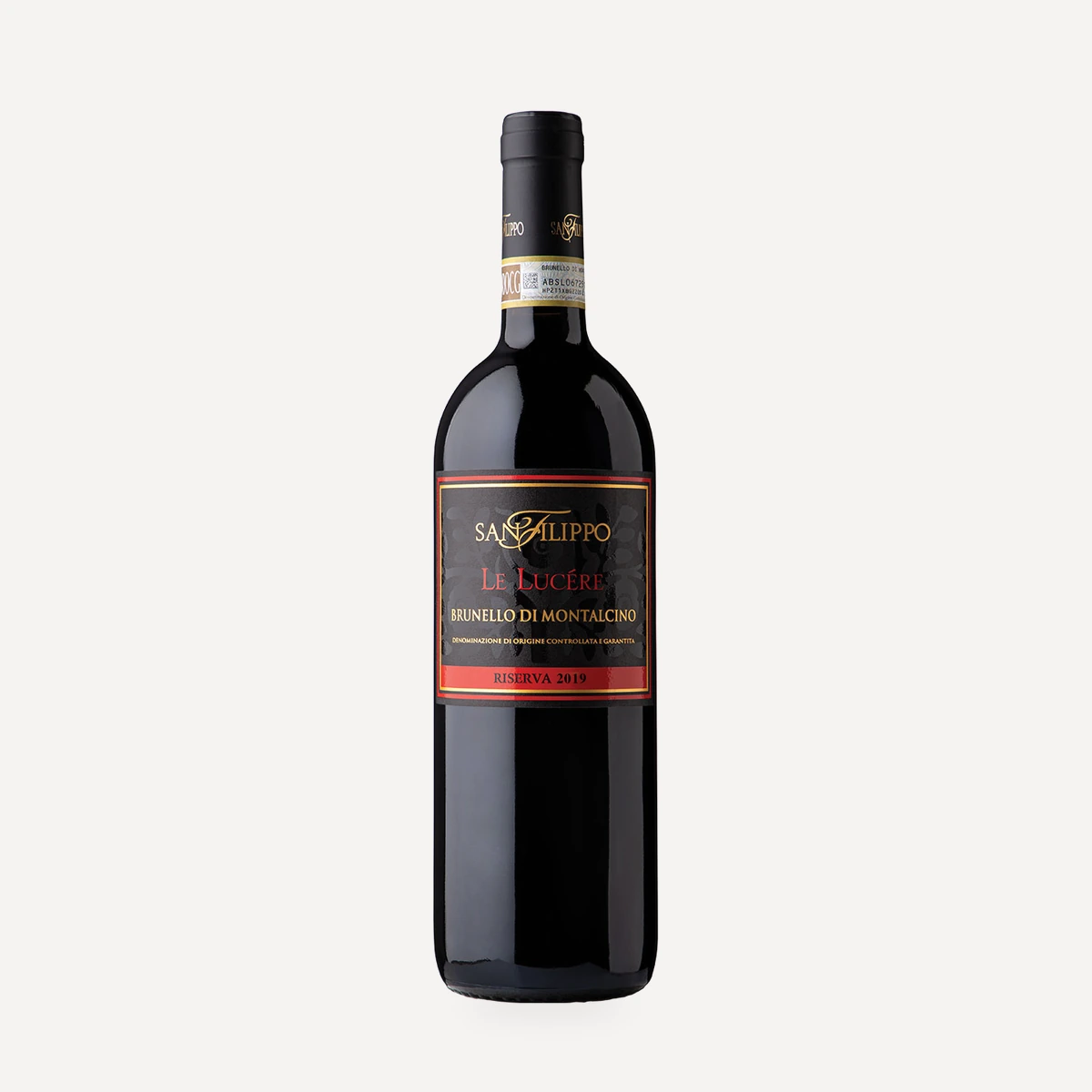
San Filippo Le Lucére Riserva Brunello di Montalcino DOCG

San Filippo Dei Comunali Brunello di Montalcino DOCG

San Filippo Le Lucére Brunello di Montalcino DOCG

San Filippo Lo Scorno Rosso di Montalcino DOC