Storia
Ancient origins and the first records
The borgo of Stomennano stands on Etruscan and Roman remains that are still visible. Its first written appearance dates to 1059, when it was recorded as a Roman outpost. The name may have Etruscan roots, although the family history associates it more probably with the Latin expression strumentum pacis, referring to peace agreements between the local population and Roman invaders.
Around 1100, Siena entered into agreements intended to secure control of Strove, Castiglion Ghinibaldi, Stomennano and Staggia. Santa Maria al Poggiolo, the church on Stomennano’s hilltop, is also documented from about 1100. Records of parish income preserved in the Vatican Archives establish that it predates the church built within Monteriggioni castle. Remains of Santa Maria al Poggiolo survive in the villa’s cellars.
In 1164, Ubaldino and Ugolino Soarzi transferred their lands between Poggibonsi and Siena to the city of Siena. The transfer included Stomennano and its farmland, which was then crossed by the Via Francigena, the pilgrimage route linking Paris with Rome.
The peace between Siena and Florence
On 11 June 1254, representatives of Siena and Florence signed a peace treaty in front of Stomennano’s church. Under its terms, Siena surrendered Montepulciano and Montalcino to Florence. Maestro Brunetto Latini, later known as Dante Alighieri’s tutor, was among the Florentine delegates.
Family tradition holds that Latini subsequently returned to Stomennano with Dante. From the estate, Dante is said to have seen Monteriggioni’s towers emerging through the mist, an image associated with his comparison of the towers to giants in the Divine Comedy.
Medici rule and successive owners
In 1555, the Republic of Siena was incorporated into the Grand Duchy of Tuscany. Stomennano and Monteriggioni consequently passed under Medici control. Ownership later moved first to the noble Golia family and then to the Accarigi family.
The family estate from 1700
In 1700, Stomennano passed to the Griccioli family, from whom the present owners descend. The borgo’s final transformation into a family holiday residence also dates to 1700. The Grassi family describes itself as an old Sienese lineage extending back to the Middle Ages; its members served over the centuries in the government, administration and army of the Sienese Republic, and its coat of arms remains visible in Siena’s city hall.
The family has lived permanently at Stomennano for more than 250 years. Niccolò spent part of his childhood at the estate and later returned after living in Rome, where Luisa and Matteo were born. The current family continues to operate Stomennano as a working farm producing wine and olive oil, as well as a historic residence and hospitality property. Matteo oversees wine and olive-oil production, while Luisa manages much of the guest experience. Nicoletta remains closely involved in the life of the house and gardens.
Terroir
Stomennano lies at Monteriggioni in Tuscany, within the Chianti Classico area, approximately 10 km from Siena and 60 km from Florence. The estate is surrounded by woodland, vineyards and olive groves; Monteriggioni is about 2 km away. The Chianti Classico vineyards reach an average altitude of approximately 250 metres above sea level.
The ground used for Chianti Classico is loose and relatively shallow. Grey clay and tuffaceous rock occur in the subsoil, and the underlying rock bed is itself fairly close to the surface.
Other estate ground is deeper, clayey and rich in pebbles, with a comparatively firm structure. The white-wine vineyard occupies a fresher, lower-valley position and has loose soil with a substantial sandy component and moderate fertility.
The olive groves occupy two distinct settings: land immediately around the borgo and terraces surrounding Monteriggioni’s walls. These hillside olive sites have shallow, light-textured ground with abundant exposed stone.
Vinificazione
The estate uses spur-pruned cordon across its red-wine vineyards. Chianti Classico is associated with double spurred cordon and approximately 5,000 vines per hectare, while Chianti uses single and double spurred cordon at about 4,500 plants per hectare. Chardonnay and Pinot Nero for the traditional-method sparkling wine are also double-spur-cordon trained, at 4,000–5,000 vines per hectare and an average yield near 7 tonnes per hectare.
White varieties are vertically trellised. Depending on the variety and the fertility of its basal buds, pruning may be single or double spurred cordon or double Guyot. White-wine yields are about 11 tonnes per hectare.
Harvesting is manual where specified. The white grapes are picked during September; Colorino follows in the second half of September, while Sangiovese is gathered from late September into early October. Chianti grapes are hand-picked toward the end of September.
The wine cellars occupy one of the villa’s two matching wings, joined to the historic residence by an arch.
For Chianti Classico and Chianti Classico Riserva, grapes are crushed and destemmed before inoculation with selected yeasts. Fermentation proceeds with an 18-day skin maceration, programmed daily pump-overs and délestage. The wines mature for 12 months in oak, using 20-hectolitre casks and barriques; vintage specifications also identify French-oak barriques. Chianti Classico receives a further 12 months in bottle, while Riserva receives 24 months.
Chianti ferments in stainless steel at controlled temperature with a long maceration on the skins. Malolactic fermentation takes place in vat. The wine then rests in cement before preparation for bottling, traditionally in the following spring.
White grapes are softly pressed, and the free-run juice ferments at controlled temperature. The wine remains on its lees until bottling; one production description specifies three months on the lees followed by at least two months of bottle maturation.
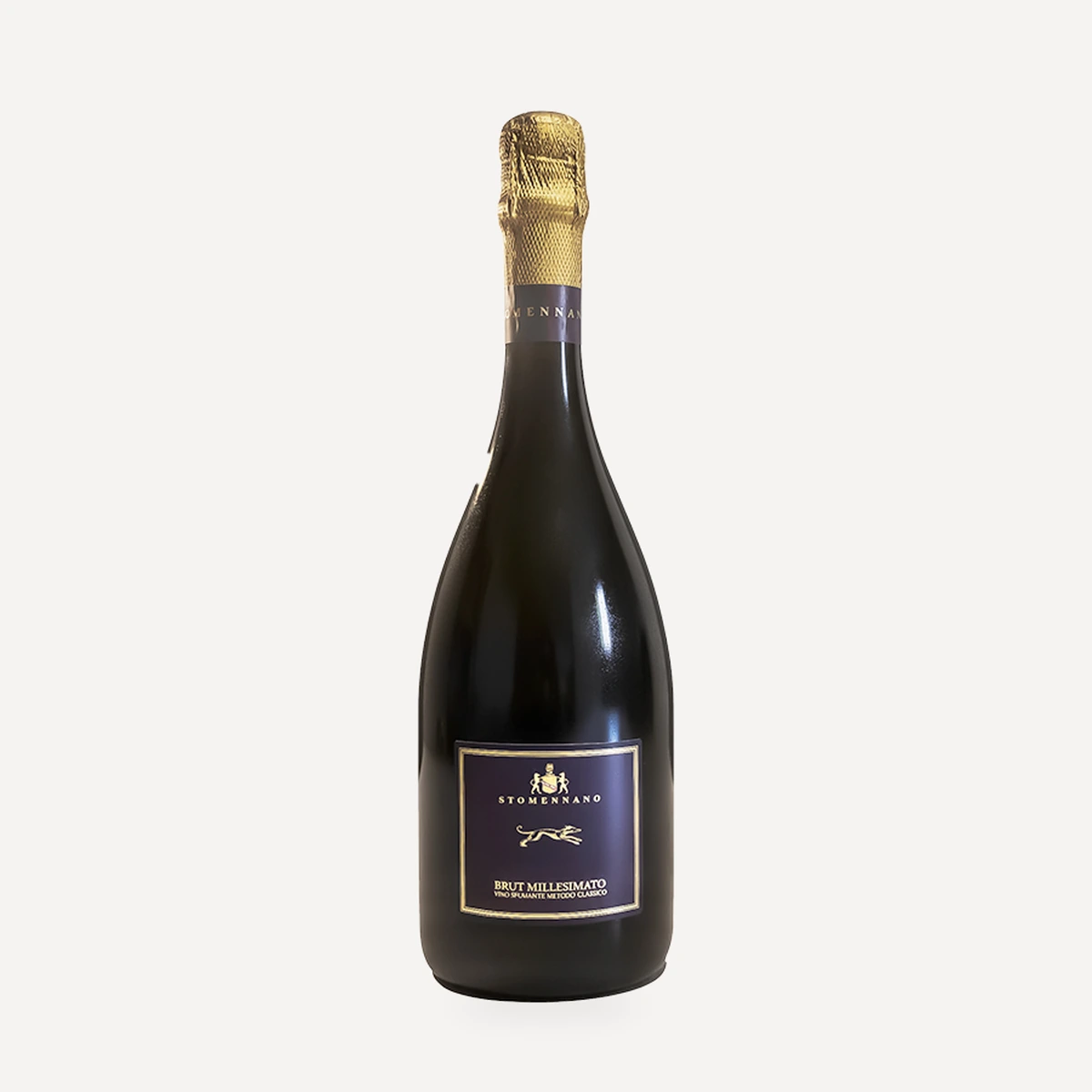
The vintage Brut is made by the traditional method. After tirage, it undergoes 24–30 months of secondary fermentation and maturation in bottle. Remuage on pupitres lasts 45 days, after which the bottles remain neck-down for one month before disgorgement. A further three months of maturation precedes release. The proportions of Chardonnay and Pinot Nero may change slightly with the growing season.
Filosofia
Stomennano is maintained as both a working farm and a lived-in family estate. The current generation emphasizes continuity with the families who have occupied the borgo since 1700, preserving its historic residence, gardens, agricultural buildings, vineyards and olive groves while keeping wine and olive-oil production active.
The family’s stated hospitality ideal is personal rather than anonymous: visitors are welcomed as family guests, with direct involvement from Niccolò, Nicoletta, Luisa and Matteo. This approach links the agricultural work of the estate with its domestic and cultural history.
Vini