Storia
Nineteenth-century origins
The family's winemaking activity began in the second half of the nineteenth century. Commendatore Vincenzo De Marco established the production of bulk wine in San Pietro Vernotico and successfully marketed it in France and Tuscany.
The 1934 union
Tenuta Flaminio became part of the agricultural enterprise created through the union of Professor Donato Vallone's land and the property associated with Maria, Commendatore De Marco's daughter. Their 1934 marriage deed formally joined Tenuta Flaminio in Brindisi and Tenuta Iore in San Pancrazio Salentino.
The estate today
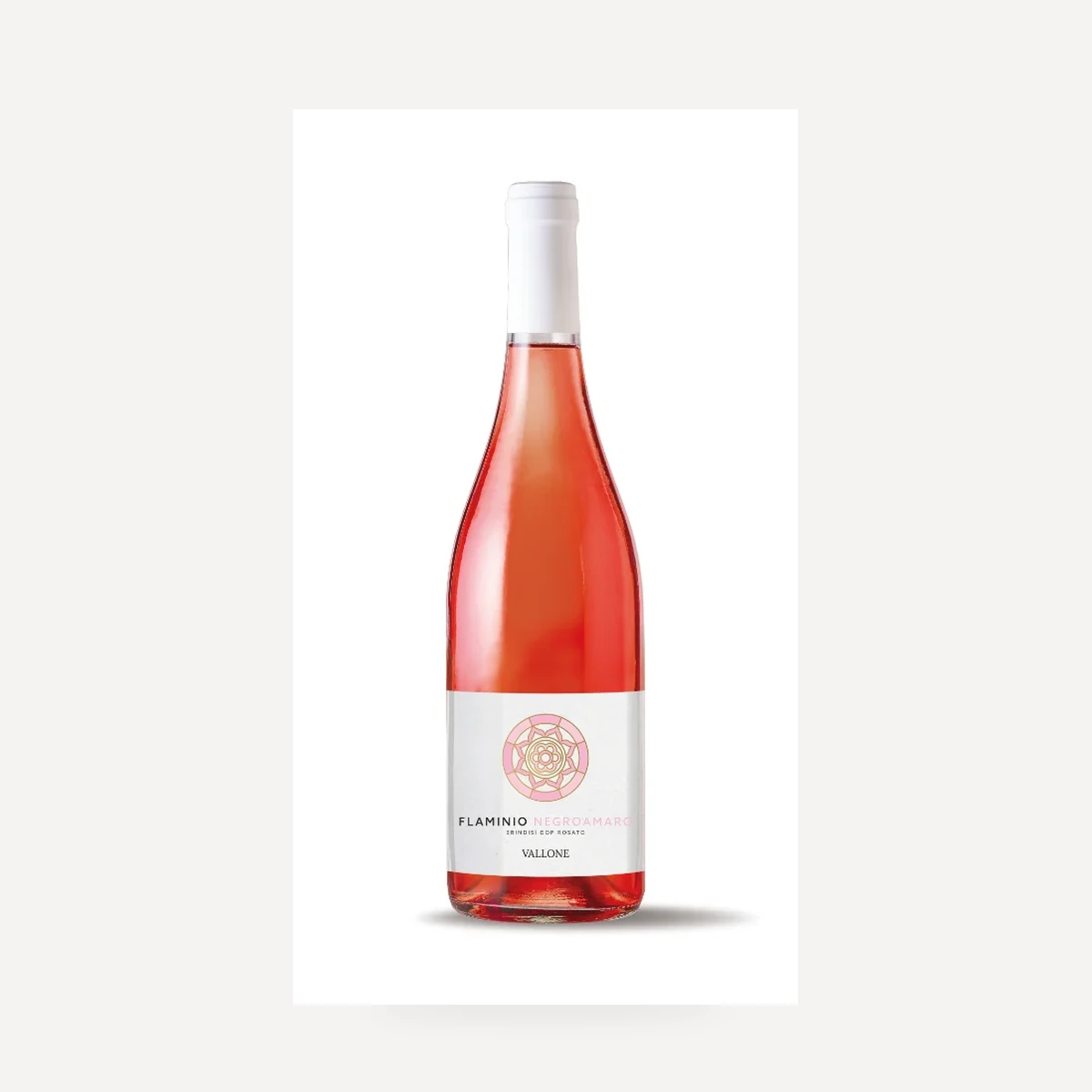
Tenuta Flaminio now covers 130 ha, including 95 ha under vine. Its historic Flaminio vineyards stand on an ancient Messapian settlement near San Pietro Vernotico. The estate gives its name to the Flaminio collection, conceived as the Vallone family's interpretation of indigenous grape varieties and described as a tradition in continuous evolution. Vigna Flaminio DOC Brindisi Riserva is identified as the estate's signature wine.
Terroir
Tenuta Flaminio lies near San Pietro Vernotico in the Province of Brindisi, within the Salento peninsula. The historic Flaminio vineyards occupy the site of an ancient Messapian settlement on the outskirts of the town.
The documented vineyard sectors have limestone-clay soils. Most are oriented north–south, including the Negroamaro sector and Vigna le Viscarde; the documented Primitivo sector is oriented northeast–southwest. The wider Vallone property is presented as three estates with distinct physical characteristics and soil textures, of which Tenuta Flaminio accounts for 130 ha.
Vinificazione
The documented vineyards use spurred-cordon training in several forms. Negroamaro and the shared Susumaniello source vineyards are trained to bilateral spurred cordon; the current Italian description of the Primitivo sector specifies a single spurred cordon; Verdeca uses spurred cordon; and Vigna le Viscarde combines bilateral spurred cordon with Guyot.
Harvest practices depend on the vineyard and grape. The Negroamaro sector is harvested manually in the first ten days of September. The current Italian description places the Primitivo harvest in the first ten days of September after partial overripening on the vine, using both manual and mechanical picking. The shared Susumaniello vineyards are harvested manually and mechanically in the first ten days of October, while the shared Verdeca vineyards are harvested by hand in the final ten days of September. At Vigna le Viscarde, grapes are carefully selected and hand-picked into crates in the first ten days of September before being dried on racks.
Filosofia
The Vallone family presents Tenuta Flaminio within an artisanal, family-based interpretation of Italian wine. Its stated objective is to express the defining character of each source variety precisely, without excess or forced effects.
The Flaminio collection is framed as a tradition in continuous evolution: it remains tied to indigenous varieties and the historic Flaminio vineyards while allowing the stylistic and oenological approach to remain contemporary. The broader family philosophy seeks continuity of identity without allowing that identity to become obsolete.
Vini