Storia
The Corsini arrival in Maremma
Tenuta Marsiliana entered Corsini family history in 1759, when the Grand Duke of Tuscany granted the estate, together with its fortified village, to Prince Corsini under a livello tenure. The property then comprised a difficult landscape of marshes and wetlands interspersed with woodland and cultivated fields. The Corsini family immediately began reclamation and modernization work intended to make the land productive.
Tommaso Corsini and nineteenth-century modernization
The most consequential phase of rationalization was led by Tommaso Corsini (1835–1919), VII Prince of Sismano. A deputy in the Kingdom of Italy from 1865 to 1882 and later a senator for life, he was also a founder of Fondiaria Assicurazioni and president of the Cassa di Risparmio di Firenze.
From the middle of the nineteenth century, Tommaso introduced agricultural mechanization at Marsiliana in a rational and systematic manner. Around the turn of the twentieth century, he developed the property into one of the period’s most innovative agricultural enterprises. Mechanization was combined with an employment model based almost entirely on salaried, highly skilled workers, a marked departure from the sharecropping system then prevalent in Tuscany.
Tommaso was also an archaeologist. His investigations around Marsiliana d’Albegna brought to light the Etruscan necropolis of Banditella, containing more than one hundred tombs of different forms, and initiated excavations at the necropolises of Piani di Perazzeta and Macchiabuia. Finds associated with him include the Fibula Corsini and the Tavoletta di Marsiliana, an important surviving example of the Etruscan alphabet. The discoveries linked the agricultural estate to the archaeological history of its territory.
Agricultural development in the twentieth century
A second Tommaso Corsini (1903–1980), VIII Prince of Sismano and grandson of the senator, continued the family’s contribution to the modernization of Maremma. An expert in agriculture and livestock, he served as a deputy in Italy’s Constituent Assembly and participated in drafting the Constitution of the Italian Republic. His work supported the modernization and recovery of agriculture and animal husbandry in Tuscany and Umbria.
In the post-war period, expropriation by the Ente Maremma disrupted Marsiliana’s economic model, which had depended on mechanization and specialized salaried labour. The estate’s arable area contracted from more than 3,000 ha to 200 ha, while its 2,680 ha of forest remained unchanged. Agriculture consequently became marginal to forestry and wildlife management during a difficult period for the property.
Return to wine production
In 1996, Duccio Corsini and his sister Elena Sabina Corsini became directly involved in managing Tenuta Marsiliana. Their objective was to restore the estate’s agricultural vocation while protecting its historic properties and landscape.
Extensive ampelographic trials were undertaken to determine which varieties could best express the site. The resulting project established 20 ha of vineyards, planted principally with Cabernet Sauvignon, Merlot and Petit Verdot—non-native varieties that had become established on the Tuscan coast. Duccio and Sabina began producing wine at Marsiliana that same year, pursuing elegance, balance and a clear expression of the local terroir.
Organic and vegan milestones
Conversion of the company’s crops to organic management began in 2012, and organic certification was obtained in 2015. Marsiliana’s vineyards have been certified organic since that year.
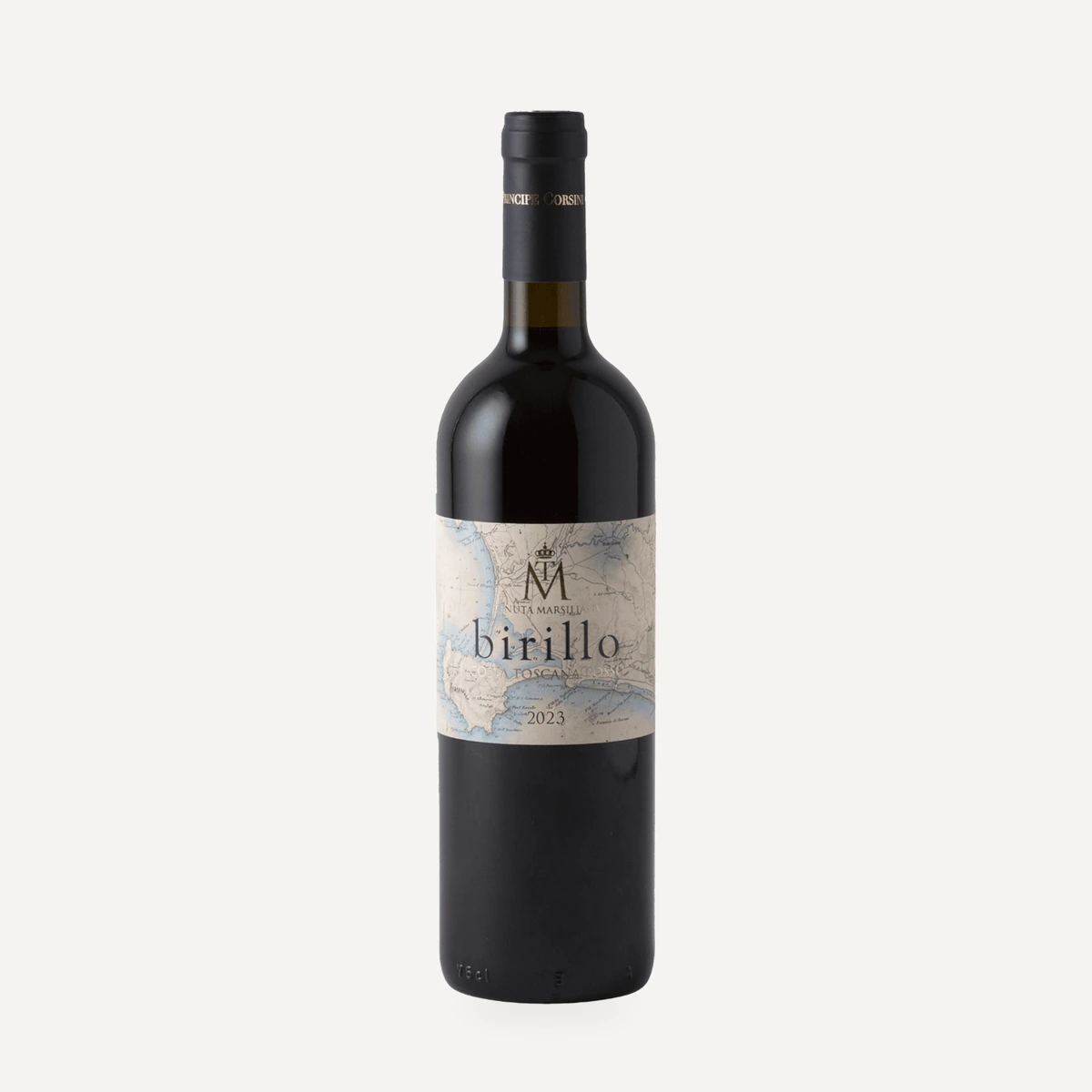
The estate subsequently obtained Vegan Quality certification. Certified releases included Birillo Costa Toscana Rosso IGT from 2013, 2014 and 2015, Vermentino Costa Toscana Bianco IGT 2015, and Marsiliana Maremma Toscana IGT beginning with the 2016 vintage. The standard excludes animal-derived ingredients from the wine, production process, agricultural phase, equipment and packaging materials.
In 2022, the wider Principe Corsini organization joined the Italian Ministry of Environment and Energy Security’s VIVA sustainability programme, whose performance assessment is organized around the Air, Water, Vineyard and Territory indicators.
Terroir
Tenuta Marsiliana lies at Località Marsiliana in Manciano, in the province of Grosseto and the Maremma area of coastal Tuscany. Its vineyards occupy Maremma hills influenced by proximity to the sea and by maritime air.
The soils are described as lean and highly mineral, conditions associated with the estate’s coastal character. The Vermentino sector is more specifically characterized by sand and silt over clay. Mediterranean vegetation, pinewoods and the wider coastal landscape form the vineyards’ environmental setting.
Sea influence, local climate, soils and varieties are treated as the principal elements distinguishing Marsiliana from the family’s inland Chianti Classico property. The Tyrrhenian influence is also central to the identity promoted collectively by the Tuscan coastal producers represented by Grandi Cru della Costa Toscana.
Vinificazione
Organic conversion began in 2012, with certification achieved in 2015. Marsiliana’s 20 ha of vineyards have been certified organic since that year and are managed with respect for natural cycles and seasonality.
Crop protection relies on contact products that are not absorbed by the plants, in contrast to systemic synthetic treatments associated with conventional agriculture. Fertilizers are selected for low nitrite and nitrate inputs, while copper and sulphur are applied only in limited quantities. The stated objective is to preserve soil fertility and balance while protecting the land’s capacity for future production.
Grapes are harvested by hand. Vineyard and olive-grove materials are preferentially purchased from local suppliers, with biodegradable or recyclable packaging favoured. Waste management receives particular attention during harvest, when the workforce is larger.
Vegan Quality requirements extend beyond the finished wine: animal-derived ingredients and components are excluded from farming and processing as well as equipment and packaging. At company level, VIVA sustainability assessment addresses air emissions, water, vineyard management and the relationship between production and territory.
Claudio Giglioni coordinates the production chain from grape pressing through bottling and storage. His responsibilities cover every stage in transforming grapes into wine and maintaining quality and safety across the process.
Production combines technological control with an emphasis on conveying the character of Marsiliana’s coastal terroir. Stainless steel is used for fermentation and maturation in part of the range, while open temperature-controlled steel vats and barriques are used for the estate’s structured red production. Vegan Quality protocols exclude animal-derived materials from processing equipment, production inputs and packaging.
Sustainability measures applied across the organization include careful use of technology to reduce energy consumption, replacement of polystyrene wine packaging with lower-impact cardboard, PEFC-certified cardboard from sustainably managed forests and interlocking cartons that require no adhesive tape. Used barrels, barriques and vats may be repurposed as crafted objects rather than discarded.
Filosofia
Tenuta Marsiliana’s modern project is guided by the desire to restore the property’s agricultural vocation while conserving its historic buildings, forests, wildlife and wider landscape.
Duccio Corsini describes the production philosophy as an effort to express the individuality and character of the territory. At Marsiliana, this principle led to extensive ampelographic research rather than an automatic reliance on inherited planting choices. The selected international varieties are interpreted through the warm, maritime conditions of the Tuscan coast, with elegance and balance identified as production goals.
The estate presents environmental responsibility as inseparable from quality. Organic farming, manual harvesting, reduced-impact crop protection, vegan protocols and sustainable packaging are intended to preserve natural resources for subsequent generations. Nature, seasonality and the rhythms of the vineyard are treated as working parameters rather than stylistic abstractions.
The approach combines agricultural innovation with historical continuity. Mechanization and rational organization have been part of Marsiliana’s identity since Tommaso Corsini’s nineteenth-century reforms; the contemporary project continues that experimental outlook while placing greater emphasis on biodiversity, ecological sensitivity and the recognizable expression of place.
Vini
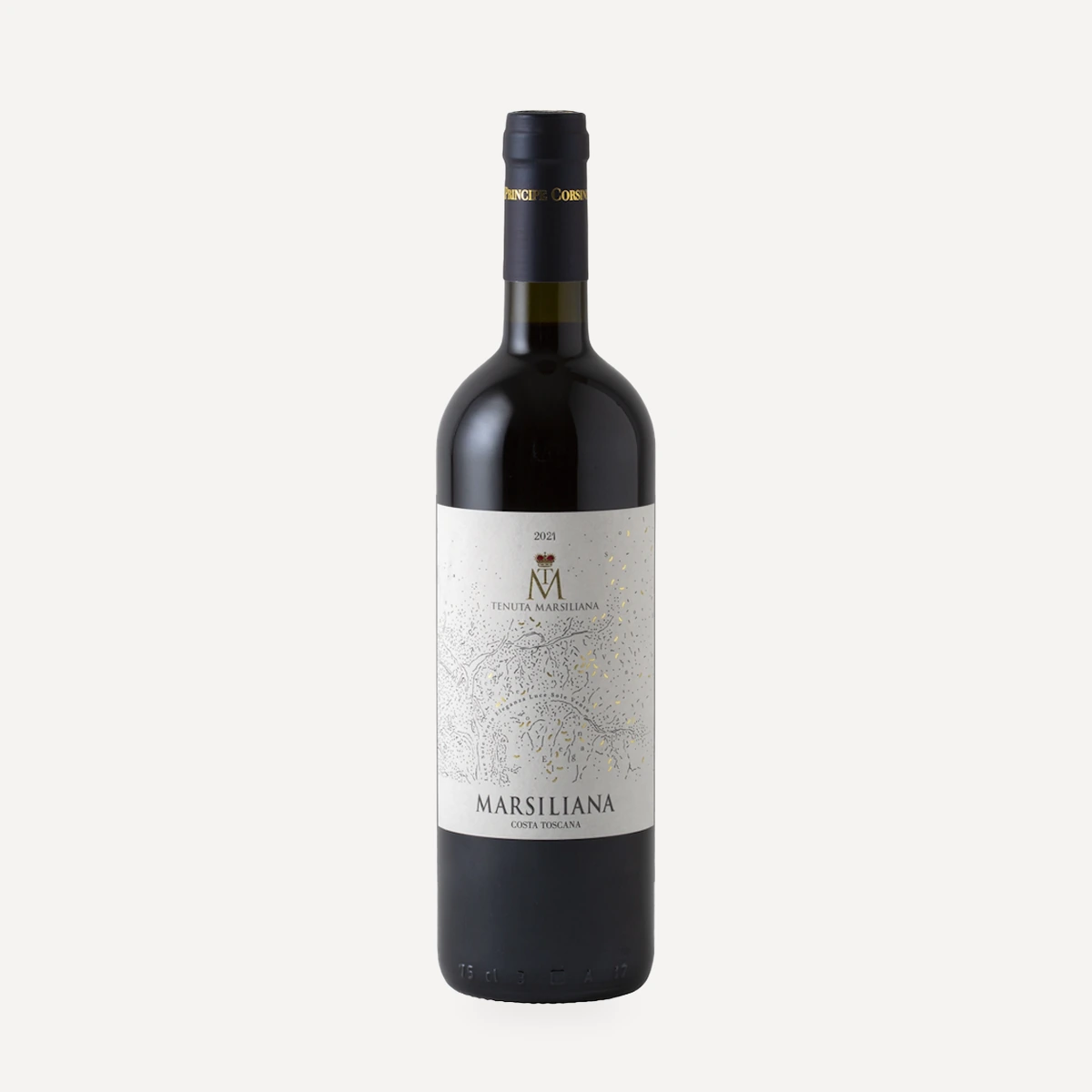
Marsiliana Costa Toscana IGT