Storia
Altomonte and the memory of Balbia
The estate is situated at Montino, on the mid-slope above the medieval town of Altomonte. Its name draws on the area’s historical identity: the site presents ancient Altomonte as the place called “Balbia” by Pliny the Elder, linking that name to a celebrated wine called Balbino. Altomonte acquired its present name in the 14th century. Its historical setting includes Angevin and Ruffo di Calabria associations, a feudal castle, monastic complexes dating from the 15th century and 1635, the 14th-century Gothic-Angevin church of Santa Maria della Consolazione, and works connected with Simone Martini, Bernardo Daddi and the school of Giotto.
Nineteenth-century local wine heritage
In the second half of the 19th century, Altomonte was home to the wine enterprise of Cavaliere Francesco Giacobini. His record comprised eight gold medals, 22 silver medals, four grand honorary diplomas and a Ministry-awarded silver medal for export. He is presented as an export pioneer who helped revive the wines associated with ancient Balbia. This local history predates the present Terre di Balbia business but forms an explicit part of its account of place.
The partnership behind the estate
Gianni Venica and Silvio Caputo joined forces at the end of the 1990s and made a shared commitment to Calabria. Venica came from Friuli and owned Venica & Venica, with two generations of family wine experience behind him. Caputo was Calabrian and had spent 17 years importing wine in California.
2001: Terre di Balbia begins
The Terre di Balbia project entered the market in 2001 under Venica and Caputo. Its stated challenge was to produce high-quality wine while placing native Calabrian varieties at the centre of the enterprise.
2014: the Chiappetta family
In 2014, Cosenza engineer Giuseppe Chiappetta acquired the estate together with his brother Nicola and Giuseppe’s sons Marco and Luca. The family recalibrated its development, prioritising quality and the potential of native Calabrian grapes.
The meeting with Salento grower and winemaker Gianfranco Fino became central to the new phase. Fino guided the modernisation of the existing vineyards, advised on cultivation, followed construction of the winery and established and supervised the vinification processes. Existing spurred-cordon vineyards were converted to Guyot, while new plantings adopted the traditional Calabrian alberello system at about 10,000 vines per hectare. The estate also brought in Simonit & Sirch for pruning techniques and Worldwide Vineyards for grafting and top-grafting work.
Terroir
The agricultural property lies at Montino, on a mid-slope in the commune of Altomonte. Approximately eight hectares are planted to Magliocco, Gaglioppo and Merlot, while olive trees occupy about two hectares.
The vineyards stand at approximately 250–300 metres and are principally south-facing. Their soils are clay-based, with sand and stony material over limestone substrates. Behind the property are the Pollino peaks, which can remain snow-covered until late spring; ahead lies the Ionian Sea and the plain of ancient Sibari. Warm air from the Ionian and Tyrrhenian seas meets cooler winds descending from the Pollino range, creating marked temperature variation. In the late morning, the vineyard pages describe a south-to-north wind that can reach 50 km/h. It removes humidity, moderates summer heat and helps keep the vines healthy.
The estate is surrounded by oak woods, olive and fig groves, maize, wheat, barley and sown meadows. Strips of mixed trees and flowering hedges divide the vineyards and provide habitat for wildlife.
The upper, drier sector supports succulents, prickly pear, cherry, mulberry, plum, pear, apple, medlar, persimmon, strawberry tree and jujube. The middle sector includes yellow broom, pomegranate, walnut, apple, pear and wild cherry. In the lower part, divided between olive grove and vineyard, a small natural pond collects water draining from higher ground and supports fish and other aquatic fauna. Oak, hazel, manna ash, English oak, elm and willow grow nearby, together with butcher’s broom, hawthorn, wild asparagus, bay, rosemary and oregano. The recorded fauna includes small hawks, blackbirds, magpies, thrushes, sparrows, robins, goldfinches, herons, foxes, porcupines and hares.
Vinificazione
Terre di Balbia farms organically under Agriculture Italia control code IT-BIO-015, operator no. 113186. Vineyard protection is preventive and uses zeolite, copper and sulphur. The estate applies no fertiliser and relies on rainfall rather than irrigation.
Weed control is manual and mechanical, supported by mowing. Vineyard work is performed by hand or with two compact tracked tractors only 1.10 metres wide, chosen to minimise soil compaction. During green pruning, excess shoots are removed; at veraison, bunches are thinned to restore the intended crop load.
Existing spurred-cordon plantings have been converted to Guyot. New vineyards use the traditional Calabrian alberello system at approximately 10,000 vines per hectare. Simonit & Sirch contributes pruning expertise, while Worldwide Vineyards advises on grafting and top-grafting.
Harvest is strictly manual and scheduled when the bunches are coolest, reducing the energy required to chill incoming fruit. Bunches are inspected individually on the vine and collected in 15 kg crates. Loads are limited to 30 crates so that only sound, ripe fruit reaches the cellar in small consignments.
Biodiversity is treated as part of the farming environment. Mixed tree and flowering strips interrupt the vineyard blocks, while woodland, fruit trees, olive groves, spontaneous vegetation and a natural pond provide habitats for birds, mammals, fish and other aquatic life.
The production cellar is at Via Alcide De Gasperi in San Marco Argentano. Its equipment and largely manual operations are intended to produce what the estate calls artisanal, high-quality wine in which human attention and manual work remain perceptible.
Bunches are selected manually and delivered in small crates. The crates are emptied into a crusher-destemmer, and the berries receive a light crushing. Red-wine fermentation and maceration take place in 50 hl stainless-steel vats under temperature control. Skin contact lasts 12–15 days, with pump-overs during the first two days followed by two délestages per day. Pomace is pressed gently in a vertical hydraulic press fitted with a stainless-steel cage.
The Magliocco wine is transferred after draining into 10 hl casks and French-oak barriques. The Merlot goes into French-oak barriques divided equally between new wood and second use. Both receive daily bâtonnage until the first racking and undergo natural malolactic fermentation in barrique. Wood maturation lasts about 12 months. The wines are bottled without fining agents or induced tartaric precipitation, then remain for approximately 36 months in bottle, protected in wooden cases, before labelling.
For the Gaglioppo rosé, destemmed and lightly crushed fruit macerates in 50 hl stainless-steel vats for 24 hours before very gentle vertical pressing. It is then transferred to temperature-controlled stainless steel for about five months, followed by checks of protein and tartaric stability, bottling and further bottle ageing in wooden cases.
Filosofia
Terre di Balbia places native Calabrian grapes—particularly Magliocco and Gaglioppo—at the centre of its quality project, while also retaining a single-vineyard Merlot. Its stated aim is to express the distinctiveness of the Altomonte site through three monovarietal crus and through vinification and maturation that respect each wine’s character.
The estate presents sustainability as a daily responsibility towards both the environment and the people who work alongside it. Organic farming, manual harvesting, reduced soil compaction, biodiversity habitats and harvesting at the coolest time of day translate that principle into practical choices.
In the cellar, technical equipment is combined with extensive manual work. The intended result is an artisanal wine in which human presence remains tangible, rather than a product detached from its vineyard and makers. The broader development strategy combines modernisation with traditional regional forms such as high-density alberello training.
Vini
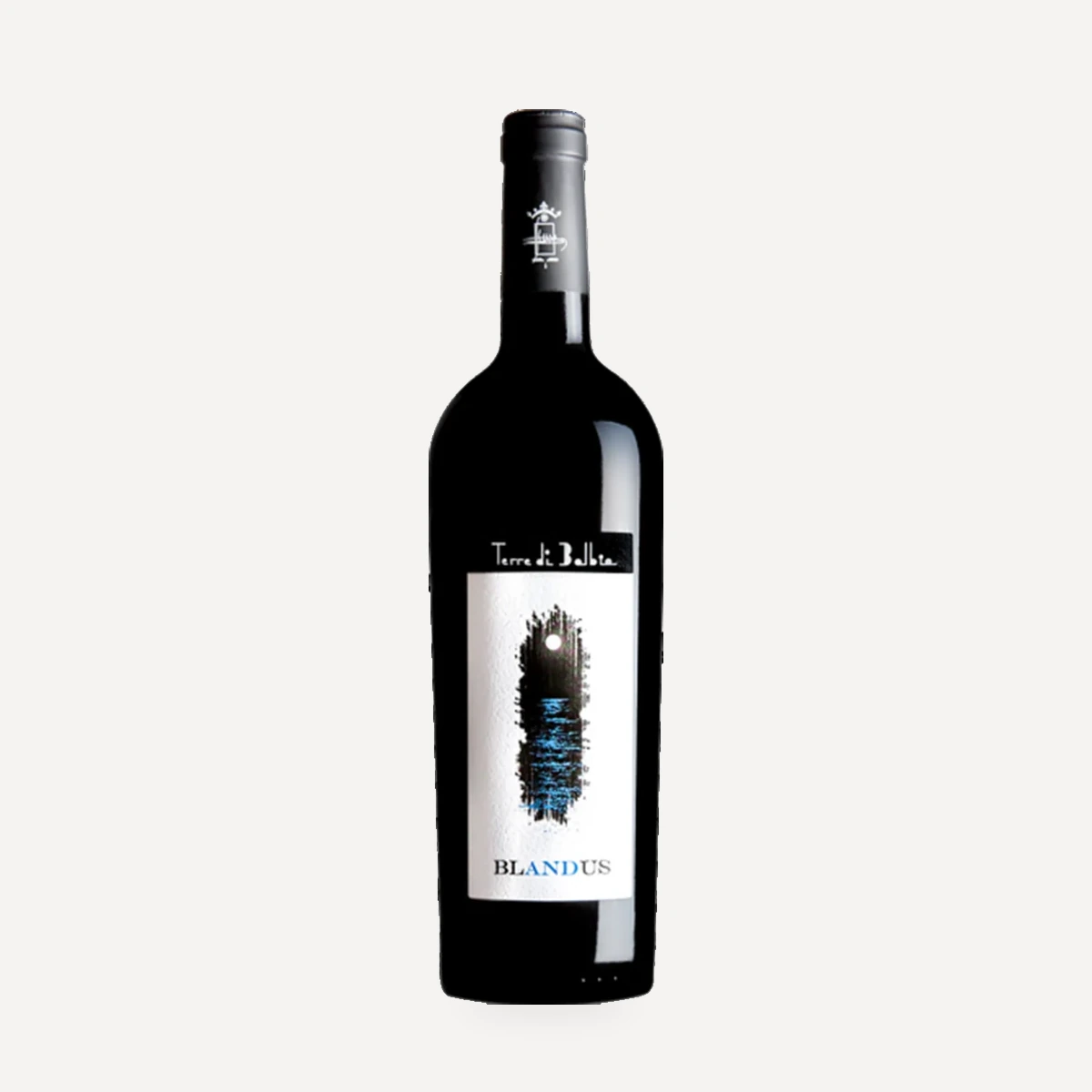
Blandus