History
Origins in Val di Fiemme
The Di Pauli family originated in Carano in Val di Fiemme. Its connection with wine extends across more than three centuries.
Settlement in Caldaro
During the 18th century, the family established itself in Caldaro and became influential in the area’s economic, political and winemaking life. Its activity contributed to the development of Caldaro’s wine tradition.
Imperial and international recognition
During the Austro-Hungarian imperial period, Baron Di Pauli received the title of Purveyor to the Imperial and Royal Court. Its wines also acquired an international reputation at the Tsar’s court in St. Petersburg.
The estate today
The contemporary estate is organized around two contrasting properties: Arzenhof above the western shore of Lake Kaltern and Höfl unterm Stein in Sella above Termeno. Its identity is presented as a continuation of the family’s historical legacy, combining accumulated experience and respect for tradition with a forward-looking approach to winemaking.
Terroir
Baron Di Pauli draws on two estates with markedly different settings in Caldaro and Termeno.
Arzenhof
Arzenhof occupies a hillside at approximately 250–390 m above the western shore of Lake Kaltern. The site lies on a morainic debris cone inclined toward the southeast. Its soils combine calcareous gravel, porphyry, quartz sand and a sufficient proportion of loam. A Mediterranean microclimate complements this mixed geological composition.
Höfl unterm Stein
Höfl unterm Stein stands at approximately 500 m in Sella, a hamlet above Termeno. Its soils are calcareous and rich in clay. They are associated with structured, deep wines that retain clearly defined acidity.
The contrast is central to the estate’s identity: a lower, southeast-facing, Mediterranean-influenced site above Lake Kaltern is paired with a higher calcareous-clay site above Termeno.
Winemaking
Viticulture differs between the two estates and their planted varieties. At Höfl unterm Stein, Sauvignon, Riesling, Incrocio Manzoni and Gewürztraminer are trained to Guyot. The white-variety parcels represented in the current range carry stated yields of 50 hl/ha, with vine ages ranging from approximately 15 to 25 years.
At Arzenhof, Cabernet and Merlot are Guyot-trained, while Lagrein is cultivated with both Guyot and Pergola systems. Stated yields are 35 hl/ha for Cabernet and Merlot and 40 hl/ha for Lagrein. The corresponding vines range from approximately 25 to 35 years of age.
Production employs stainless steel, large oak casks, open fermenters, oak fermentation vats, barriques and small barrels according to variety and style.
For the white blend from Höfl unterm Stein, Riesling and Incrocio Manzoni ferment in stainless-steel tanks, while Sauvignon ferments partly in stainless steel and partly in large oak casks. The components mature for six months on the fine lees before blending and bottling.
Gewürztraminer receives a 12-hour cold skin maceration, followed by fermentation in stainless steel and five months of maturation on the fine lees, also in stainless steel.
The Arzenhof Cabernet–Merlot undergoes spontaneous fermentation in oak vats with a three-week maceration. It is then transferred to barriques for spontaneous malolactic fermentation and matures in barrique for 18 months.
Arzenhof Lagrein undergoes spontaneous fermentation in open vessels with a 20-day maceration. Spontaneous malolactic fermentation follows in barriques at the end of October, with 50% new barrels. Maturation lasts 16 months in small barrels, with one racking, followed by bottling with light filtration.
Philosophy
Baron Di Pauli defines its wine culture through respect for tradition and history, accumulated knowledge and experience, and an uncompromising conception of quality. Its contemporary identity combines that inheritance with innovation rather than treating tradition as a fixed formula.
The estate presents the vine as the source of its wines’ character and seeks a common stylistic identity across two contrasting properties in Caldaro and Termeno. The intended qualities are presence, character and timeless elegance. Its self-description also emphasizes that these are conceived as wines for deliberate occasions rather than everyday consumption.
Wines

Enosi Bianco IGT

Exil Gewürztraminer DOC
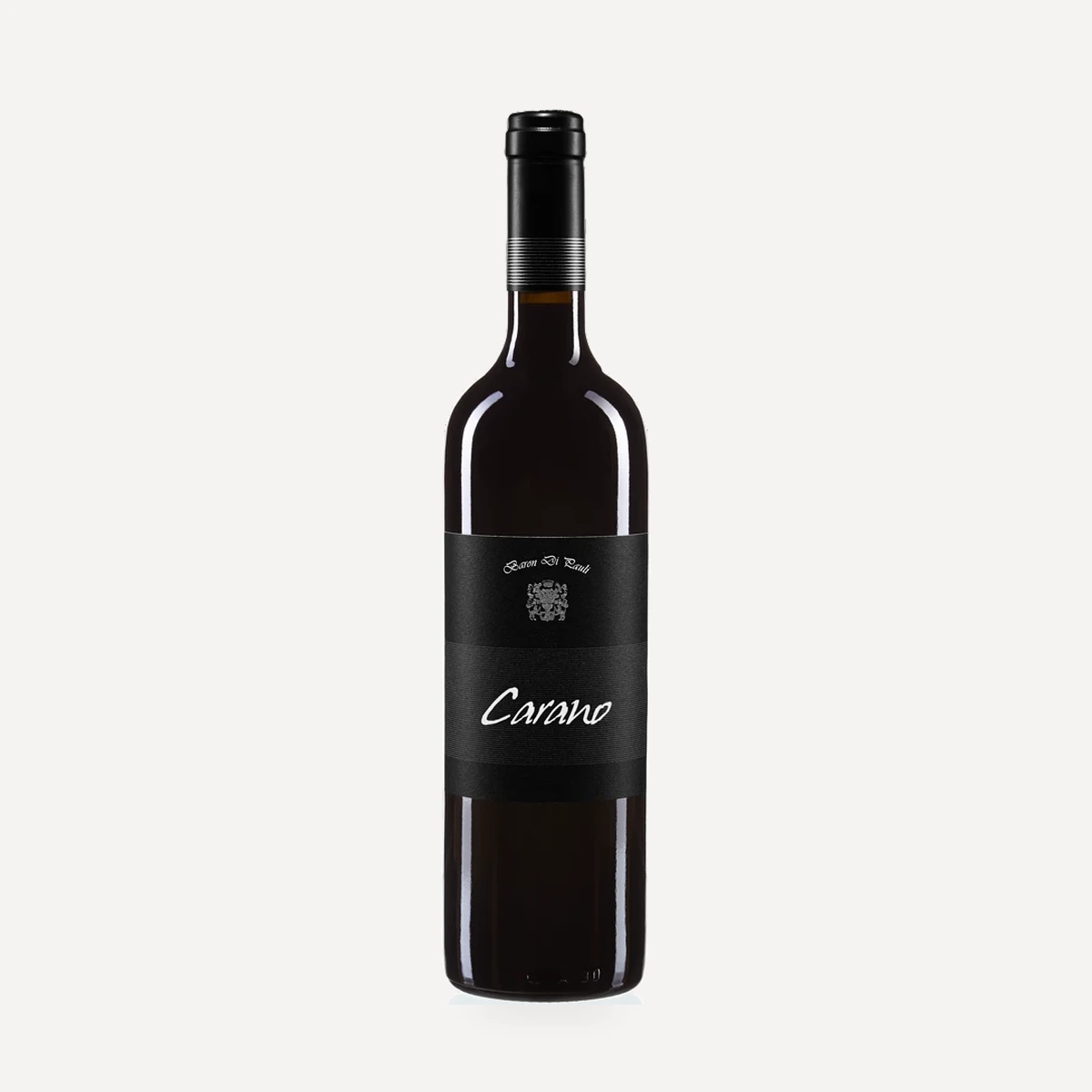
Carano Lagrein Riserva Vigna Arzenhof DOC
