History
The eighteenth-century farmhouse
The core of Piancornello is a rural farmhouse dating from the 1700s, surrounded by land that now includes Brunello vineyards and centuries-old olive groves.
1950: Zefiro and the beginning of the estate
Piancornello’s family history began in 1950, when Zefiro, the current family representative’s great-grandfather, acquired the farmhouse and its surrounding land after becoming attached to Montalcino. He then began planting the family’s first Brunello vineyards.
Continuity through the family
In the following years, much of the family left the property. The current representative’s grandparents, together with his parents, Alfeo and Silvana, remained and continued Zefiro’s work. Their decision reflected the importance they attached to living from and on their own land.
The present generation
The family describes Piancornello as the result of four generations of work. The tradition is now continued by the fourth-generation family representative together with his wife and daughters. The family personally manages the estate’s agronomic work and has developed Piancornello around organic cultivation, reduced intervention in the vineyard and continuity with the traditional methods of Brunello production.
The historic farmhouse also functions as an agriturismo. Its vaulted rooms have undergone a recent renovation in traditional Tuscan style. A separate wine shop has opened in the historic centre of Montalcino at Via Boldrini 7.
Terroir
Piancornello lies in the Sesta zone, between Sant’Angelo in Colle and Castelnuovo dell’Abate. The approximately 20-hectare property occupies a plateau overlooking Val d’Orcia, with Mount Amiata visible across the valley.
The estate has a Mediterranean microclimate. Its terrain is markedly steep, and the red soils contain abundant stones and rock. These conditions support the estate’s organic cultivation and shape its close association with the Sesta growing area.
Brunello vineyards share the property with centuries-old olive groves. The broader setting is the hilly territory around Montalcino, whose town centre stands at 564 metres above sea level and overlooks the valleys of the Orcia, Arbia and Ombrone rivers; this elevation refers to Montalcino rather than to the estate vineyards themselves.
Winemaking
All agronomic work is managed personally by the family. Organic agriculture is central to the estate’s decision to live and work in direct contact with its vineyards, olive groves and surrounding environment.
Piancornello was among the founders of the organic Brunello di Montalcino district. Its Sesta growing zone has developed a strong orientation toward organic and biodynamic agriculture. The family’s stated next step is to reduce human intervention in the vines further and progress toward biodynamic farming; biodynamics is an objective rather than a declared current certification.
Valoritalia controls compliance with the organic-production requirements. The available documentary evidence identifies Piancornello Società Agricola S.S. as operator 67545 under control-body code IT-BIO-015. It records 12.9468 ha of wine grapes, 2.037 ha of olive trees, 3.2465 ha of arable land and 0.9132 ha of grazing or land withdrawn from production, all under organic management. The final audit preceding that document took place on 17 December 2019; it was issued on 23 March 2020 with validity through 22 March 2023.
Cellar work follows two principles: continuity with Brunello di Montalcino tradition and cooperation with nature in accordance with the natural cycles of Sangiovese.
Alcoholic fermentation begins spontaneously through indigenous yeasts naturally present on the grape skins. Fermentation takes place in concrete vessels for 20–30 days, with the temperature maintained at approximately 28 °C.
After fermentation, the wine rests for approximately 24–36 months in traditional oak casks housed in an underground cellar.
Philosophy
Piancornello’s philosophy joins family continuity, attachment to the land and respect for natural cycles. Living on the family’s own land was a defining value for Alfeo, Silvana and the generations before them, and it remains the basis of the present family’s approach.
In the vineyard, the family seeks to limit intervention progressively, maintain organic methods and move toward biodynamic agriculture. Environmental sustainability is also framed as an intergenerational responsibility to the family’s daughters.
In the cellar, the guiding principles are the preservation of Brunello tradition and work in synergy with nature. Spontaneous indigenous-yeast fermentation, concrete vessels and maturation in traditional oak casks express that approach. The intended result is wine tied closely to its place of origin rather than detached from vintage and site.
Wines
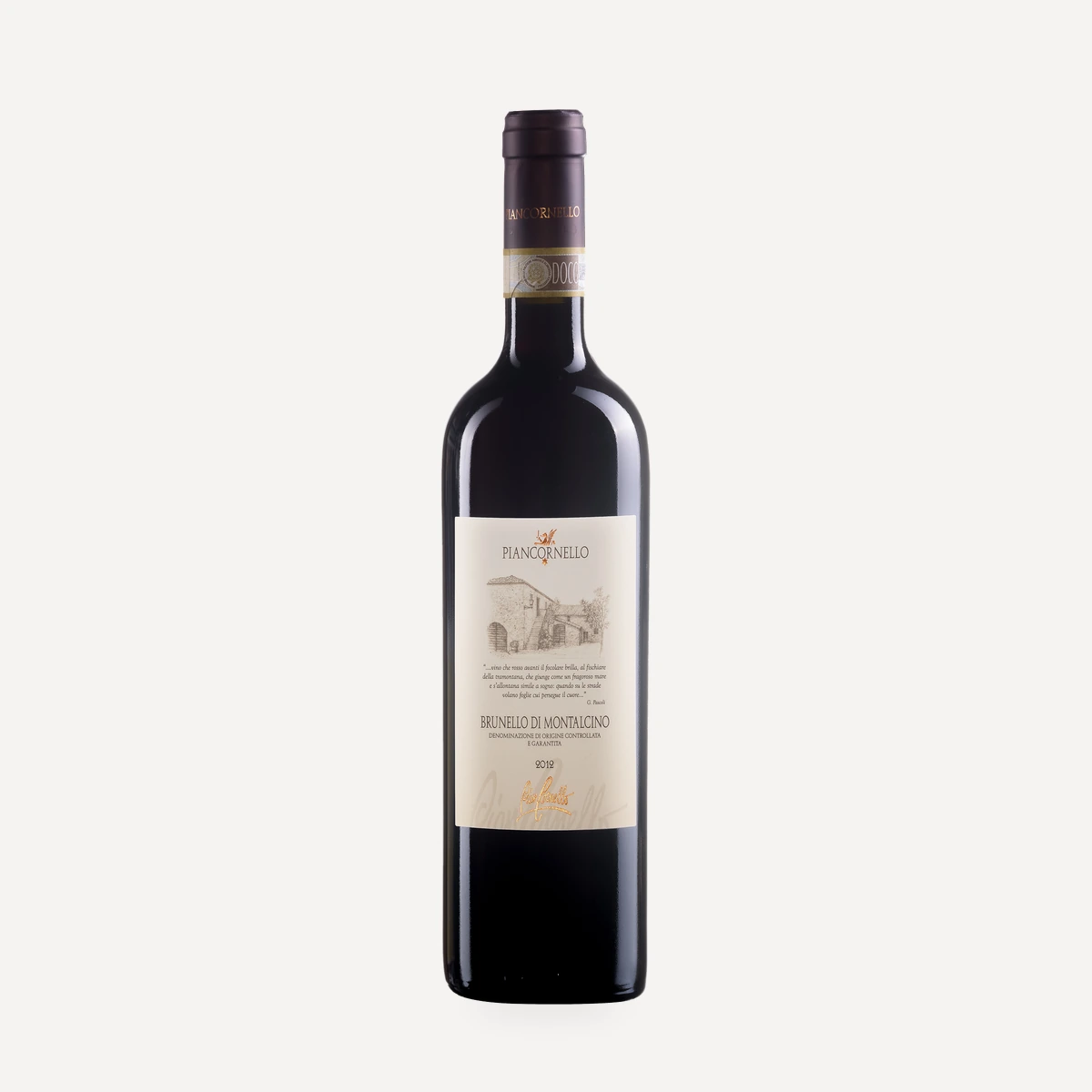
Brunello di Montalcino
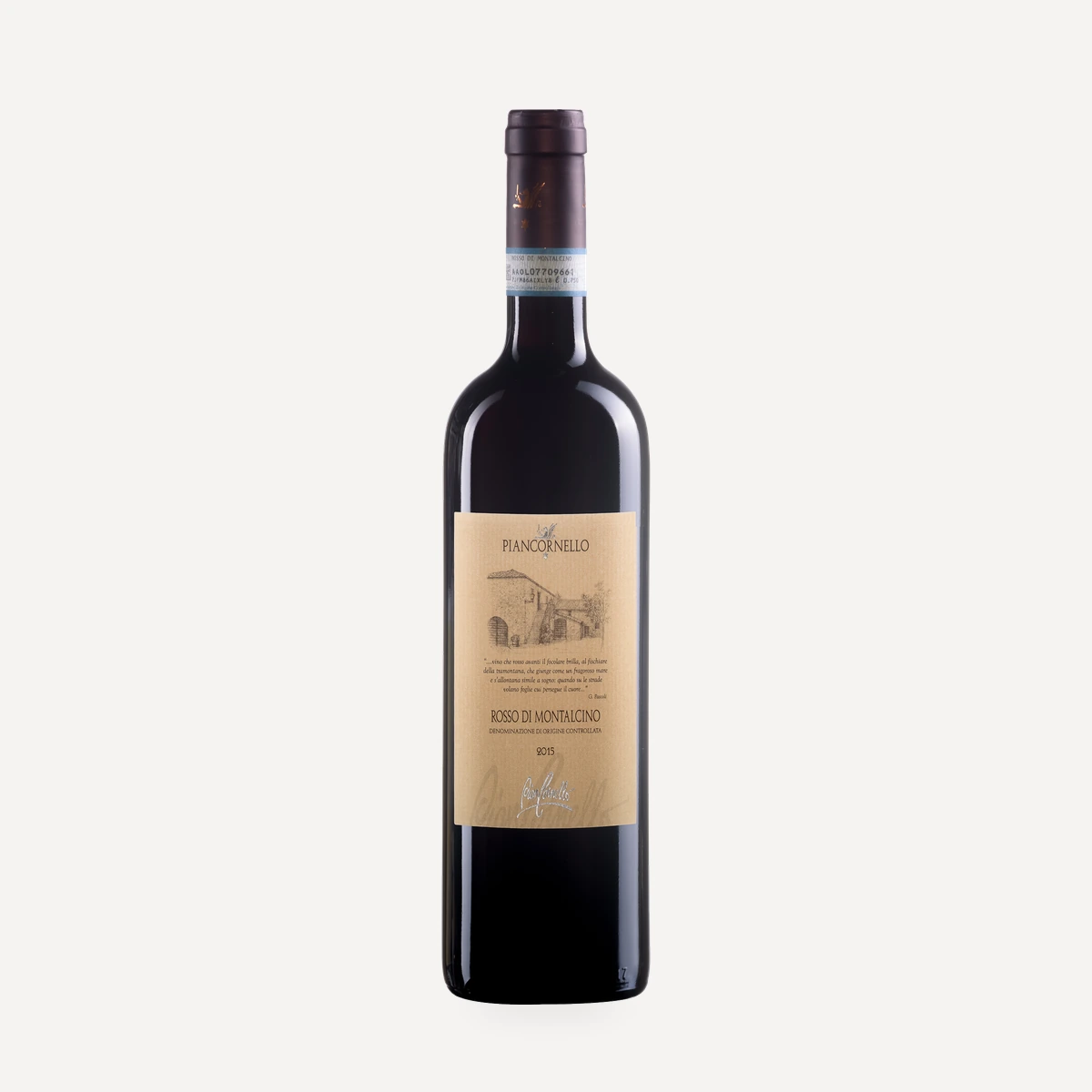
Rosso di Montalcino