Storia
The island before the wine project
Gorgona is the smallest island in the Tuscan Archipelago and lies approximately 32 km west of Livorno. Predominantly mountainous, it was once inhabited by hermits and monks and was repeatedly exposed to raids.
The island’s surviving architecture records several periods of occupation and defence. Torre Vecchia, a massive Pisan stronghold faced with local stone, was built on the steep western coast between the 11th and 13th centuries. Rising about 200 m above the sea, it watched the channel towards Corsica and protected the monks from pirate attacks. The Medici added Torre Nuova above the fishing port of Cala dello Scalo in the 17th century, completing the defensive perimeter on the side facing mainland Italy. Cistercian monks built a small church dedicated to San Gorgonio in the 18th century. In the late 19th century, two reddish-stone observation towers were constructed to monitor activity on the mainland: Torre dell’Orologio, near the pine wood and vineyards and named for its sundial, and Torre Garibaldi, looking towards Cala Scirocco.
Since 1869, Gorgona has housed an open penal colony. Its inmates can move around the island to work and learn occupations intended to support their return to employment and society after completing their sentences.
Vineyard development
The present vineyard history begins with a planting in 1999. Further plantings followed in 2015 and 2018. The vineyard now covers 2 ha, combining the original area with a second hectare planted in 2015. Vermentino and Ansonica occupy the principal white-wine vineyard, while several rows of Sangiovese and Vermentino Nero supply the red project.
Collaboration and first harvests
Frescobaldi agronomists and oenologists began working with the inmates in 2011, transferring practical knowledge of viticulture and wine production that could become a professional resource after imprisonment.
The formal Gorgona project began in August 2012 as a partnership between Frescobaldi and the Gorgona Penal Institute. It centred on the small vineyard in a natural amphitheatre overlooking the sea. Under the supervision of Frescobaldi’s technical team, inmates acquired direct experience in grape growing and winemaking. The first documented Gorgona white vintage was 2012, made from Vermentino and Ansonica.
Andrea Bocelli contributed a text in 2014 portraying Gorgona as the wildest and most luminous of the Tuscan Archipelago’s islands, surrounded by water and salt. This text became part of the project’s continuing narrative.
Expansion and Gorgona Rosso
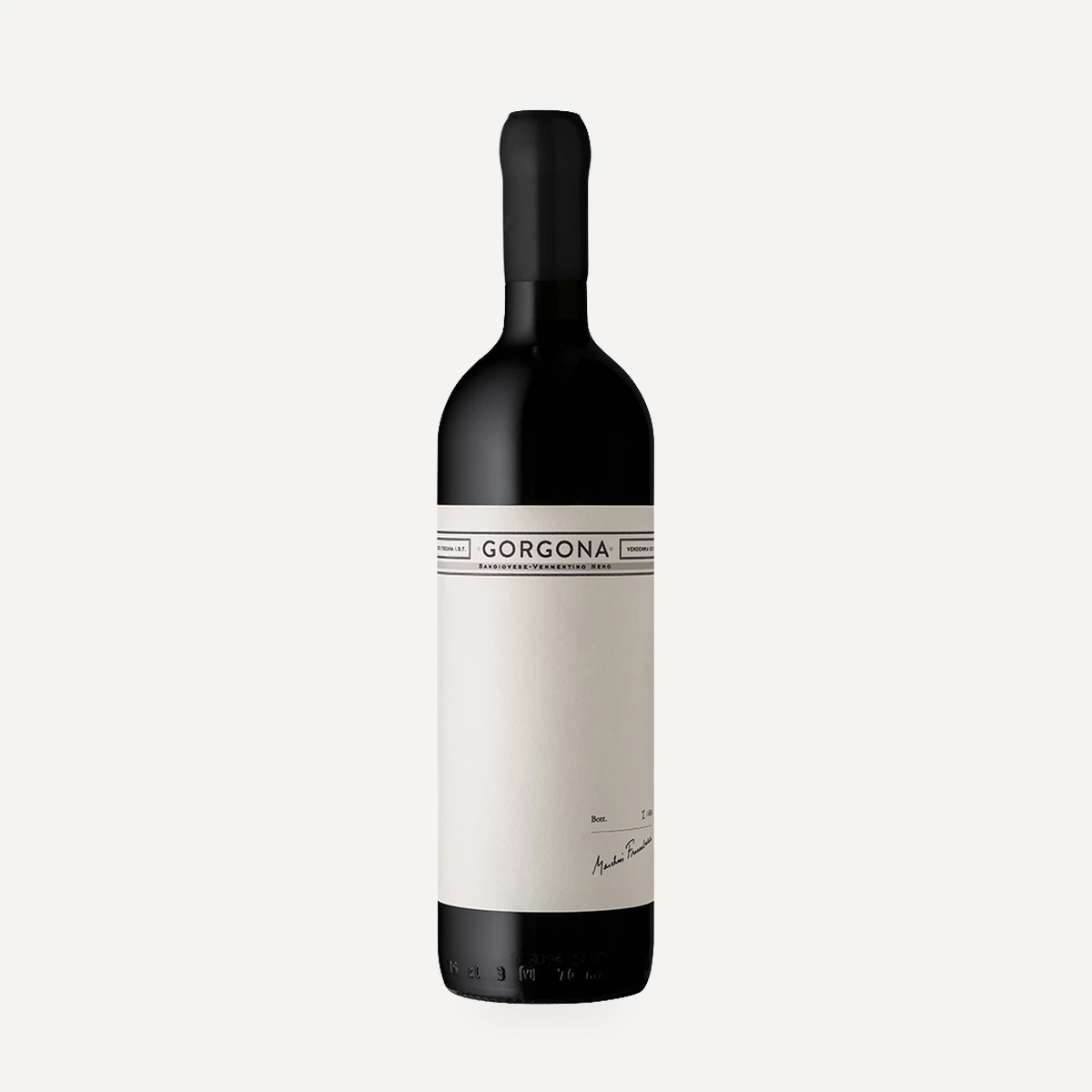
A second hectare was planted in 2015. The same harvest produced the first Gorgona Rosso from a few rows of Sangiovese and Vermentino Nero. Its grapes were vinified on the island and the wine was subsequently matured in terracotta jars. The red label was dedicated to rehabilitation and to the hope that the skills learned in the vineyard would help inmates begin a new chapter after returning to society.
Additional planting took place in 2018, completing the three planting phases identified for the present 2 ha vineyard.
The labels as an annual record of the island
Each Gorgona white label is conceived as a special annual edition devoted to a different feature of the island.
The 2020 edition explored Gorgona’s fortifications and historic buildings, including Torre Vecchia, Torre Nuova, Torre dell’Orologio, Torre Garibaldi and the church of San Gorgonio.
The 2021 edition marked the project’s tenth harvest. It honoured the inmates and wine professionals who accepted the challenge of learning and teaching a profession, together with the directors, authorities, police, teachers, partners and sponsors involved in the project.
The 2022 edition focused on the island’s orchids, numerous varieties of which flower at different times of year.
The 2023 edition examined the four principal winds—Grecale, Sirocco, Libeccio and Mistral—and their role in regulating air temperature and grape ripening.
The 2024 edition featured the 50 butterfly species that find suitable habitat on Gorgona and connected their presence with the use of green manure, which enriches the soil and attracts pollinating insects.
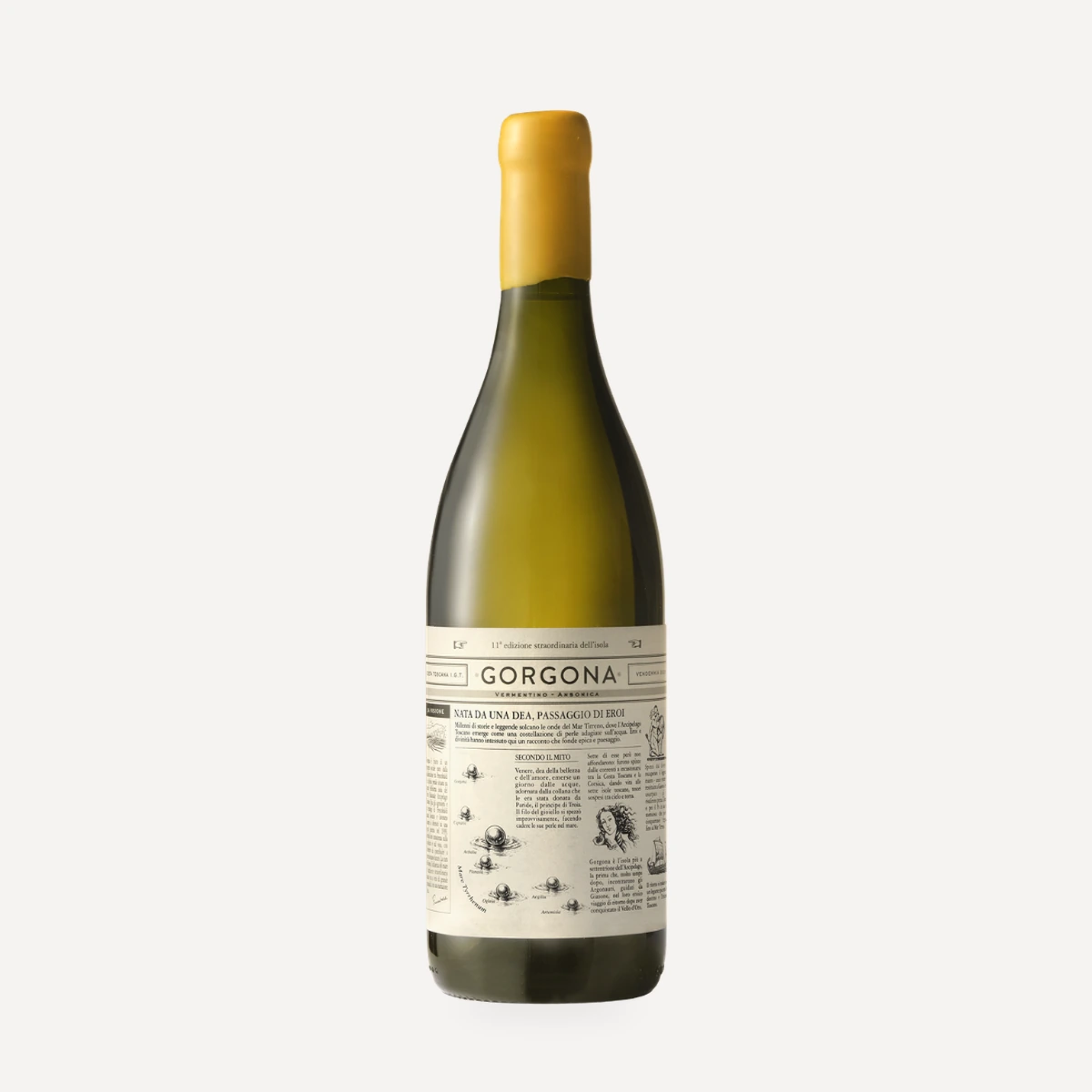
The 2025 edition turned to ancient stories rooted in Greek mythology, linking the heroes and deities associated with the Tyrrhenian Sea to the landscape of the Tuscan Archipelago.
Terroir
Gorgona is the smallest island of the Tuscan Archipelago, situated approximately 32 km west of Livorno. The island is predominantly mountainous, with steep and rocky coastal terrain. Its vineyards occupy a natural amphitheatre overlooking the sea at approximately 60 m above sea level.
The 2 ha vineyard faces east and lies in an area sheltered from the strongest maritime winds. Its soil is described as sandy, free-draining and rich in iron. This drainage proved particularly important during the exceptionally wet 2014 season.
The sea is the dominant climatic influence. It moderates high summer temperatures, softens sudden cold events and maintains air movement around the vines. The island generally experiences mild winters, temperate springs and hot but ventilated summers. Its vegetative cycle begins earlier than on the mainland and can also extend for longer. Archived growing-season accounts place the advance at roughly 10–20 days, depending on the year.
Four winds—Grecale, Sirocco, Libeccio and Mistral—are identified as important elements of island viticulture because they regulate air temperature and consequently influence ripening. Continuous sea breezes can also help preserve healthy bunches in rainy seasons. The combination of wind exposure and maritime temperature moderation has repeatedly limited the effects of drought, excessive heat and sudden springtime temperature falls.
The site supports dense Mediterranean scrub and a rich island ecosystem. Numerous orchid varieties flower at different times, while 50 butterfly species have found suitable habitat on Gorgona. The vineyards sit within this wider mosaic of scrub, pine wood, rocky slopes and uncontaminated sea.
Vinificazione
The vineyards are managed organically by inmates of the Gorgona penal colony, working with the guidance and supervision of Frescobaldi agronomists and oenologists. The programme combines vineyard labour with practical professional instruction intended to remain useful after the participants return to society. No organic certifying organisation or certification date is identified.
Green manure is used to enrich the soil and help preserve its natural balance. It also attracts pollinating insects, connecting soil management with the island’s biodiversity, including its 50 recorded butterfly species.
The maritime environment shapes vineyard decisions and plant development. Sea breezes moderate heat and support bunch health, while the free-draining sandy soil manages periods of heavy rainfall. Vermentino normally begins its cycle before the later-budding Ansonica. Harvest dates consequently differ between the varieties: in 2025, Vermentino was collected in the second week of September and Ansonica in the latter half of the month, after cool, sunny conditions allowed both to reach suitable ripeness.
Winemaking forms part of the inmates’ practical training and takes place with the collaboration and supervision of Frescobaldi’s oenologists.
The most clearly documented estate-wide cellar practice concerns Gorgona Rosso. Sangiovese and Vermentino Nero from a few island rows are vinified on Gorgona and subsequently matured in terracotta jars. This approach has been used since the first red harvest in 2015.
Filosofia
Gorgona is conceived as both a wine project and a programme of social rehabilitation. Its central principle is that meaningful work in contact with nature, accompanied by professional instruction, can give inmates practical skills for their return to employment and society.
The project presents wine as the result of a specific island environment and human labour, and as a symbol of hope and freedom. The Gorgona Rosso label develops this idea explicitly: it is dedicated to rehabilitation and to the possibility that experience gained in viticulture can help participants begin a new chapter after imprisonment.
The annual white-wine label functions as a changing portrait of Gorgona rather than a fixed design. Each edition interprets one aspect of the island—its architecture, people, orchids, winds, butterflies, farming practices or mythology—connecting the agricultural project with Gorgona’s natural and cultural identity.
Organic cultivation, green manure and attention to pollinating insects place soil care and biodiversity within the project’s working practices. The aim is not limited to grape production: vineyard work is integrated with the island’s ecological setting and with the development of human dignity, competence and prospects for the future.
Vini
Gorgona