Storia
1385: Lionardo’s journey
In 1385, Lionardo Di Niccolò Frescobaldi recorded his departure on a journey to Egypt and the Holy Land. His travel account provides the historical reference used to frame Tenuta Calimaia’s exploratory identity.
1390: A Frescobaldi in Montepulciano
Lionardo—an explorer, writer and merchant—became mayor of Montepulciano in 1390. This episode establishes an early connection between the Frescobaldi family and the town.
2003: Planting the single vineyard behind Viacroce
The Sangiovese vineyard associated with Viacroce was planted in 2003 at 300 metres above sea level. Its south-south-east exposure, fossil-rich marine clays and Pliocene geology distinguish it within the estate.
The return to Montepulciano
Tenuta Calimaia represents the Frescobaldi family’s return to Montepulciano. The project consciously links this return with Lionardo’s exploratory character and the family’s medieval presence in the town. The estate now extends across approximately 70 hectares in Cervognano, a historic Vino Nobile di Montepulciano production area between the Val di Chiana and Val d’Orcia.
Terroir
Tenuta Calimaia occupies gentle hills between the Val di Chiana and Val d’Orcia. The approximately 70-hectare property lies in Cervognano, an area historically associated with Vino Nobile di Montepulciano production.
The vineyards form a crown around the Monteliscione hill at approximately 300 metres above sea level. Their exposures and soil types vary, allowing different varieties and vineyard selections to be matched to distinct conditions.
This is described as the lowest part of the production area. Its relatively low elevation brings higher temperatures, while the soils have a substantial clay component. Together, these conditions foster structured, powerful wines with abundant tannins and the capacity for prolonged ageing.
The underlying geology is Pliocene in origin and generally poor in organic matter, conditions considered particularly suitable for Sangiovese, traditionally called Prugnolo Gentile in the area. Estate vineyards include clay sites as well as soils containing sand and yellow sandstone. In the single vineyard associated with Viacroce, the clay-rich loam contains marine clays of Pliocene origin and numerous fossils.
Vinificazione
The Viacroce Sangiovese vineyard is harvested by hand. For Calimaia Riserva, bunches are also selected carefully in the vineyard. Broader information about soil management, pruning, cover crops, plant protection, water use, biodiversity measures, yields or environmental certification is not specified for Tenuta Calimaia.
The three estate selections share a cellar approach based on temperature-controlled stainless-steel vinification, skin maceration and malolactic fermentation in steel before transfer to oak.
For Tenuta Calimaia, hand-picked grapes ferment spontaneously at 26 °C. Extraction is managed through frequent pumping over at the beginning of fermentation, délestage during the intermediate phase and gentler pumping over toward the end. Malolactic fermentation finishes in steel before winter. Maturation follows in 50 hL oak barrels for 24 months, with a further four months in bottle before release.
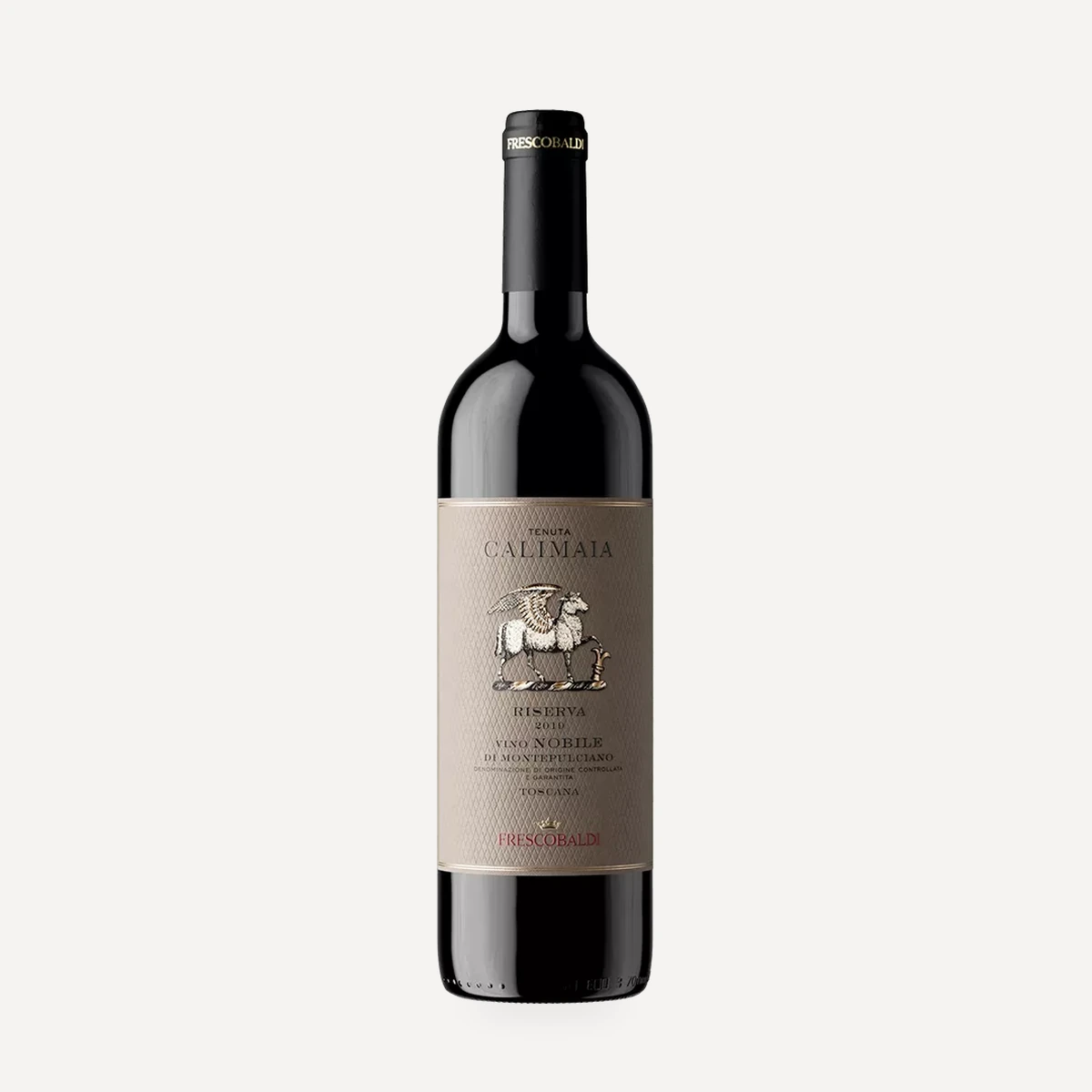
Calimaia Riserva follows the same controlled-temperature, spontaneous-fermentation approach after hand harvesting and field selection. Skin maceration lasts 20 days, with pumping over, an intermediate délestage and gentle final extraction. The current English presentation gives 24 months in 50 hL oak barrels followed by six months in bottle.
Viacroce is made exclusively from hand-picked Sangiovese grown in one vineyard. The grapes remain in temperature-controlled steel for a 25-day vinification, with skin maceration and frequent early pumping over. Malolactic fermentation takes place in steel. The 2022 selection spends 24 months in wood—12 months in barriques followed by 12 months in 50 hL French-oak barrels—and then one year in bottle.
Filosofia
Tenuta Calimaia is framed as a return to Montepulciano inspired by the exploratory disposition of Lionardo Di Niccolò Frescobaldi. This historical reference gives the project a dual perspective: renewed engagement with Montepulciano and continuity with a family connection documented in the fourteenth century.
The estate’s approach centres on interpreting differences in exposure and soil across the vineyards surrounding Monteliscione. Viacroce expresses this most explicitly: it is presented as an interpretation of the strength of one Sangiovese vineyard in Pieve Cervognano and as a tribute to a land whose character continues to reveal itself.
The production identity is oriented toward time and maturation. Clay-rich soils, warm conditions, Sangiovese’s tannic structure and extended oak and bottle ageing are brought together to produce expressions intended to develop over time.
Vini