Storia
Earlier ownership
Tenuta Vignega takes its name from the locality in Pescantina where it stands. The property historically belonged to the noble Counts Serego Alighieri, direct descendants of Dante Alighieri. Its vineyards formed the southern extension of the family's lands around Villa Serego Alighieri in Sant’Ambrogio. The estate subsequently passed to the Bolla family, whose background lay in winegrowing and winemaking.
The stone farmhouse preserves a vaulted cellar dating to 1400, demonstrating that the property's built wine heritage predates its acquisition by the Bettili family by several centuries.
1977: acquisition by Siro Bettili
Siro Bettili purchased Tenuta Vignega in 1977. At the time, it included 8 hectares of old vines. He added the property to his established poultry-farming activity while retaining its vineyards. The acquisition also continued a longer Bettili family connection with wine: the family had cultivated vineyards, vinified grapes and traded wine on the hills of Verona since the opening decades of the twentieth century.
Late 1990s: Cristiana Bettili and organic conversion
Cristiana Bettili entered the family business permanently at the end of the 1990s and worked alongside her father. Her growing concern with the relationship between quality of life, environmental conditions and business decisions led to the conversion of the family enterprise to organic cultivation. Tenuta Vignega adopted organic management in this period and has held BIOS organic certification since 1999.
2002: vineyard renewal
A program to renew the old vineyards began in 2002. The changes introduced denser planting layouts and Guyot training, replacing or restructuring the earlier vineyard configuration while maintaining the estate's focus on the traditional red grapes of Valpolicella.
2005: the Pescantina cellar
After gaining experience in the family business and directing substantial environmental changes in the vineyards, Cristiana decided to vinify the estate's own grapes. In 2005, a winery was established within Tenuta Vignega's old stone farmhouse. The oldest vaulted section, dating to 1400, became the maturation area for casks and barriques used for Ripasso and Amarone. Stainless-steel tanks were installed in the restored spaces formerly occupied by stables and haylofts. The Pescantina facility also became the shared vinification cellar for the family's Veronese estates.
Terroir
Tenuta Vignega lies in the northern part of the commune of Pescantina, adjoining Sant’Ambrogio di Valpolicella within the classic production area of Valpolicella DOC. The vineyards occupy a foothill setting at 140 metres above sea level.
The soils are freely draining, with a substantial gravelly skeleton over rocky limestone substrata. Their calcareous texture originated in Mesozoic ocean floors. This limestone component can retain moisture and release it during dry periods, providing the vines with a reserve under drought conditions.
The climate is mild and dry. Airflow arriving from the nearby pre-Alpine mountain chain ventilates the vineyards. The vines face south, an exposure that provides ample solar irradiation.
Vinificazione
Tenuta Vignega has been farmed organically under BIOS certification since 1999. The conversion followed Cristiana Bettili's entry into the family enterprise and her decision to align wine quality with environmental responsibility and the protection of natural biodiversity.
Synthetic chemical fertilisers, herbicides and insecticides are excluded, as are genetically modified organisms. Vineyard protection uses products permitted for organic cultivation: sulphur against powdery mildew, copper against downy mildew, and pyrethrum and Bacillus thuringiensis against damaging insects.
Because repeated copper applications can accumulate in the soil, reduce biological activity and harm earthworms and beneficial insects, the agricultural program includes trials designed to bring copper use well below the referenced limit of 6 kg/ha per year. These trials include bacterial antagonists to downy mildew and natural citrus-based alternatives valued for fungistatic, bacteriostatic, antioxidant and foliar-strengthening effects.
BIOS srl of Marostica, an external control body authorised by the Italian agricultural ministry, verifies compliance throughout the production chain through continuing inspections. Vineyard restructuring initiated in 2002 introduced denser planting and Guyot training. The estate vineyard description identifies a south-facing orientation, while specifications for some bottlings also retain references to Pergola Veronese alongside Guyot.
Vinification at Tenuta Vignega began under Cristiana Bettili in 2005, when the winery was established inside the estate's stone farmhouse in Pescantina. The building incorporates an original vaulted cellar dating to 1400.
The oldest portion of the cellar houses casks and barriques used to mature Ripasso and Amarone. Stainless-steel tanks occupy the restored former stables and haylofts. The arrangement places maturation vessels in the historic underground or vaulted fabric while using the converted agricultural spaces for tank-based cellar work.
The Pescantina winery is also the shared production facility in which grapes from the family's Veronese estates are vinified. Beyond the allocation of stainless steel, casks and barriques, no single estate-wide protocol is defined for fermentation, maceration, maturation duration, clarification, filtration, sulphur use or bottling; those parameters vary among individual wines.
Filosofia
Cristiana Bettili's central objective is to produce quality wine while respecting the environment. Her organic commitment developed from the conviction that quality of life cannot be separated from environmental conditions or from the consequences of business decisions.
Organic farming is presented as a substantive guarantee rather than a response to fashion or market trends. Its purpose is to protect the environment and natural biodiversity while excluding synthetic fertilisers, herbicides and insecticides, as well as genetically modified organisms. Independent certification and controls throughout the production chain are integral to that guarantee.
The broader principles guiding this approach are agricultural self-sufficiency based on local resources, protection of the soil's natural fertility, avoidance of pollution caused by farming techniques and production of nutritious, high-quality agricultural products in sufficient quantities. The trials aimed at reducing copper inputs express the same preference for continuing environmental improvement rather than simple compliance with an upper legal threshold.
Tenuta Vignega's identity is also framed through the relationship between father and daughter. Pride, tenacity and freedom are the values attached to the estate's eagle emblem and to the shared story of Siro and Cristiana. Its wines are intended to retain the traditional character associated with Corvina and Corvinone while favouring vivid colour, aromatic elegance, moderate alcohol and drinkability.
Vini
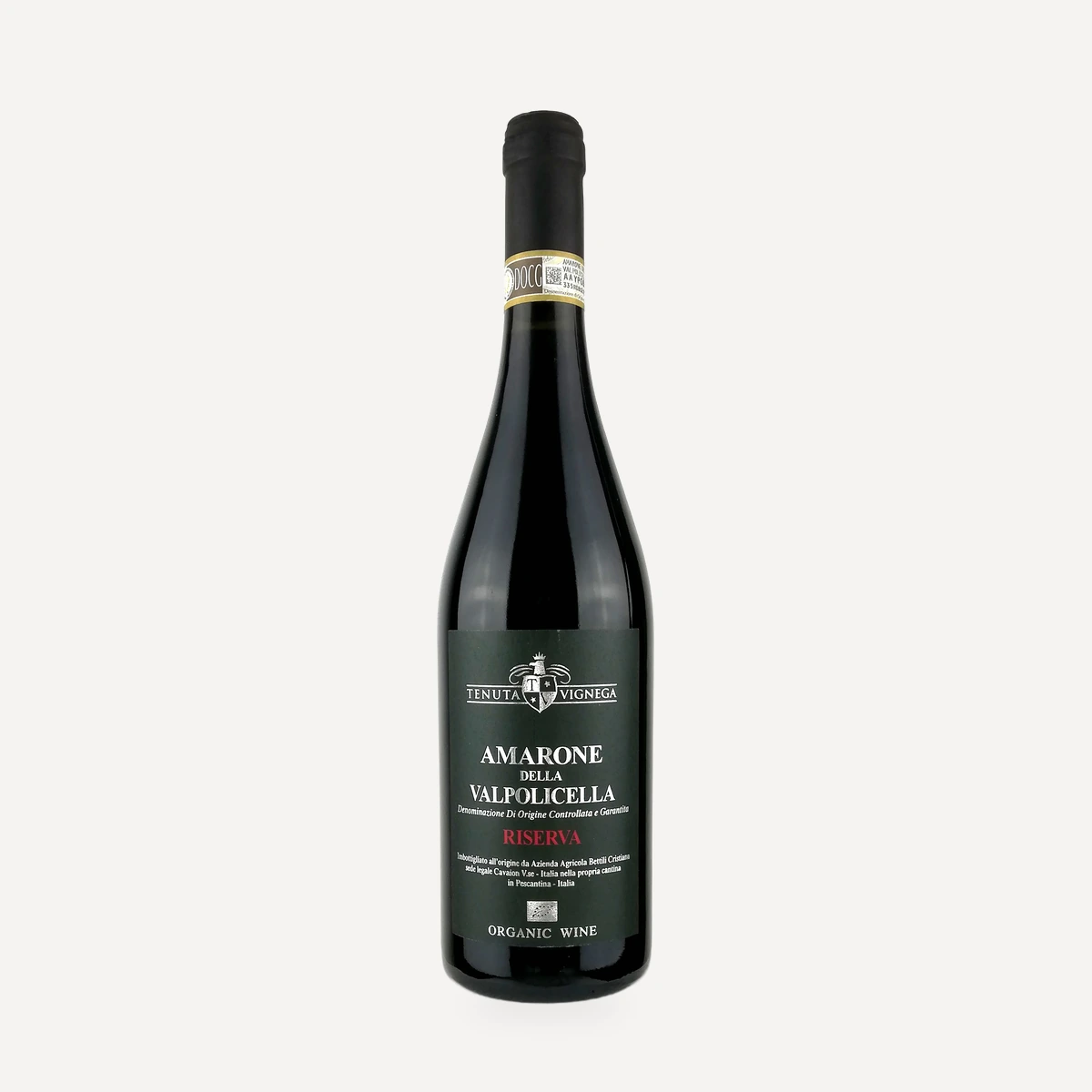
Amarone della Valpolicella Riserva DOC
