History
Medieval origins
Borgo Scopeto’s recorded memory reaches back to around the year 1000. The settlement was created by Siena as a fortified northern outpost from which approaching threats could be reported and the territory defended against siege. Much of its ancient tower survives, including the former prisons and canitoia.
The name Scopeto derives from the abundance of erica scopaia, or broom heath, formerly used locally to make brooms.
The Sozzini era
From the 14th through the 19th century, Borgo Scopeto belonged to the Sozzini, a noble, reformist Sienese dynasty. They transformed the fortified complex into a castle. Successive additions to the original tower included the main villa, stables, farmers’ houses, a chapel and a cellar. Together they formed a self-contained village and prosperous agricultural enterprise devoted to vines and olive trees.
The estate also became a cultural centre. Mariano Sozzini was a noted Sienese jurist, while Lelio Sozzini and his nephew Fausto were associated with the religious movement later known as Socinianism. A secluded circular stone structure in the oak woods, known as the Soccinian Circle, is traditionally identified as a secret meeting place for their followers. Its concealed position against the slope may have allowed participants to avoid the attention of the Inquisition.
Florentine conquest
At the end of the 16th century, Florence captured the strategic outpost during its conflict with Siena. To mark the victory, the Florentines erected a Marzocco, the emblem of Florentine popular power, in an intentionally provocative gesture. It remains in the main garden. The surviving villa and chapel preserve the social organization of the former agricultural community: the noble owners attended Mass from a raised gallery, while the estate workers occupied the lower part of the chapel.
The Roccolo
During the 17th century, a circular garden called the Roccolo was formed beside the vineyards and lavender fields. Trees were trained into a pergola-like ring around low-pruned oaks and holm oaks, creating a leafy labyrinth in which nets could be concealed for bird-catching. The Roccolo was also a social place where participants gathered during migrations and demonstrated their botanical knowledge and familiarity with bird species and calls. It survives as the last example of this former practice in the immediate area and is maintained according to precise horticultural rules.
Later architectural layers
Borgo Scopeto continued to evolve rather than remaining fixed in a single historical period. A balcony now attached to Executive Suite 115 was added in the 20th century. Although stylistically separate from the medieval nucleus, it was retained as part of the property’s accumulated history. The complex also preserved an intact cistern and buildings from several distinct construction phases.
Acquisition and restoration
After approximately ten years of abandonment, Borgo Scopeto was acquired in the 1990s by Elisabetta Gnudi. The previous owner was Swiss, and the agreement was concluded with a handshake while Gnudi’s daughter Alessandra Angelini, then 11 years old, was present. Gnudi abandoned negotiations for another property at Castellina in Chianti after seeing Borgo Scopeto.
The tower had lost its roof and housed a large colony of bats, while the main garden was dominated by a magnolia more than 30 metres tall; the tree was subsequently killed by lightning. Gnudi led a careful restoration that retained the complex’s historical layers while converting it into a luxury hotel. Architect Umberto Sifola helped define the restored interiors, chiefly through restrained beige, grey and blue tones, with touches of green and orange. Gnudi’s young son photographed the restoration and produced the individual prints displayed throughout the hotel and associated cellars.
The restored village was paired with the separately situated agricultural company of the same name, located a few kilometres away and producing wine and DOP extra-virgin olive oil. The estate’s contemporary activities also encompass vineyards, olive groves, an organic vegetable garden, an apiary, an orchard and aromatic crops.
Terroir
Borgo Scopeto works in Chianti Classico, in the Tuscan countryside near Siena and within the municipality of Castelnuovo Berardenga. The surrounding landscape is formed by hills, woods, vineyards, olive groves and meadows, with views toward Siena’s Torre del Mangia and cathedral tower. The property also looks toward Val d’Orcia and Monte Amiata from selected viewpoints.
Oak woods surround the estate, while a centuries-old cypress avenue forms its historic approach. The wider landscape includes more than 300 hectares of woodland. No vineyard-specific figures for altitude, exposure, rainfall, climate or soil composition are given.
Winemaking
Vine growing forms part of a broader mixed agricultural landscape that also contains olive groves, woods, an organic vegetable garden, an apiary, lavender, helichrysum and a small orchard planted with old fruit varieties. Biodiversity is supported by the apiary, whose bees pollinate the surrounding vegetation.
Environmental infrastructure serving both hospitality and cellar activities includes biological water-purification systems. Treated water is returned to the environment clean. Photovoltaic panels and solar-thermal systems have also been installed within the wider Borgo Scopeto operation.
No vineyard-specific account is provided for certification, soil cultivation, cover crops, pruning, canopy work, disease protection, yield control, harvest method or grape selection.
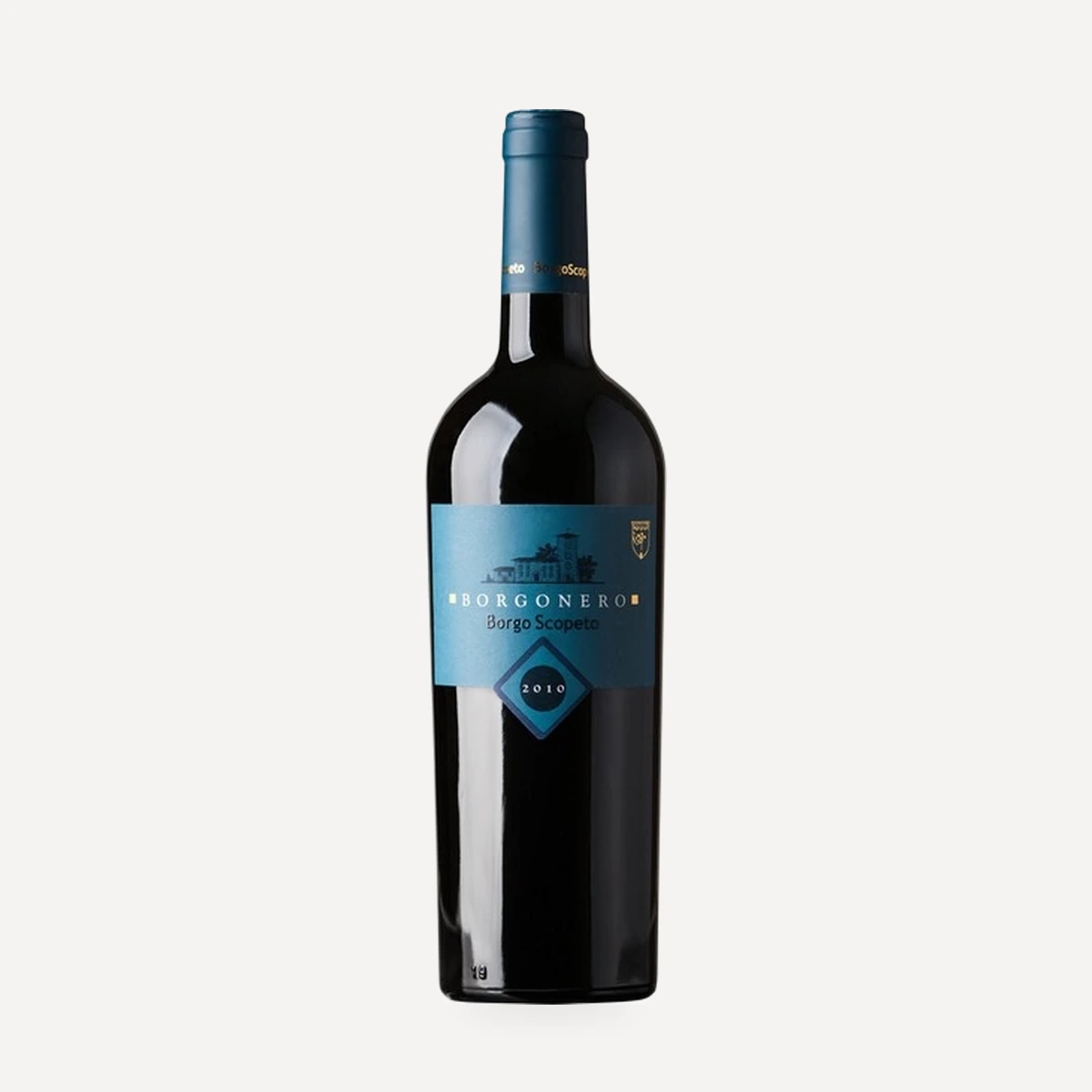
Borgo Scopeto produces wine in its own cellars, including Chianti Classico, Chianti Classico Gran Selezione and Borgonero. Its Gran Selezione is made entirely from Sangiovese. Winery effluent passes through biological purification before the water is returned to the environment.
Grape pomace is also retained for the Bagno di Bacco, a body treatment based on vinotherapy. Grape must is sent to a vinegar producer in Modena to make Borgo Scopeto balsamic vinegar, which is aged for eight years.
No cellar description or technical vinification sequence is provided for grape reception, sorting, crushing, fermentation, maceration, extraction, maturation, blending, stabilization, filtration or bottling.
Philosophy
Elisabetta Gnudi’s move into Tuscan agriculture was driven by the conviction that making wine offered a particularly satisfying form of country life. The contemporary project treats wine as Borgo Scopeto’s emblematic product and as the starting point for a broader connection among agriculture, hospitality, food, art and landscape.
The desired relationship between nature and people is expressed through wines intended to represent their territory. Self-production is central to the wider vision: vineyards and wine are joined by olive oil, vegetables, honey, fruit, aromatic plants, vinegar and cosmetics, recreating aspects of a self-sufficient medieval village.
Environmental responsibility is presented as a continuing mission. The priorities include renewable energy, biological water treatment, efficient heating and cooling, waste reduction, biodiversity and greater control over the origin of ingredients. The hospitality operation holds ISO 14001 environmental-management certification, although this is not identified as a viticultural or winery certification.
Wines
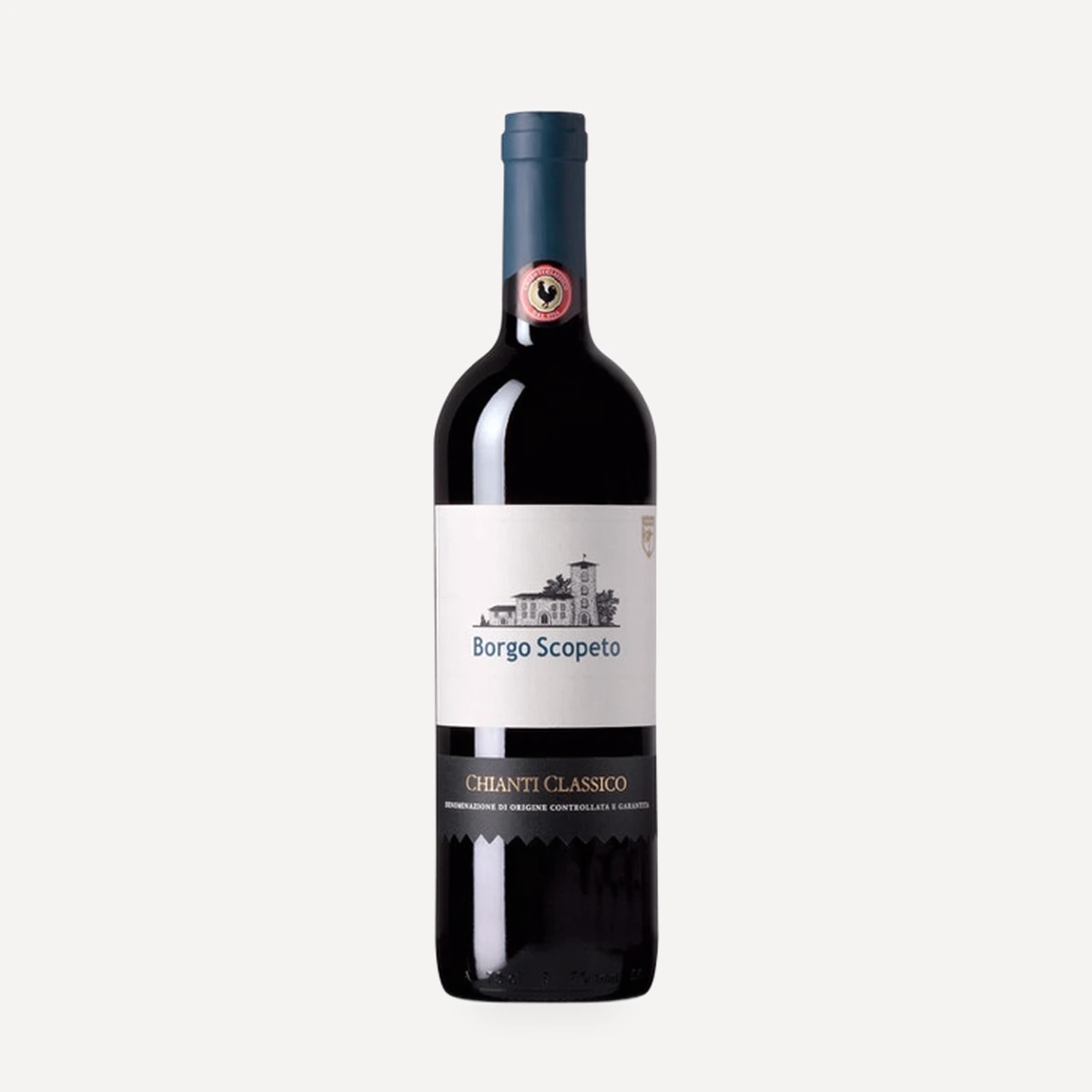
Borgo Scopeto Chianti Classico DOCG