History
The abbey’s disputed origins
The history of Badia a Passignano is inseparable from the monastery around which its vineyards and cellars developed. Its foundation date remains unresolved. Pietro Aretino, writing in his biography of San Zanobi, attributed the monastery’s foundation to the archbishop of Florence in 395. The oldest documents preserved in the monastic archives, however, date only from 891.
The Vallombrosians and a millennium of viticulture
In 1049, the abbey passed to the Vallombrosian order, a reformed branch of the Benedictines whose activities included viticulture and forestry. The surrounding district has been associated with wine production since around the year 1000. Hundreds of historical volumes now held in the Florence State Archives document Sangiovese vineyards and other local crops over the ensuing centuries.
The medieval cellars beneath the monastery date from the tenth century. Their network of underground passageways, vaulted ceilings and massive masonry walls creates naturally stable temperature and humidity conditions throughout the year. They remain the place where Badia a Passignano is matured.
Galileo and the changing monastery
Galileo Galilei stayed at the monastery in 1587 and 1588 as a mathematics teacher. Over subsequent centuries, repeated restoration and conservation campaigns altered both the structure and appearance of the monastic complex.
Archaeobotanical evidence
In 1983, a Vitis vinifera plant estimated to be one thousand years old was discovered on land around Badia a Passignano. The find complemented the extensive written record of viticulture in the district.
The Antinori estate and contemporary hospitality
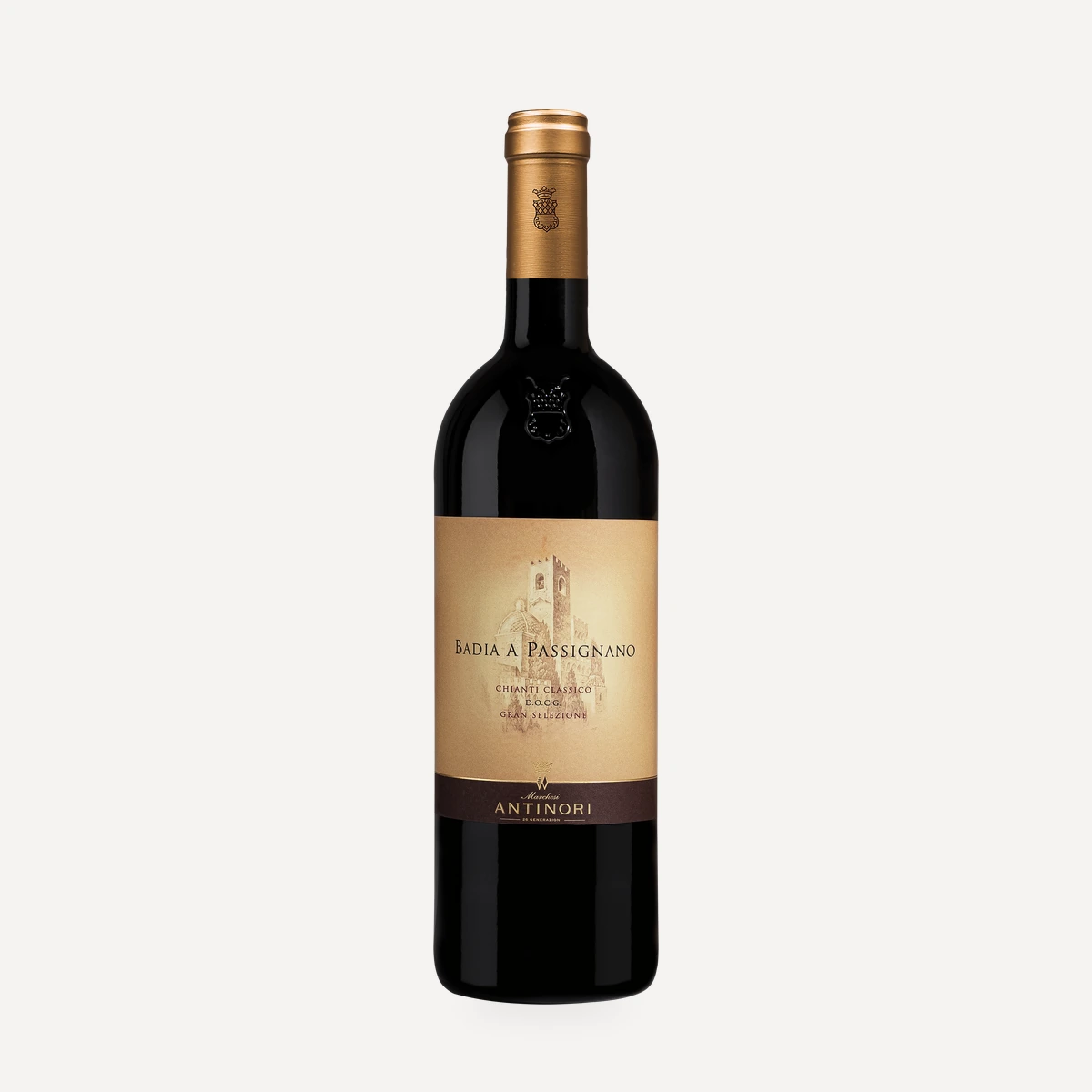
The Antinori family owns the vineyards surrounding the abbey. The estate now encompasses 223 ha, including 65 ha of vineyards, and produces Badia a Passignano Chianti Classico DOCG Gran Selezione from selected Sangiovese grown in the abbey’s historic vineyards.
In 2000, Allegra Antinori and Marcello Crini founded Osteria di Passignano with the aim of renewing the area’s gastronomic and winemaking traditions. The restaurant has held a Michelin Star continuously since 2007. The wider Badia a Passignano experience now includes guided visits to the medieval cellars, the Osteria, a wine shop and the seasonal Orto di Badia dining experience.
Terroir
Badia a Passignano lies above Sambuca Val di Pesa, 3 km south of Tenuta Tignanello, in the Chianti Classico area. The property covers 223 ha, of which 65 ha are vineyards.
The vineyards stand between 250 and 300 metres above sea level. Their soils are predominantly calcareous; the more detailed vineyard description identifies abundant limestone rock accompanied by a moderate clay component. These conditions support an estate planted principally to Sangiovese.
The estate’s relationship with viticulture extends back more than a millennium. Historical volumes held in the Florence State Archives record Sangiovese vineyards and other crops in this locality over the centuries, while the discovery in 1983 of a thousand-year-old Vitis vinifera plant provides additional physical evidence of its long viticultural history.
Winemaking
The estate’s 65 ha of vineyards are planted principally to Sangiovese. Fruit for Badia a Passignano Gran Selezione is selected from the best Sangiovese grown in the historic vineyards around the abbey.
For the 2022 harvest, the vines maintained balanced vegetative development and crop load despite below-average rainfall through the first part of August and elevated June and July temperatures. Mid-August rain and cooler conditions brought pronounced day-to-night temperature variation and supported the beginning of ripening. Harvest ran from the final week of September through the first week of October.
No estate-wide farming system, certification, soil-management regime, disease-control program, irrigation policy or general harvesting protocol is identified.
Historic underground cellars
Maturation takes place in the tenth-century medieval cellars directly beneath the Vallombrosian monastery. The extensive underground passages have vaulted ceilings and massive masonry walls that naturally maintain stable humidity and temperature throughout the year. Hungarian oak is the cellar’s signature maturation vessel, although French oak is also used in the current production cycle.
Current documented process
For the 2022 production, the grapes were destemmed before individual berries were carefully selected and gently crushed. Alcoholic fermentation lasted approximately 10 days, followed by at least another 10 days of skin maceration. Once the wine had been racked and malolactic fermentation completed, it matured for several months in French oak, with a smaller portion in Hungarian oak. The wine was bottled at the estate and rested in bottle before release.
The resulting production is based exclusively on selected Sangiovese from the historic vineyards around the abbey.
Philosophy
Production is centered on Sangiovese and on the identity of the historic vineyards surrounding the abbey. Only selected fruit from these vineyards is used for Badia a Passignano Gran Selezione. The approach links modern berry selection and controlled vinification with maturation in the monastery’s naturally stable tenth-century cellars.
The hospitality projects extend this emphasis on place beyond wine. Osteria di Passignano combines research and innovation with Tuscan tradition, local ingredients and the history of Passignano, while Orto di Badia interprets seasonal vegetables from a bioactive garden through a contemporary, sustainability-focused dining experience.
Wines