Storia
Piedmont to Sonoma, 1886–1895
Edoardo Seghesio left his family’s vineyards in Piedmont, Italy, in 1886 and settled in northern Sonoma County. He found work at Italian Swiss Colony, where he could continue pursuing winemaking, and eventually married his employer’s niece, Angela. The couple bought a home and approximately 22.7 hectares of land with the intention of establishing vineyards and producing their own wine.
In 1895 they planted their first vineyard, Home Ranch in Alexander Valley. Zinfandel was among the varieties established there, and portions of those founding blocks remain under cultivation. Edoardo managed the vineyard and winemaking; Angela directed the business and household while raising their five children.
Expansion at Chianti Station, 1910
In 1910 the family acquired land around the busy Chianti railway station and planted approximately 4 hectares to a traditional Tuscan field blend of Sangiovese, Canaiolo Nero, Trebbiano and Malvasia. The surviving 0.61-hectare block contains the oldest Sangiovese vines in North America and heirloom material no longer found elsewhere. The railway later became central to the family’s shipping and commercial operations.
Business grew before Prohibition, accompanied by a reputation for wine quality and for helping other participants in the young local wine industry.
Prohibition and the bulk-wine era
When Prohibition began in 1920, the United States had more than 2,000 wineries. Seghesio was among roughly 100 that survived. The family continued growing and selling grapes, grape juice and grape concentrate, accompanied by warnings to customers that adding yeast could turn the products into wine.
After Prohibition, Seghesio supplied grapes and bulk wine to major California wineries. Following Edoardo’s death, Angela inherited the vineyards and winery, continued producing wine and used the railway crossing the property for shipments. Family tradition recalls her watching arriving trains for grape and wine brokers, then preparing a chicken dinner so that business could be discussed around her table.
Rising demand led the family to acquire a second Healdsburg production facility, the former Scatena Brothers Winery. Registered as Bonded Winery No. 56, it remains Seghesio’s winery home. During the latter half of the twentieth century, the family’s bulk-wine operation at one point produced much of Sonoma County’s red wine and reached approximately 6.44 million litres annually.
New vineyards and the return to estate-bottled wine, 1961–1995
The family purchased Keyhole Ranch in northern Russian River Valley in 1961, when the property was still a cattle ranch. It became a long-term testing ground for new varieties and vineyard decisions.
In 1975, Ed Seghesio co-fermented equal parts Zinfandel, Petite Sirah and Carignane for his personal cellar. When the family introduced its first wines under the Seghesio name in 1983, the blend was bottled as Marian’s Reserve in honour of his wife, Fay Marian Seghesio.
In 1993 production was cut to 30,000 cases and redirected from bulk wine toward higher-quality wines made exclusively from vineyards owned and farmed by the family. This change established estate-grown Zinfandel and Italian varieties as the core of the modern portfolio.
Rattlesnake Hill was planted in 1995 after a seven-year selection project using Sangiovese from Chianti Station. Individual vines were chosen for the fruit they produced, with an emphasis on small-berried selections, then propagated on the terraced hillside. The same centennial year brought the first Omaggio, a Sangiovese–Cabernet Sauvignon blend honouring Edoardo and Angela and the varieties planted by the first two generations.
Sustainable farming and continuity, 2003–2015
Sustainable farming was formally adopted in 2003 and subsequently became a central operating principle. That year Andy Robinson joined as enologist and began working with consultants Phil Freese and Alberto Antonini. He developed his approach to Zinfandel and Italian varieties while working in the cellar under fourth-generation Ted Seghesio.
Keyhole Ranch was planted in its current vineyard configuration in 2008, primarily to Vermentino and Zinfandel. In 2011 Seghesio purchased Montafi Ranch in Russian River Valley specifically in part to prevent its historic, then 94-year-old Zinfandel vines from being removed.
Fifth-generation Ned Neumiller returned to the family enterprise in 2012 as Grower Relations & Viticulture Manager when Peter Seghesio began withdrawing from grower relations. Andy Robinson became Winemaker in 2015 and now works closely with Neumiller on farming and production.
The 125th anniversary and the next chapter, 2020–2022
The 125th anniversary in 2020 prompted changes intended to lower the environmental footprint, improve bottle consistency and refresh the presentation of the portfolio. Early that year Seghesio adopted a single California-made bottle weighing 496 grams—18% lighter than its predecessor, made with 30% recycled glass and entirely California raw materials. The change reduces glass consumption by approximately 156 tonnes per vintage.
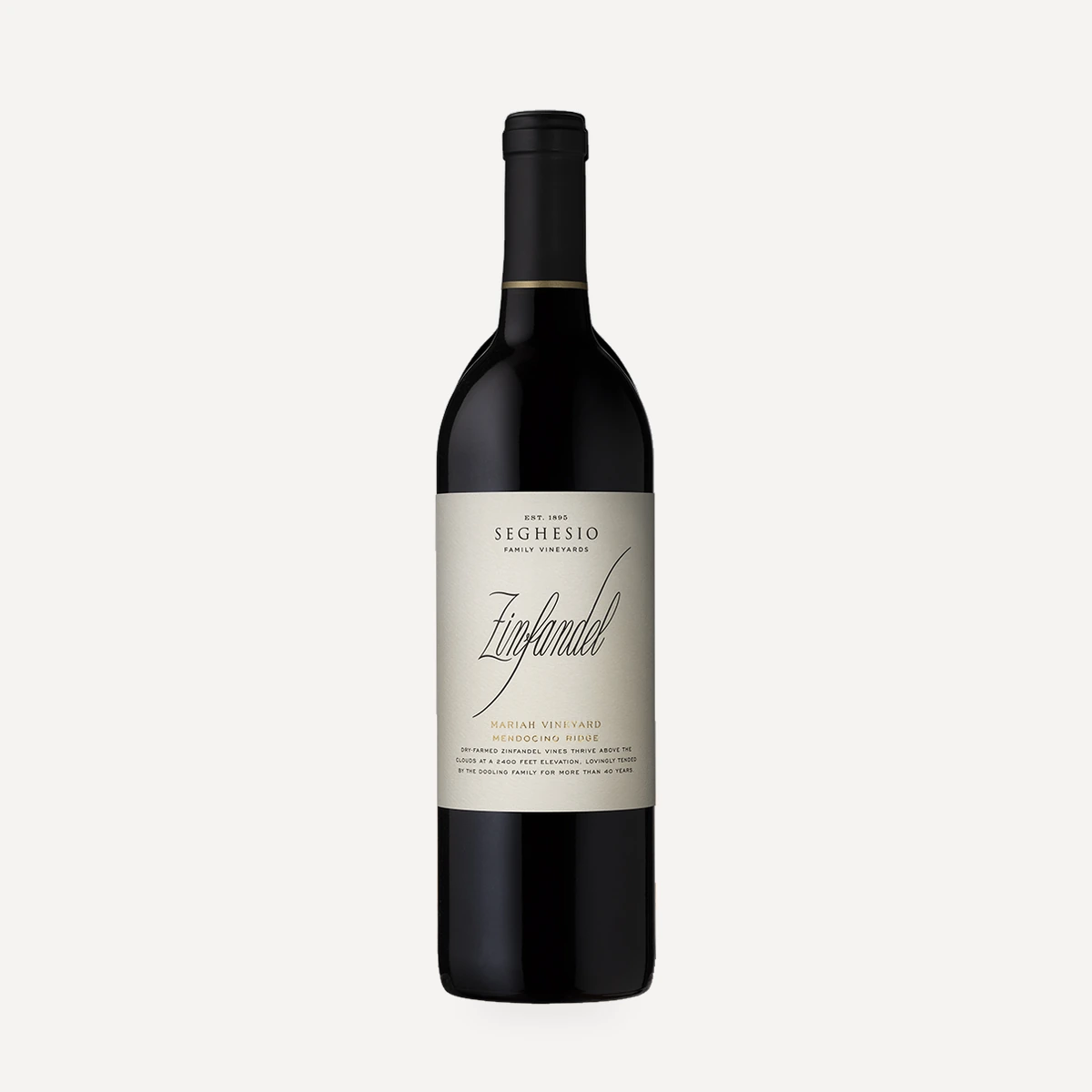
Micro-agglomerated corks treated to remove cork-taint compounds replaced earlier closures after bottle variation had affected an estimated 10% of wines. The tasting room received Italian-bistro-inspired décor and new seating. Wines from the 2019 vintage released during 2021–2022 introduced revised labels: the single-vineyard Zinfandel designs drew on classic Barolo labels from the founders’ native Piedmont, while the Italian Heritage range received a more unified Italian-inspired identity.
Terroir
Seghesio works across more than 121 hectares of estate vineyards in Alexander Valley, Russian River Valley and Dry Creek Valley, with additional longstanding vineyard relationships elsewhere in Sonoma County and on Mendocino Ridge. The sites span warm inland conditions, fog-influenced plains, coastal-air corridors, elevated ridges and steep volcanic hillsides.
Alexander Valley
Home Ranch experiences warm days moderated by cooling afternoon breezes. Its vines grow through only about 20–41 centimetres of topsoil into clay with variable underlying basalt, sandstone and volcanic rock. Rattlesnake Hill is a terraced, rocky slope with thin topsoil, where vine stress contributes to small berries and concentrated fruit.
Russian River Valley
Montafi Ranch occupies the eastern bench of the Santa Rosa plains in the northern Russian River Valley. Its deep-rooted, head-trained vines produce small clusters at low yields. Keyhole Ranch lies in the northern part of the valley, where frequent summer-morning fog and cool coastal breezes moderate the microclimate. Gravel and clay loams support both white varieties and Zinfandel.
Dry Creek Valley and Rockpile
At Chen’s Vineyard, summer mornings are foggy, encouraging even ripening. The principal soil is Cortina, a gravelly loam; several sandy blocks are known as Sand Point. Saini Farms lies on the Dry Creek bench, whose red gravelly clay loam drains readily and stresses the vines. Todd Brothers climbs a remarkably steep hillside above Geyserville, with shallow, bright-red volcanic and rocky soils.
Rockpile rises high above Dry Creek Valley. Zinfandel grows along rugged mountain ridges in shallow, iron-rich red rocky soils, producing low yields and small berries. The AVA contains only approximately 64.7 hectares of planted vineyard.
Sonoma Valley and Mendocino Ridge
Pagani Ranch follows a rolling, east-facing slope in Sonoma Valley. Mariah Vineyard occupies a high, cool-climate position on Mendocino Ridge.
Vinificazione
Sustainability became a formal farming policy in 2003 and now encompasses resource use, ecosystem health, employee treatment and preservation of the land for future generations. More than 121 hectares of estate vineyard are certified sustainable, although the certifying body is not identified.
Old vines are central to the farming strategy. Seghesio defines an old vine as at least 50 years old and preserves founding Zinfandel at Home Ranch, the 1910 Sangiovese at Chianti Station and the 1926 field blend at Montafi. These low-yielding plantings are retained for their concentration and complexity. Much of the old-vine Zinfandel is head-trained and cannot be mechanically managed or harvested; hand labour is therefore fundamental.
Early-season canopy work removes excess shoots and leaves by hand to improve airflow and sunlight penetration. This reduces pest pressure and the need for sprays. Other hand canopy operations include shoot thinning, cluster de-clumping and lifting trellis wires. Canes are tied to support wires after pruning.
Predator habitat supports natural pest control, helping reduce pesticide use. Cover crops limit dust, encourage beneficial microorganisms, supply nutrients and increase biodiversity. At the end of their active season they are crimped into a protective mulch layer. Incorporating leguminous cover crops returns captured nutrients to the soil and prevents the covers from consuming the remaining soil moisture.
Seasonal vineyard workers are recruited from Mexico through the United States H-2A program. Seghesio assists with temporary visas and transport; team members live and work in Sonoma County for nine months before returning home.
The 2024 season illustrates the team’s vineyard response to vintage conditions: approximately 940 mm of winter rain, equal to 117% of the historical average, filled soil profiles and moderated vegetative growth. Warmer days arrived in late May, while cool nights continued through summer. Harvest ran from 27 August to 10 October, with most fruit arriving in September. In early 2026, budbreak appeared at Rattlesnake Hill in late January; after pruning, crews tied canes and crimped cover crops to conserve soil beneath a mulch layer.
Andy Robinson and Ned Neumiller coordinate a terroir-led approach from vineyard to cellar. Long relationships with the same growers and detailed knowledge of individual vineyards allow fruit to be separated and later blended according to site, variety and vintage. Ned’s grower-relations work encompasses more than 30 growers, multiple sites and approximately 1,089 tonnes of fruit.
Zinfandel receives labour-intensive handling. Grapes are harvested and rigorously sorted, then fermented as small individual lots in open-top fermenters. Seghesio cultivates indigenous yeast strains and associates its open vessels, detailed selection and lot-by-lot work with Burgundian cellar practice.
After primary fermentation, young wines complete malolactic conversion and settle during late autumn and winter. They are reassessed in January. The team changes ageing vessels where necessary and racks wines that need aeration after malolactic conversion. Barrels are then evaluated for their ability to represent the region, vineyard, vintage and variety.
Blends are assembled from the strongest components as early as practical, allowing them to integrate for a further nine to twelve months before bottling. Winter 2026 work included completing the bottling of the 2024 reds and beginning the first 2025 bottlings.
A compositional analysis of the largest-production wine, Sonoma County Zinfandel, found 99.97% grapes, 0.02% tartaric acid and 0.01% sulfites. Packaging uses micro-agglomerated corks treated to eliminate cork-taint compounds. The standardized California-made bottle weighs 496 g, is 18% lighter than its predecessor, contains 30% recycled glass and uses entirely California raw materials.
Filosofia
Family is understood both as kinship and as a community built by choice. The guiding values are humility, respect for the local community, hospitality and celebration of Sonoma County’s agricultural bounty.
Zinfandel is treated as a world-class variety deserving the same precision commonly devoted to Cabernet Sauvignon or Pinot Noir. Seghesio regards Sonoma County as Zinfandel’s natural benchmark and seeks to preserve the vineyards that have sustained the family through five generations. Old vines are valued despite their low yields because their fruit can provide concentration, complexity and dependable quality.
Andy Robinson’s stated objective is to make elegant, balanced wines that celebrate the work completed in the vineyard and express an individual site, region and vintage. The broader stylistic goals are balance, purity and character, achieved through close participation in every stage of a wine’s life.
Tradition and experimentation coexist. Historic Zinfandel and Sangiovese plantings remain foundational, while later generations introduced varieties including Arneis, Vermentino and Aglianico and tested new sites such as Keyhole Ranch. Sustainability is treated as continuing work rather than a fixed achievement: present goals should be pursued without compromising the resources required by future generations.
Food and the shared table form another central theme. Italian-heritage wines are conceived as companions to meals, and hospitality is framed around turning guests, colleagues and long-term growers into an extended family.
Vini