History
Family origins: 1933
The Mantengoli family’s winemaking history at La Serena begins in 1933. The family narrative reaches back to Andrea and Marcello Mantengoli’s great-grandfather and continues through their mother, Iva. Andrea’s father worked in the vineyards and established the foundations of an estate centred on Brunello.
The family inheritance is presented as a sequence of generations rather than a finished historical chapter. Andrea Mantengoli describes himself as part of an “in-between generation”: the children of the older custodians and the parents of a younger generation preparing to carry the estate forward.
1993: vineyards for Gemini
The best vineyards surrounding the cellar were planted in 1993. Their fruit became the basis of Gemini, conceived as both a cru selection and a Brunello di Montalcino Riserva.
Early 2000s: a purpose-built cellar
During the early 2000s, La Serena constructed a new cellar designed by Andrea’s twin brother, architect Marcello Mantengoli. The project applied bio-architecture principles: natural materials, forms integrated into the surrounding landscape and colours related to those of Montalcino. Its design provided the additional room needed to store and mature several vintages at once.
The building combined bricks and travertine with a geothermal system devised to maintain a constant temperature throughout the seasons. Its ageing hall, approximately 5 metres high, was arranged with stacked casks, arches, vaults, rhomboid beams, terracotta ceiling elements and carefully planned lighting. A tower was created with a tasting room on its upper floor.
2010: organic certification
In 2010, La Serena obtained organic certification. This formalised agricultural practices described as having been followed and transmitted within the family for generations. Organic farming was placed within a broader programme of agronomic and oenological research, daily observation and greater awareness of the land’s potential.
2020–2021: three generations, diversification and environmental pressures
Three generations participated in the 2020 harvest, with Andrea directing work among the rows. Despite intense heat during August and early September, followed by September rain, cool nights and sunny days, the estate harvested Sangiovese with good acidity, high but controlled potential alcohol and promising phenolic maturity.
The family was simultaneously working towards a diversified, non-monocultural farm. Chickpeas and spelt were among the crops sown, while vineyards and olive groves were maintained together to encourage agricultural diversity and interaction between crops.
The 2021 growing season brought drought until mid-summer, relief from August rain and a broad difference between daytime and night-time temperatures during final ripening. April frost caused little damage at La Serena. Fences had been installed to protect the vineyards from increasingly troublesome wild ungulates, while climate change was identified as a growing viticultural threat.
The family fresco
The history of the estate was translated into a large true-fresco painting in the cellar. Marcello Mantengoli and Andrea conceived the work for a room used for tastings and family storytelling. Artist Carlotta Parisi reconstructed the Mantengoli narrative through conversations with the family, including Iva, and collaborated with illustrator Marta Farina.
Its horizontal composition begins with the great-grandparents and the land, follows Andrea and Marcello as twins whose paths diverged and later met again at La Serena, and extends towards the next generation. Marcello brings architectural knowledge back to the family enterprise, while Andrea brings his attachment to the land. The imagery moves from a seed and the vineyard rows to a butterfly carrying the strength of those foundations into the future.
2022: FIVI membership
On 5 December 2022, La Serena joined FIVI, the Federazione Italiana Vignaioli Indipendenti. Membership reflected its identity as an independent grower responsible for the entire chain from cultivating and harvesting its own grapes to vinification and bottling. The decision followed a lengthy evaluation and aligned the estate with a model based on defending and sustainably managing its land.
The current generation
Under Andrea Mantengoli, the family has continued investing rather than treating its inherited patrimony as static. The estate acquired additional land, sought to revive a complete mixed farm, constructed and equipped the new cellar, and adopted technology intended to assist work without abandoning its origins. The next generation is increasingly involved and is presented as preparing to carry the family enterprise into the future.
Terroir
La Serena lies at Loc. La Serena in Montalcino, Tuscany. Its vineyards surround the cellar and occupy well-exposed positions on the Montalcino hills.
The vineyards used across the estate’s wines range from approximately 300 to 400 metres above sea level. Soils are mixed and include clay, sand and galestro; the vineyards associated with Gemini also contain tuff.
The 2021 season illustrates the climatic factors affecting the property. Drought caused concern until mid-summer, August rain brought relief, and pronounced differences between warm daytime and cooler night-time temperatures aided final ripening. An April frost caused only limited damage to the estate’s vines. Climate change and increasingly intrusive wild ungulates are identified as continuing pressures on viticulture.
From the tower, the surrounding landscape encompasses Monte Amiata, Montalcino and Pienza; the lights of Siena can be visible on especially clear summer nights.
Winemaking
La Serena has been certified organic since 2010, although the underlying practices are described as a multigenerational family inheritance. Organic agriculture is treated as a combination of research, knowledge and continuous practical work rather than a certification alone.
Andrea Mantengoli’s “industrious not-doing” begins with soil management and close observation of the vines. The objective is to intervene only when support is necessary, including in cultivation, water-resource management and canopy vegetation. This restraint is not passive: it depends on knowing the vineyard, monitoring its condition and identifying the appropriate moment to act.
Interference with spontaneous flora and fauna is kept to a minimum. The estate promotes vineyard cover through seed reproduced on the farm and delays mowing as long as possible after flowering so that its bees can continue pollinating. The long-term aim is to restore a complete agricultural organism in which flora and fauna coexist and different crops work in synergy.
Biodiversity also extends beyond the vineyard. The farm maintains olive groves alongside vines and has cultivated chickpeas and spelt as part of its effort to avoid monoculture. Its olive grove covers 2 hectares and contains 630 trees aged 10–50 years, representing Frantoio, Leccino, Moraiolo and Pendolino.
Harvesting is manual. Grapes are first selected in the vineyard and, where described, pass through sorting tables and a further selection area on the ramps leading to the destemmer. Fences protect the vines from wild ungulates, whose increasing presence is considered a serious threat.
The cellar was purpose-built in the early 2000s for the requirements of long-lived Montalcino wines. It provides sufficient ageing and storage space to hold multiple vintages simultaneously. Bricks, travertine and natural materials connect the structure to its landscape, while a geothermal installation maintains a stable temperature through the seasons.
Manually harvested grapes are selected in the vineyard. The reception sequence includes sorting tables and additional inspection on the inclined approach to the destemmer. After destemming, alcoholic fermentation takes place in temperature-controlled steel or in dedicated wooden vats, followed by malolactic fermentation.
Ageing uses large wood rather than a single standard vessel. The cellar employs casks of approximately 20–40 hectolitres, while selected lots may ferment, complete malolactic conversion and mature in the same dedicated truncated-conical vat of approximately 70 hectolitres. Time in wood is adjusted to the grapes and vintage rather than imposed as a fixed formula; the documented maturation regimes extend from about 12 months to 30 months, and at least 36 months for the longest-aged selection. Bottle ageing follows where necessary before release.
The principal ageing hall is approximately 5 metres high. Its casks are stacked within an architectural arrangement of arches, vaults, rhomboid beams, terracotta elements and controlled lighting. The overall production philosophy is to use technology as practical support while accompanying the wine’s transformation without forcing it toward transient stylistic trends.
Philosophy
La Serena calls its approach “industrious not-doing.” Andrea Mantengoli defines this not as neglect, but as informed restraint: learning the needs of the soil and vines, maintaining constant vigilance and acting only when intervention is genuinely required.
Soil is treated as the foundation of viticulture and the unseen origin of everything expressed above ground in the stem, foliage and fruit. Wine quality is therefore understood primarily as an agronomic achievement founded on care, respect, experimentation and the search for equilibrium in the vineyard before equilibrium in the finished wine.
The intended relationship between winegrower and territory is cooperative rather than hierarchical. Vinification should accompany transformation instead of forcing it or following temporary stylistic fashions. Technology is accepted when it assists the work without erasing the estate’s origins.
Environmental responsibility extends to soil cultivation, water use, vegetation, spontaneous plants, bees and other fauna. The family’s ambition is to rebuild a complete and diversified farm rather than a monoculture, allowing vineyards, olive trees, other crops, flora and fauna to function together.
Family continuity is equally central. Andrea presents his generation as the custodian between the inheritance received from its parents and the responsibilities of the next generation. Investment, additional land and modern communication are framed as ways of keeping that inheritance active rather than freezing it in the past.
Wines
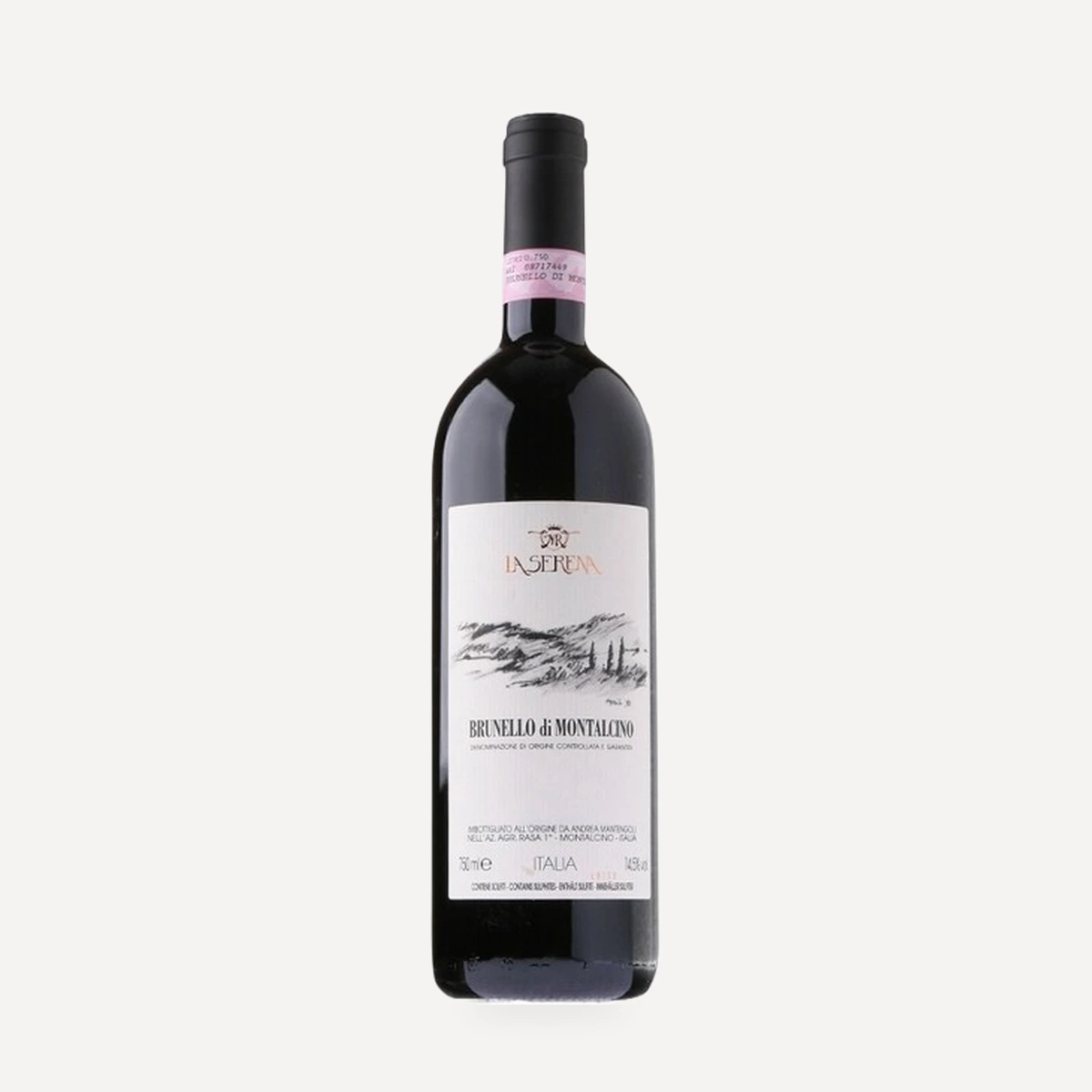
Brunello di Montalcino