History
Medieval origins
The earliest evidence for Fattoria Terrabianca as a rural property dates to the Middle Ages. It belonged to the Bishopric of Siena while its administration was associated with the Florentine contado. This historical position between Sienese ownership and Florentine control preceded the estate’s modern viticultural identity.
The first vineyards
The first vineyards were planted in the early 1950s. The surviving older plantings include Vigna Terrabianca, established with a single Sangiovese clone and described at approximately 40 years of age in the current vineyard presentation.
The Guldener period
Terrabianca’s contemporary history began in 1988, when the Swiss Guldener family acquired the estate. Under their ownership, the winery and its wines developed a strong, recognisable international profile.
Acquisition by the Burkard family
In 2019, Terrabianca became part of the project created by the Italian-Swiss Burkard family. Adriana and Urs Burkard acquired Terrabianca together with Il Tesoro. Their objective was to develop a contemporary, environmentally sustainable enterprise rooted in Tuscan wine culture. Adriana provided the project’s creative and philanthropic impetus, while Urs contributed entrepreneurial expertise.
The new owners reinterpreted their family coat of arms as the Arillo in Terrabianca emblem. Its castle represents family solidity; two stars evoke continuity through their sons Gregor and Ricardo; and three hills refer to the three estates in the wider family project. The oval surrounding the design recalls a grape berry, derived from the Latin arillus.
Organic conversion and vineyard renewal
Organic conversion at Terrabianca began in 2020 under a model based on inputs of natural origin, reduced intervention and the recovery of soil vitality and biodiversity. In 2023, the company recorded its first certified-organic vintage. Terrabianca also established new vineyard plantings in 2023, using selections from its own vine material on 110R rootstock.
A new architectural phase
By April 2023, Mario Botta’s design for a new flagship winery at the Radda in Chianti headquarters had entered the construction phase. Adriana Burkard was identified as the driving force behind the project, conceived as an integration of wine, architecture, nature and art.
Renovation and construction were continuing in March 2024 under Botta’s supervision. The plans combine a new author-designed winery with outdoor contemporary sculpture and a fine-dining restaurant associated with chef Heinz Beck.
Terroir
Terrabianca lies in the heart of Chianti Classico, between the provinces of Siena and Florence, at San Fedele a Paterno in the commune of Radda in Chianti. The estate occupies a natural, south-facing basin at the foot of the northern hill of Vagliagli.
The vineyards rise from approximately 350 to 470 metres above sea level. This elevation, together with the basin’s light and warmth, produces pronounced temperature variation. Extensive woodland surrounds the vines and materially shapes the microclimate while supporting biodiversity.
The soils are cool and combine galestro, clay and stone, with abundant limestone rock on the sloping, middle-to-upper elevations. Soil composition changes down the slope. In the upper vineyard, compact stone and a lower crop level favour greater aromatic and flavour concentration. The lower ground contains more clay, gives a larger crop and sustains a longer vegetative cycle, contributing greater structure.
The estate name refers to the characteristic patches of whitish soil found here.
Winemaking
Terrabianca’s 12.5 ha of vineyards are planted primarily to Sangiovese. Organic conversion began in 2020, and 2023 became the company’s first certified-organic vintage. Bioagricert certification is presented alongside the wider sustainability credentials.
The farming model rests on two principles: using elements of natural origin and minimising human intervention in the soil to restore biodiversity and biological vitality. Existing vineyards are preserved where possible, and vineyard material is managed in relation to the characteristics of each terroir. Green manure, composting and low-intervention cultivation are used to support soil life. Ground cover, including under-vine cover, improves the retention of water and minerals, encourages microbiological activity and biodiversity, and helps reduce vine water demand.
Small weather stations positioned among the rows transmit real-time measurements of air temperature, soil temperature, humidity and leaf wetness. These data guide rapid, targeted interventions and help reduce unnecessary inputs. Water and soil management aim to prevent erosion, accumulate autumn and spring rainfall and extend its availability into summer. Rainwater-collection basins and precise, environmentally considerate drip irrigation form part of the wider water strategy.
Canopy management is used to limit water stress and sunburn. More adaptive vine varieties and rootstocks are selected in response to climatic pressure, with the objective of retaining balance, freshness and finesse. Native plants and ecological corridors are maintained or restored to support pollinators and other beneficial organisms. Bees have been introduced to strengthen pollination and the vitality of both cultivated and wild flora.
Harvesting is predominantly by hand to reduce stress on the vines and protect bunch integrity. Agricultural machinery is kept to a minimum to lower CO₂ emissions and avoid unnecessary soil compaction or disturbance. Picking decisions target phenolic maturity while preserving acidity and aromatic integrity.
During the rainy spring of 2023, careful phytosanitary management limited disease-related damage. A mild summer without extreme heat allowed an orderly ripening season and precise harvest timing. Varieties were picked in their traditional sequence, with the fruit showing balance between technological and phenolic maturity.
Terrabianca is the Radda in Chianti headquarters of the wider family enterprise. Cellar work follows a low-intervention approach intended to retain the identity of the vineyards while reducing environmental impact. Water-saving procedures extend into production: cellar operations incorporate treatment and recycling systems, while infrastructure renewal emphasises energy efficiency, renewable power, solar panels, environmentally compatible construction materials and low-emission technology.
A new flagship winery designed by Mario Botta entered the construction phase by 2023. Works were continuing in March 2024 under Botta’s supervision. The project is conceived as an art-and-wine complex, combining functional winemaking architecture with contemporary outdoor sculpture and a planned fine-dining restaurant associated with Heinz Beck.
Philosophy
Terrabianca’s guiding principle is respect for the equilibrium of the terroir. The estate seeks structured, elegant wines capable of expressing their place of origin, while treating differences among sites and vintages as material to be interpreted rather than standardised.
Within the Tuscan Theorem, Terrabianca represents the Chianti Classico vertex. The concept connects three disciplines. Geometry of Places concerns the integration of land, environmental wellbeing, human wellbeing, landscape and cultural sites. Music of Nature treats terroir as a score to be observed, analysed and interpreted through sensitive, intelligent viticulture so that a wine can capture both place and vintage. Architecture of Wine applies ethical, aesthetic, technological and functional innovation in service of wine.
Sustainability is conceived as a daily responsibility extending from soil to bottle and encompassing environmental, social and economic concerns. The stated priorities are soil vitality, biodiversity, minimal intervention, efficient resource use, employee inclusion, equal opportunity, training and transparent communication. The long-term objective is regenerative rather than merely conservative: reducing measurable impact while improving the natural assets entrusted to the estate.
Wines
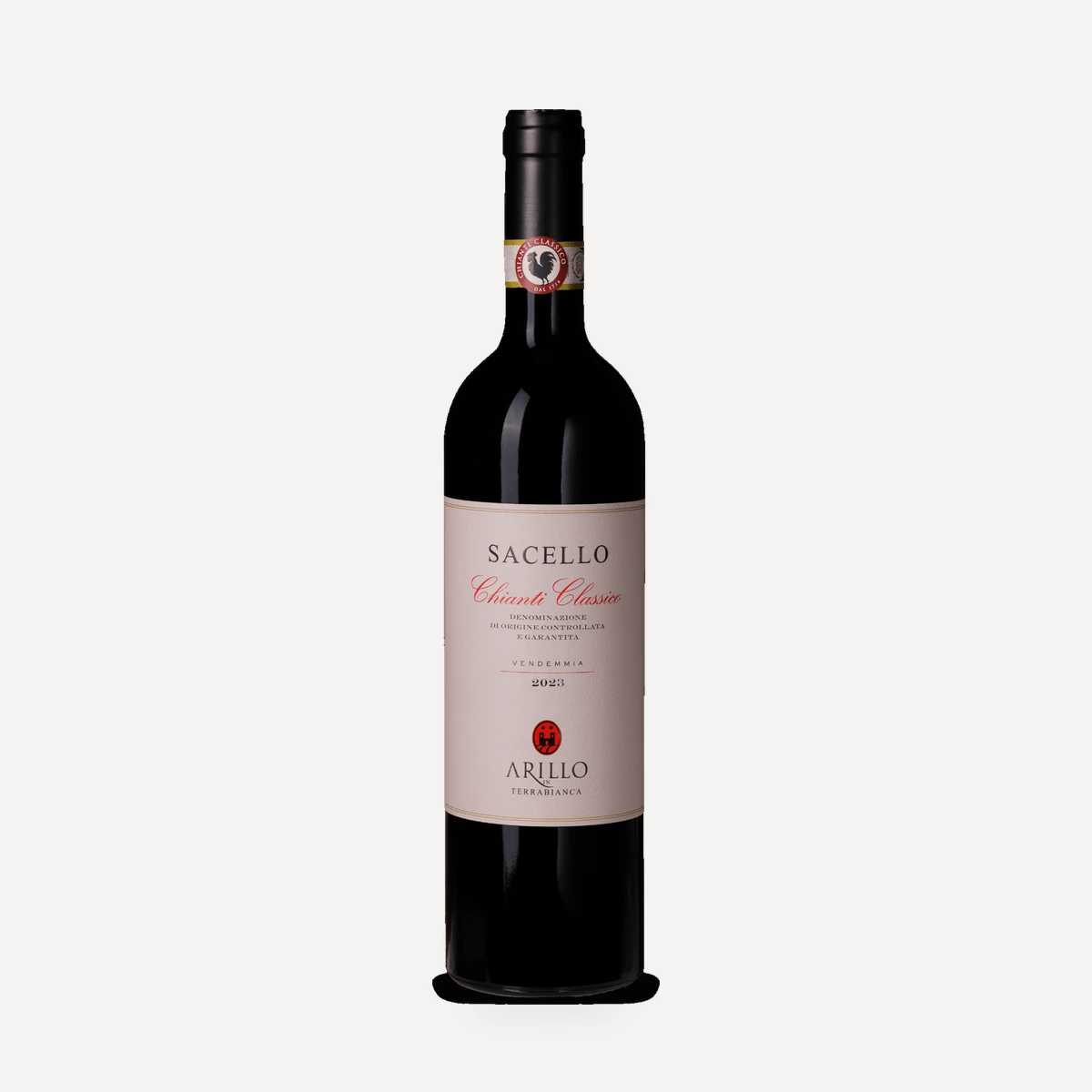
Sacello Chianti Classico Annata DOCG