Storia
Origins and the historic cellars
Rocche Costamagna’s roots lie in La Morra and in the family’s holdings at Rocche dell’Annunziata. Francesco Antonio Costamagna is identified as the founder, while the first surviving evidence of the business concerns his son Luigi.
The historic property in the centre of La Morra has late-18th-century origins. Its surviving early-19th-century cellar layout is associated with the years immediately following the Congress of Vienna, when former Napoleonic officers brought expertise in military and fortified construction to the Langhe. The thick brick and local-stone walls and underground rooms created stable temperature and humidity for ageing wine.
1841: the royal licence
On 15 May 1841, the Police Office of the Royal Military Command for the city and province of Alba granted Luigi Costamagna permission to retail wine made from grapes grown in his own vineyards in La Morra. The document regulated the quantity and geographical origin of the wine and is the first written evidence of the estate’s winemaking and commercial activity.
By that date, the family’s properties extended through the municipality of La Morra and already included vineyards at Rocche dell’Annunziata as well as the historic cellars in the old town. The estate therefore presents 1841 as the beginning of its documented history, although the family had already established its vineyard and cellar holdings.
1911 and the succession to Riccardo
In 1911, Francesco Costamagna received a Gold Medal at the Gran Premio dell’Esposizione Internazionale di Torino. The distinction recognized fifty years of uninterrupted production. After Francesco’s death, his son Riccardo Costamagna—a lawyer practising in Turin and Alba—continued to manage the family business with his wife, Maddalena.
The late 1930s: Maddalena preserves the vineyards
Riccardo died toward the end of the 1930s. Maddalena recognized the long-term value of the family’s vineyards in La Morra, particularly Rocche dell’Annunziata, and transferred this inheritance to her children and grandchildren. Successive generations continued cultivating and vinifying the same land.
The late 1960s: Claudia Ferraresi and Giorgio Locatelli
At the end of the 1960s, Maddalena’s granddaughter Claudia Ferraresi assumed responsibility for the estate. A painter, journalist, art critic and event organizer, she worked with her husband Giorgio Locatelli to refocus the business on Barolo and high-quality wine production.
This renewal took place under difficult economic conditions and involved both experimentation and investment. Vineyards were replanted and reorganized through a more rational approach. The historic La Morra cellars were restored and equipped with contemporary winemaking technology.
Cultural initiatives and hospitality
The cellars began welcoming visitors for tastings and guided tours in the mid-1970s. In 1975, Claudia Ferraresi founded Ca dj’Amis, a cultural association devoted to Piedmontese local art, microhistory, minorities and food-and-wine culture. The ground-floor rooms of the former stables developed into an enoteca, tasting room and museum displaying her paintings, historical images of the Langhe and Rocche Costamagna, old decorated bottles, unusual documents and collectible objects.
In the mid-1980s, Claudia initiated Le tavole della cultura, a programme of conferences, books and essays exploring food and wine. I Ristoranti della Tavolozza followed in 1990, bringing together selected hospitality professionals committed to food education.
Beginning in 1996, Libri da Gustare became the name of an event series using books to explore and promote food culture, local territory and its protagonists. Claudia’s collection eventually exceeded 3,500 works on wine, gastronomy and the region. In 2005, it became the publicly accessible Libri da Gustare library, incorporated into the regional library system.
The 1980s onward: Alessandro Locatelli
Alessandro Locatelli entered the business during the 1980s and is its present owner. His arrival coincided with Barolo’s increasing international recognition. The following period concentrated on improving vineyard management and winemaking through trials and innovations in both vineyard and cellar. The purpose was to develop repeatable techniques capable of articulating La Morra’s terroirs and the particular identity of Rocche dell’Annunziata without abandoning the estate’s classical orientation.
Most vines were replanted during the 1990s after analysis of each site’s terroir and soil. Plant material and rootstocks were selected according to the conditions of individual soils, with an emphasis on consistent quality and long-lived vines.
2005–2008: library, Art Suites and Neirane
The Libri da Gustare library opened in 2005. Restoration of the old family farmhouse and barn created four Art Suites above the historic cellars; the accommodation opened in 2006 and was furnished with antiques and paintings by Claudia Ferraresi.
In 2008, the estate purchased a 3 ha vineyard in the Neirane MGA of Verduno. Planted mainly to Barbera, it added a geologically distinct marly-sandy, gypsum-rich site to the family’s La Morra vineyards.
Continuing estate
Rocche Costamagna remains centred on the historic La Morra cellars and the family’s 3.2 ha Nebbiolo parcel at Rocche dell’Annunziata, cultivated by the family since the 19th century. Its contemporary work combines classical Barolo production, site-specific vineyard management, sustainable cultivation, cultural activity, visits, tastings and hospitality.
Terroir
La Morra and Verduno
The vineyards lie between La Morra and Verduno in the Langhe, within the production territory of Barolo DOCG. The estate’s historical centre is La Morra, while its two individually described sites are Rocche dell’Annunziata MGA in La Morra and Neirane MGA in Verduno.
Rocche dell’Annunziata
Rocche dell’Annunziata takes its name from the nearby Abbey of Annunziata. Benedictine monks cultivated the cru from the 12th century, and it appears in a La Morra land register compiled in 1477. The Costamagna family has owned and cultivated land there since the 19th century.
The estate’s parcel is a long, narrow strip of 3.2 ha below Cascina Costamagna, planted to Nebbiolo. It descends from 350 to 310 m and has predominantly southeast exposure. The orientation makes it cooler than the west-facing slopes elsewhere in Rocche dell’Annunziata and encourages slower, later ripening.
Its soil is composed of stratified marl and blue-grey clay belonging to the Marne di Sant’Agata Fossili formation, dated to approximately 7–11 million years ago. These soils retain water effectively and reduce moisture stress during dry periods. The resulting wines are associated with an elegant, soft and layered profile, floral and balsamic aromas and a characteristic eucalyptus note.
Neirane
The 3 ha Neirane vineyard in Verduno has marly-sandy soils rich in gypsum. They developed from the Vena Gessoso-Solfifera formation of the Messinian age, approximately 5.5–6.2 million years old. The geological base comprises carbonate rocks—limestone and marble—and evaporitic, iron-rich rocks. Karst features include sinkholes, subterranean caverns and watercourses.
This soil environment is particularly suited to Barbera and is associated with structural depth, fragrant and spicy expression, and a balance between acidity, freshness, alcoholic strength and power.
Recorded conditions in 2015 and 2017
The 2015 season began with abundant winter snow, which replenished soil-water reserves. Early-summer conditions advanced ripening by roughly ten days compared with the preceding year, while remaining consistent with a climatically classical season. The high position of Rocche dell’Annunziata and the clay-rich deeper strata supported gradual, complete Nebbiolo maturation.
The winter preceding the 2017 harvest was mild and relatively dry, followed by a warm, rainy spring that advanced vegetative development. A sharp temperature fall at the end of April caused frost damage across Italy, but the estate’s elevated, well-ventilated vineyards—especially Rocche dell’Annunziata—were unaffected. Above-average heat and little rain from May through summer made 2017 a warm season. The cooler summit position and clay-rich strata maintained water reserves and vine balance. Rain at the end of August and beginning of September restored moisture; subsequent cooler temperatures and pronounced day-night variation supported gradual, complete ripening. Nebbiolo and Barbera retained a balance of freshness, alcohol and structure under these conditions.
Vinificazione
Rocche Costamagna’s viticulture is based on close knowledge of each parcel, row, soil and microclimate. Operations and plant material are adapted to the actual needs and natural balance of each site, with the objective of achieving full ripeness without forcing the vine’s natural rhythm.
This sustainable approach has been followed for more than twenty years. Treatments are limited through continuous observation and timely work throughout the growing season. The vineyards are managed to reduce disease risk and the need for mechanical intervention. Leaf thinning is performed carefully, and crop levels are directed toward a small number of fully mature, high-quality bunches. Harvest timing is determined by full grape maturity rather than haste.
Most vines were replanted during the 1990s after analysis of the terroir and pedological properties of each soil. Vineyard preparation, vine material and rootstocks were selected site by site to support consistent quality and long-term vitality.
Grass is maintained between the rows. Machinery capable of disrupting soil structure, depleting the soil or increasing surface erosion is avoided. Inter-row weeding has been eliminated, while copper, sulphur and other natural inducers of plant resistance are used. Anti-hail nets have also formed part of a project to reduce damage from abiotic weather events, particularly hail.
Cellar and production spaces
The historic cellar stands in the centre of La Morra. Thick walls of brick and Langhe stone surround the underground ageing rooms, where naturally suitable temperature and humidity support maturation in barrel and bottle. The former ground-floor stables now contain the enoteca, museum, tasting room and Libri da Gustare library; the former barn houses the Art Suites.
Site- and variety-specific work
Each grape variety and cru is handled according to its individual character. Cellar operations are intended to preserve the results of vineyard work, articulate varietal identity and translate the differences among La Morra’s terroirs. The desired style favours smoothness, complexity, depth and aromatic detail over sheer body, alcohol or force.
Classical Barolo method
Barolo follows a classical method. A short cold maceration first promotes Nebbiolo’s fruit aromas. Temperature-controlled fermentation follows, with manual délestage, or rack-and-return, and a concluding period under a submerged cap. The slow and gentle sequence produces progressive polyphenolic extraction while allowing yeast to transform the sugars naturally into alcohol.
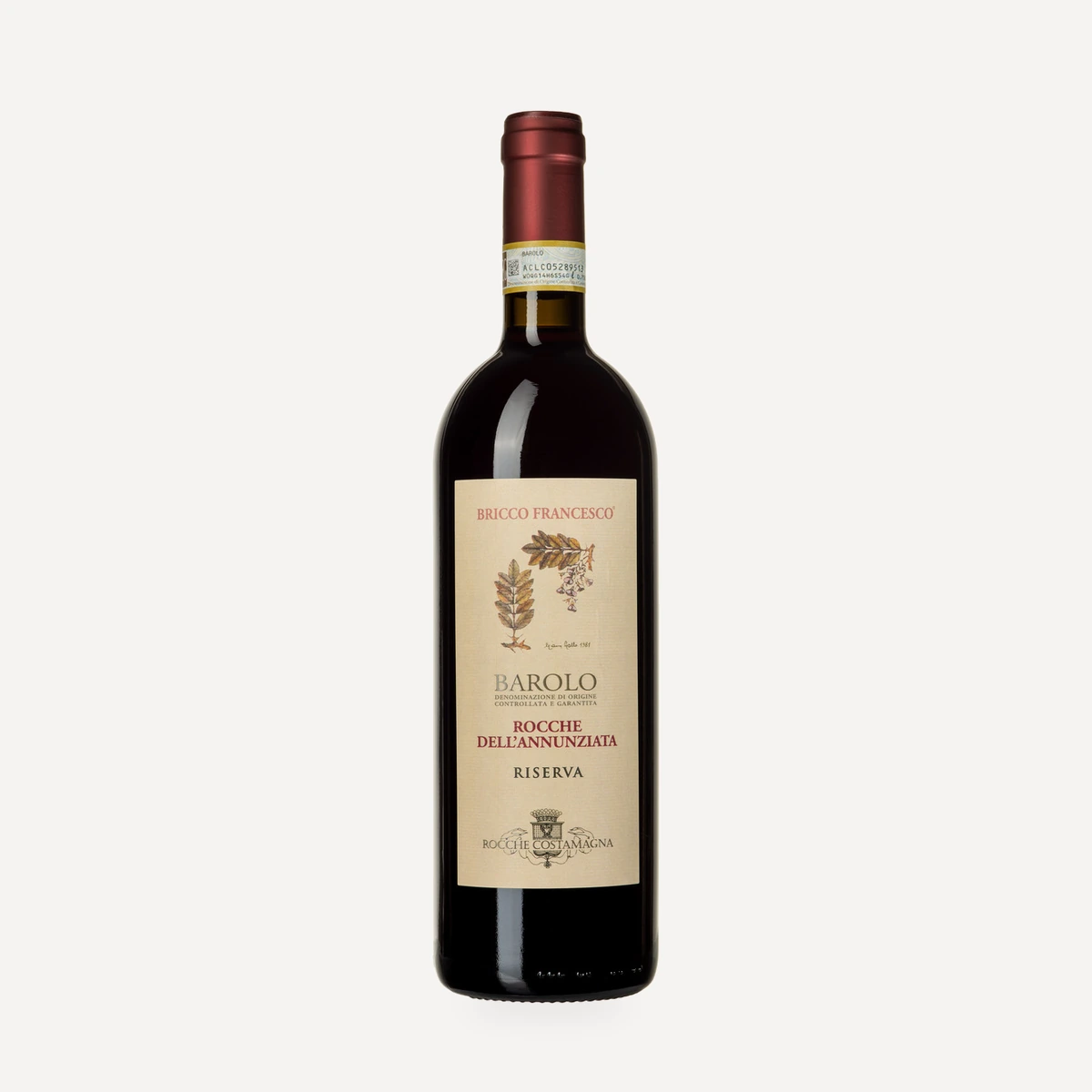
Estate specifications for the Barolo wines identify macerations of approximately three weeks at 27°C. Barolo DOCG del Comune di La Morra and Rocche dell’Annunziata mature for 18 months in oak, while the Riserva receives 24 months in oak within a total ageing period of five years.
Wood ageing
The cellar uses 2,500–3,200 l Slavonian oak casks and smaller French barriques. Barolo matures exclusively in large casks: 18 months for Rocche dell’Annunziata and up to two years for the Riserva. French barriques are used for Barbera d’Alba Superiore; the Neirane selection receives approximately ten months in barrique. Wood is treated as a tool for slow evolution and complexity rather than as an added flavour.
Other cellar techniques
Red-wine maceration varies by variety, from approximately five or six days for Dolcetto and six or seven days for Barbera to ten days for Langhe Nebbiolo and Barbera Superiore. Dolcetto matures in stainless steel followed by bottle ageing, while Langhe Nebbiolo and Barbera d’Alba are partly aged in oak.
Arneis is softly pressed, statically settled and fermented at 16°C for about three weeks before resting on fine lees in stainless steel for at least three months and ageing further in bottle. Langhe Rosato receives a few hours of skin contact, soft pressing and temperature-controlled fermentation in stainless steel at 16°C for about three weeks; it remains on fine lees for at least three months before bottle ageing.
The 1841 Metodo Classico Rosé is made from Nebbiolo harvested at the beginning of September and vinified as a white wine without skin contact. Yeast is added at tirage before bottling for secondary fermentation. It matures on its lees for at least 48 months before disgorgement and rests for another six months before release.
Barolo Chinato begins with Barolo aged for three years. Cinchona bark and a blend of herbs and spices steep in the wine for 90 days, followed by another 90 days of bottle rest. Grappa di Barolo is distilled from Rocche dell’Annunziata Nebbiolo pomace in traditional copper steam cauldrons and aged in Slavonian oak.
Filosofia
Rocche Costamagna defines its work through continuity, dedication and an awareness of the value of La Morra and Rocche dell’Annunziata. Tradition is understood as accumulated technique and experience: effective, sometimes innovative practices become established habits over time, rather than technology being pursued for its own sake.
The estate aims to produce classical Barolo capable of ageing while still giving a distinct account of each vintage. Alessandro Locatelli’s approach accepts that every wine changes from year to year and that the producer’s role is to adapt to nature, preserve its fruit and respect vintage variation.
In the cellar, this translates into different handling for each variety and cru, progressive rather than forceful extraction and restrained use of wood. The intended La Morra expression is elegant, smooth and complex, with depth conveyed through aroma and flavour rather than alcohol, mass or muscularity.
In the vineyard, the same philosophy requires patience, observation and timely intervention. Native varieties—especially Nebbiolo—are valued for their ability to reveal differences among soils and microclimates, even across very short distances. Long-term goals include maintaining vine health, limiting treatments, conserving soil structure and protecting the viticultural heritage embedded in the physical and cultural landscape of the Langhe.
Family continuity is joined to a broader cultural commitment. Art, books, gastronomy, regional history, hospitality and wine education form part of the estate’s identity alongside cultivation and winemaking.
Vini