Storia
From Montagliari to Vignamaggio
In 1250, the noble Tuscan Gherardini family built a castle at Montagliari on a hill overlooking the Greve River valley. The church of Santa Maria della Neve was constructed beside it.
In 1300, after the Black Guelphs expelled the Gherardini from Florence, the family settled permanently at Montagliari. Other exiled White Guelph families gathered in the Greve valley to resist Black Guelph political control, attacking the transport of food and merchandise into Florence.
Florence responded in 1302 by destroying the Gherardini castle. The family was forced across the valley to Vignamaggio. During the following century, the old settlement gradually developed into a small gentleman’s residence with adjoining farms. Around 1400 it was occupied by Cione Gherardini, called Il Pelliccia—“The Fur Coat,” possibly a reference to his enthusiasm for hunting—and his family. Gherardino Gherardini is identified with the construction of the great house at Vignamaggio during the fourteenth century.
The first wine record and the Gherardi era
The earliest surviving evidence of wine production dates to 1404. In an autograph letter, Amidio Gherardini, a son of Cione and co-owner with his brother Accerito, discussed how their empty barrels should be used and determined how much wine should be sent to the letter’s recipient, Francesco Datini. This document marks the beginning of more than six centuries of recorded winemaking at Vignamaggio.
Debt forced the Gherardini to surrender the estate in 1421 to the Gherardi, wealthy Florentine silk merchants and Medici allies. The surrounding Termine and Casolese farms operated under sharecropping and were worked and developed by two tenant families.
During the sixteenth century the villa continued to evolve. The Vignamaggio farm appeared on the map of the people of San Niccolò in Montagliari in Popoli e Strade dei capitani di Parte Guelfa.
Andrea Gherardi held the farm for an extended period during the seventeenth century, acquiring additional farms and increasing their production. Vineyards, orchards, olive groves and chestnut woods surrounded a residence equipped with a private chapel, oil mill, ovens, an internal courtyard and well, stables, a cheese room and poultry houses.
By the eighteenth century Vignamaggio comprised 17 smaller farms. The estate produced and sold wine, olive oil, wheat and barley, with smaller quantities of mulberry leaves, silkworm cocoons, pigeons, fruit and timber. Individual holdings had particular specialities: Podere a Luco produced hazelnuts, while Podere Termine supplied almonds and figs.
Agricultural crisis and modern ownership
A severe agricultural crisis affected the region at the beginning of the nineteenth century. In 1831 the Gherardi sold the villa, which passed through several owners during the remainder of the century.
In the twentieth century vineyards and olive groves increasingly displaced small grain plots and fruit orchards across the Chianti landscape. From 1926, the Sanminiatelli Counts developed Vignamaggio as an artistic and cultural centre, hosting prominent guests and remembered social gatherings.
The Nunziante family purchased the estate in 1987. They restored its buildings and gardens, renewed the cellars and opened Vignamaggio to visitors.
Organic conversion and the contemporary estate
Conversion to organic agriculture began in 2014 as part of an approach intended to protect the soil, plants and people. The 2018 harvest was presented as Vignamaggio’s first organically certified harvest.
The estate subsequently undertook a large expansion and restoration project led by architect Patrice Taravella. It encompassed enlarged gardens, renovated buildings and greater agricultural diversity, transforming Vignamaggio into a sustainable, polycultural estate. Vineyards, olive groves, vegetable gardens, orchards and semi-free-range Cinta Senese pigs now form a farm of more than 400 hectares. The historical villa remains under renovation, while the wider farm, hospitality properties and visitor facilities continue to operate.
Terroir
Vignamaggio lies in the geographical and oenological centre of Chianti Classico, 33 km from Florence and 35 km from Siena. The villa and surrounding farmhouses stand at Petriolo, less than 4 km from Greve in Chianti and 8 km from Panzano. The estate extends for more than 400 hectares across the hills between the Greve and Panzano areas, within a landscape of streams, woods, old hamlets, vineyards, olive groves and gardens.
The vineyard mosaic comprises 61 plots in nine areas, ranging from 260 to 450 metres above sea level. Its principal geological formations are Macigno sandstone, the Argille Scagliose chaotic complex and argilloschist or galestro. Exposures vary from east through west and south-west, creating contrasting combinations of sunlight, soil depth, fertility, sand and clay.
Prenzano and Petriolo occupy the higher Lamole-facing portion of the historical nucleus. Prenzano is sandy and based on Macigno sandstone; Petriolo lies on a slightly concave plateau where Lamole-type soils meet the more clay-rich valley material. Solatìo, Orto, Poggio Asciutto and Poggiarelli are associated with the Argille Scagliose complex but differ substantially in fertility and exposure. Solatìo is rocky, relatively infertile, clay-rich and intensely luminous, while east-facing Orto has richer soils and less sunlight. Poggio Asciutto is similarly clay-influenced and relatively shaded. Poggiarelli is a fully exposed plateau marked by early ripening.
The Panzano vineyards provide further contrasts. Vitigliano and Il Prato have sandy-clay soils derived from the Argille Scagliose formation. Querceto, within the area called La Conca d’Ora, is predominantly galestro, open to abundant sunlight and not enclosed by nearby hills or woods.
Vintage accounts illustrate the climatic variability. The 2017 season brought one of southern Europe’s most severe droughts in decades. In 2019, strong September day–night temperature changes supported gradual, even ripening, while a heavy rain on 19 September drained rapidly through the grassed ground. The 2021/2022 winter received about 35% less rain than the annual average, followed by an exceptionally warm spring and a drought of more than three months; late-August rain relieved water stress, but heat advanced harvest by roughly ten days. In 2024, a hot summer accelerated growth, while late-summer rain and cooler September weather allowed sugar and acidity to reach a balanced maturity.
Vinificazione
Vignamaggio began conversion to organic farming in 2014 and completed its first organically certified harvest in 2018. The approach excludes synthetic herbicides and pesticides, limits external production inputs and is intended to protect soil, plants and people. Sangiovese accounted for 80% of the planted vineyard surface in 2018.
All grapes are harvested by hand. Maturity is followed through bunch sampling and analysis of sugars, acidity and phenolic development. Harvest timing takes account of ripeness, fruit health and the weather forecast. In 2022 the fruit travelled to the cellar in 200 kg crates and underwent three stages of selection: an initial choice in the vineyard, manual sorting on a cellar belt and automatic optical selection of individual berries.
The estate is preserving its own plant material. Small-batch fermentation trials test the oenological suitability of presumed clones rescued from old vineyards before those sites were uprooted. This work had already resulted in new vineyards planted with selected “Vignamaggio” Sangiovese by 2022. Cabernet Franc was similarly recovered after its accidental rediscovery among old estate vines around 1990 and has since been maintained and vinified separately. Canaiolo Nero and Mammolo are also being recovered as local varieties.
A terraced vineyard in Solatìo revives an older hillside arrangement. Grassy banks support the terraces rather than stone walls; each terrace holds three vine rows, while a ditch along the ridge carries away excess water. Field beans cover the banks. This layout responds to the hydrogeological problems associated with rittochino rows running directly down the steepest line of the slope.
Organic matter is recycled through estate composting. Vineyard, olive-grove and orchard prunings, forest vegetation, pomace, grape stalks, pig bedding and organic manure are combined. Green waste is chipped, mixed with farm manure, moistened and regularly turned to maintain aeration. The process takes approximately a year, producing nutrient-rich humus used in vineyards, gardens and fields. Increasing soil organic matter improves water retention and balanced plant nutrition while avoiding the long-term soil depletion associated with burning pruning waste. After harvest, chopped stems and pomace also return to vineyard compost.
Grass-covered vineyard ground aided rapid drainage after heavy rain during the 2019 harvest. Young vines were irrigated during the exceptional 2017 heatwave, when their shallow root systems made the first year especially vulnerable. The broader farm supports biodiversity and agricultural diversity through woods, olive groves, orchards, vegetable gardens, grain fields, pastures and semi-free-range Cinta Senese pigs.
Cellar layout and grape reception
Winemaking takes place in cellars whose historical core dates to the fifteenth century, supplemented by a modern production facility. The grape-reception terrace forms the cellar roof. Harvested fruit arrives there by tractor, is washed, selected and destemmed, then enters the tanks below. The cellar’s vertical arrangement allows grapes to be dropped from the roof into stainless-steel fermenters; another account describes the prepared grapes being pumped directly into the tanks.
By 2022 reception involved three selections: fruit was chosen during hand harvesting, sorted on a manual belt and then passed through an automatic optical berry selector. Grapes were transported in 200 kg crates.
Fermentation and extraction
Natural alcoholic fermentation in stainless steel was described as lasting 12–15 days. Cellar staff monitored the tanks and carried out four pump-overs daily. Pump-over circulated must and pomace from the bottom to the top to maintain an even fermentation and limit prolonged oxygen exposure. It alternated with two daily punch-downs, which broke the cap and promoted extraction of tannins and anthocyanins.
Twelve vats were worked manually, while another 15 had a computerised pump-over system controlled by the cellar team. After alcoholic fermentation, the wine was drawn off and the pomace pressed to recover remaining liquid. Part of the dry pomace went to grappa production, while the remainder was fed to the estate’s pigs or incorporated into compost. Malolactic fermentation followed in stainless-steel tanks.
The cellar can keep lots separated by grape variety and vineyard before blending. The 2017 lots, for example, remained separate during wood ageing, with blending scheduled for the following spring. Microvinification trials also use small quantities of fruit to assess estate vine selections before wider planting.
Maturation vessels
The cellar uses 225-litre barriques, medium barrels of 1,500–2,000 litres and large barrels of 4,000–5,000 litres. Barriques are French oak; the largest vessels are Slavonian oak. Barriques were described as being replaced after approximately five years. Large barrels can be rejuvenated about every ten years by removing roughly 5 mm from their internal surface, extending their useful life. All barrels are cleaned using hot water only.
Structured wines rich in tannin and polyphenols are selected for barrique maturation so that the fruit and wood remain balanced. Less structured lots risk being dominated by oak and are therefore handled differently. Six cement fermenters were planned for acquisition after the 2018 vineyard expansion; cement was valued for thermal inertia and, when unlined, wood-like micro-oxygenation, although the accompanying bacterial risk was recognised.
Specialised methods within the range include temperature-controlled off-skin fermentation for rosé and long oxidative maturation for Vinsanto. For Vinsanto, Malvasia Lunga del Chianti and Trebbiano Toscano dry naturally for three months in a ventilated room. They are then pressed, and the skin-free must ferments and matures for at least four years in 75–100-litre oak caratelli.
Filosofia
Vignamaggio’s wine philosophy treats the estate’s 61 plots as distinct components of a broader territorial mosaic. The team may assemble parcels to produce a harmonious representation of several sites or vinify a single variety from a specific vineyard to emphasise its identity. The intended qualities are persistence, colour, balance and fragrance joined to the history and character of the surrounding hills.
The agricultural project seeks to restore the diversity of older Tuscan farms rather than reduce the landscape to vineyards and olive groves alone. More than 400 hectares combine winegrowing with orchards, grains, vegetables, livestock, woods and hospitality. Organic conversion, composting, reuse of cellar residues, preservation of old vine material and the revival of terraced cultivation support a circular, soil-centred approach.
Tradition and contemporary technology operate together. Grapes are harvested and initially selected by hand, while optical sorting and computer-controlled pump-overs add precision. Historic cellars, French and Slavonian oak and small Vinsanto caratelli coexist with stainless-steel fermentation, microvinification trials and modern clonal selection. The goal is not uniformity across the estate but wines responsive to parcel, variety and vintage.
Vini
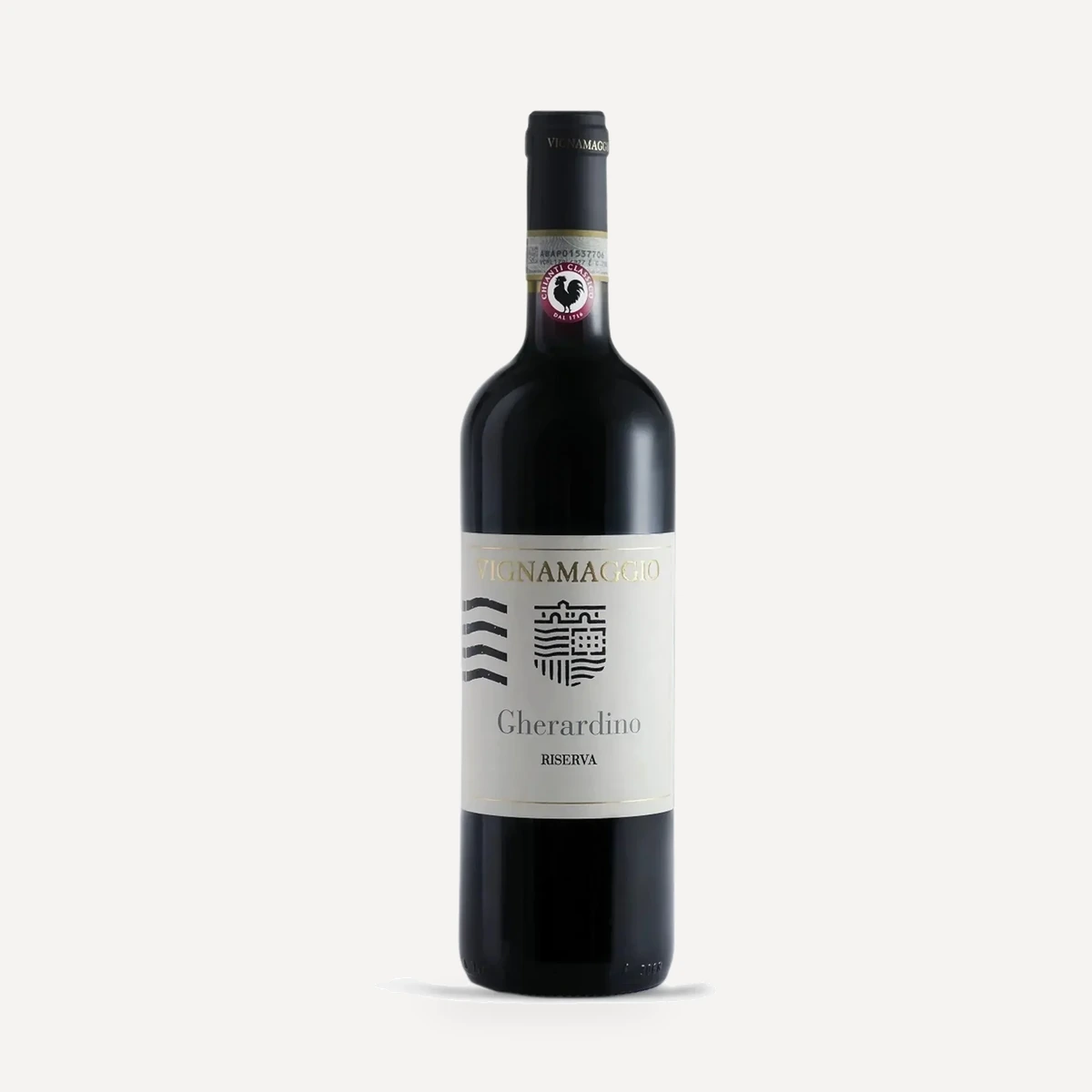
Chianti Classico Riserva Gherardino DOCG