History
Origins and the bulk-wine trade
Casa D’Ambra was founded in 1888 by Francesco D’Ambra, known as Don Ciccio. Born into an Ischian winegrowing family, he began trading the island’s wine while still young. At a time when Ischia wine was highly regarded in late-19th-century Naples, he transported wine there in carrati. The prosperous trade enabled him to establish a substantial business at the historic Villa Garavini. Its market soon expanded beyond Naples to the rest of Italy and abroad.
The second generation and the transition to bottled wine
Mario, Michele and Salvatore succeeded their father in 1952, transforming the concern into D’Ambra Vini D’Ischia S.p.A. The brothers introduced modern equipment, vinified and bottled Biancolella, Forastera and Per’ ’e Palummo, acquired vineyards in leading areas of Ischia with an emphasis on local varieties, and built a new winery at Panza d’Ischia.
A decisive reorganization followed in 1955. Mario, the most adventurous of the brothers, handled sales. Michele, who had accompanied his father on his horse-drawn cart, negotiated with growers for the island’s best grapes. Salvatore, who had studied oenology, directed vinification. Salvatore resolved to give the wine a distinct identity, ending the bulk-wine trade and introducing bottled Biancolella under the D’Ambra name.
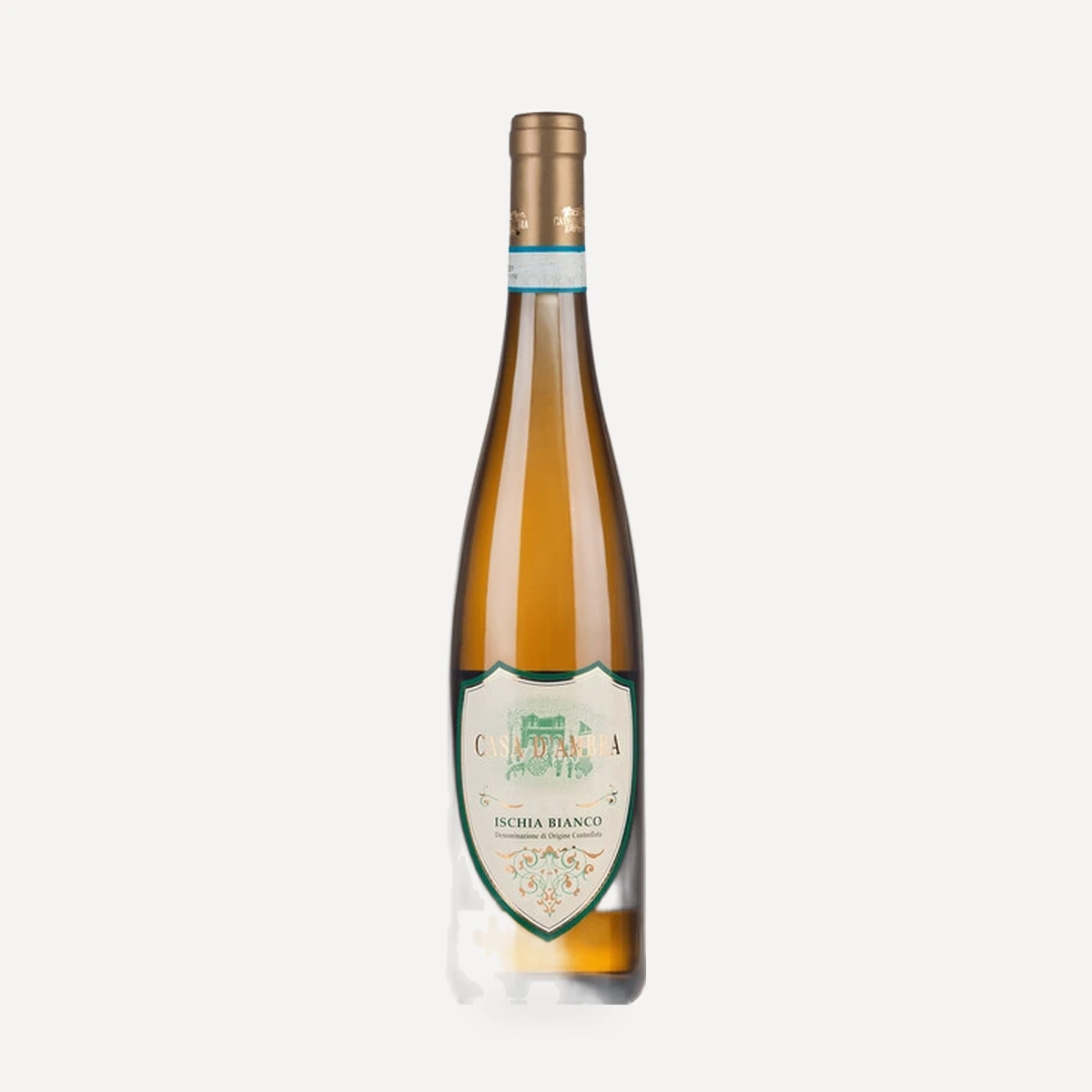
The definitive label emerged through the family’s relationship with film director Luchino Visconti. Mario sent 25 bottles of Biancolella to Visconti for the inauguration of La Colombaia, his Ischia residence. Visconti advised replacing an ornate proposed design with a simpler image built around the family house, Ischia’s sky and sea, and the necessary wording. Ischian artist Aniellantonio Mascolo executed the design. The completed label depicts Palazzo D’Ambra and a palm, together with the sun, a wine press, the sea and sailing vessels, a cart carrying barrels, and people at work.
On 9 May 1966, Ischia Bianco and Ischia Rosso received DOC recognition. It was the first DOC in Campania and one of the first five in Italy. Mario, Michele and Salvatore played a central role in securing the denomination.
Frassitelli and the third generation
Beginning in 1960, the family cultivated Biancolella at Tenuta Frassitelli. Casa D’Ambra assembled the approximately 4-hectare vineyard piece by piece from different farmers during the 1960s and 1970s. Michele Mattera, known as Candelora, spent about two years rebuilding its dry-stone parracine, then planted the rooted vines individually. Reaching the site took him an hour on foot, yet he was there by 07:00 each morning for many years.
Luigi Veronelli encountered Frassitelli while visiting Ischia for a Raiuno television programme. He regarded the site as one of Italy’s most beautiful vineyards, called its high-altitude workers the “angeli matti,” and advised Mario D’Ambra from the 1970s onward to vinify it separately.
In 1984 Andrea D’Ambra secretly selected 50 quintals of the best Biancolella and vinified them alone. Frassitelli’s first vintage followed in 1985. The first 5,000 bottles sold within a month. The wine marked a move toward more exacting vineyard selection and the separate interpretation of an individual Ischian site.
Mario became sole owner in 1984 and renewed the company’s expansion in Italian and international markets. His nephews Riccardo, Andrea and Corrado later succeeded him, pursuing greater vineyard selection and wines with a more distinct local identity.
Conservation and landscape recovery
In 1995, an experimental vineyard was established at Frassitelli as a genetic bank for old varieties at risk of disappearance. Its preserved material included Guarnaccia, Guarnaccello, Coda Cavallo, Streppa Rossa, Rillottola, Don Lunardo, Catalanesca, Uva Romana, Uva Procidana and Uva Coglionara.
The initiative formed part of a broader response to Ischia’s loss of agricultural land. From the end of the 1960s, tourism and intensive construction displaced more than 2,000 hectares of island vineyards. Casa D’Ambra consequently committed itself to recovering abandoned and uncultivated sites, restoring vineyard landscapes and planting vines rather than allowing further building development.
Andrea D’Ambra and the fourth generation
Ownership passed in 2000 to Andrea D’Ambra, an oenologist and the youngest of Mario’s nephews. He assumed responsibility for the entire production cycle, from vineyard cultivation through bottling.
A further restoration project began when Benedetto Migliaccio invited Andrea to manage his family’s historic Vigna della Iesca at Iesca in Serrara Fontana. The property, documented since 1034 and associated with the family since around the year 1000, had been overwhelmed by scrub after roughly a century of abandonment. Following extensive clearing and the planting of 4 hectares of vines, the restored vineyard first produced fruit in 2012.
Thirty years after Frassitelli’s first vintage, the 2015 harvest produced Pietra Martone from the same estate after years of trials and selection. Its name refers to the enormous green-tuff monolith overlooking the vineyard, while Marina D’Ambra created its label.
Andrea now works alongside his daughters Marina and Sara; Sara is also an oenologist. They represent the fourth generation, continuing the family’s combination of local tradition, vineyard recovery and technical experimentation.
Terroir
Casa D’Ambra’s Ischia vineyards occupy a landscape where mountain and sea meet. Sites range from sea level to high terraces on Monte Epomeo, while the island harvest as a whole can extend to almost 1,000 metres. Vines grow on coastal terraces, mountain slopes and ground close to the sea.
Green tuff, described as being of marine formation, is a defining geological material. It forms both vineyard soils and the parracine, the dry-stone walls that have divided and supported narrow cultivated strips for centuries. The vineyards are exposed to intense sun, wind and marine influence, and their steep terrain is crossed by stone stairs and retaining walls.
Frassitelli lies high on Monte Epomeo, overlooking the sea. Different descriptions place the broader property between 400 and 600 metres, the principal estate at about 600 metres, and its most extreme terraces near 700 metres. The slopes are very steep and purpose-built terraces contain crumbled green tuff. Tall broom and wild oregano grow among the vines, while sea breezes influence the exposed site.
Vigna della Iesca lies at about 400 metres at Iesca in Serrara Fontana, with views toward Sant’Angelo and Maronti beach. Its particular soil composition is associated with the site’s suitability for red varieties.
Tenuta Calitto occupies 8 hectares of vine-planted land among the green hills of Panza, Forio. It is sunlit but sheltered by the Monte Epomeo massif.
The island’s traditional viticulture depends on maintaining soils, dry-stone walls, paths and rural buildings. These structures stabilize steep slopes while also preserving the distinctive mosaic of cultivated and spontaneous plant life.
Winemaking
Viticulture is manual and adapted to Ischia’s steep, fragmented terrain. Grapes are hand-harvested and placed in small containers to protect their integrity; fruit reaches the winery in perforated crates holding no more than 20 kg. At Frassitelli, high-altitude workers carry the crates across extremely steep terraces, with monorails introduced only in later years to assist transport.
The harvest generally begins around 20 September and continues until about 10 October as different sites and elevations reach maturity. This staggered ripening permits each vineyard to be picked at the appropriate point while retaining balance across the production.
Only healthy, selected fruit is used. Vineyard protection is limited to sulfur and copper. No organic or biodynamic certification is identified.
Landscape stewardship is integral to the work. Abandoned and uncultivated land is cleared and replanted; dry-stone parracine, paths and rural structures are maintained; and soils, spontaneous flora, traditional food plants and wider biodiversity are conserved. The approach responds directly to the loss of more than 2,000 hectares of island vineyard following the growth of tourism and construction from the late 1960s.
The 1995 experimental vineyard at Frassitelli functions as a genetic bank for threatened local material, including Guarnaccia, Guarnaccello, Coda Cavallo, Streppa Rossa, Rillottola, Don Lunardo, Catalanesca, Uva Romana, Uva Procidana and Uva Coglionara.
Andrea D’Ambra supervises the complete production chain from vineyard cultivation through bottling. Annual production is approximately 500,000 bottles, divided about 80% white and 20% red. The core production relies on Ischia’s local varieties; Falanghina and Aglianico are also purchased from the mainland for the corresponding Campania IGT wines.
Harvested grapes arrive in perforated crates of no more than 20 kg. White wines are vinified exclusively in stainless steel. The broader white-wine process includes cold settling of the must and temperature-controlled fermentation, storage and bottling. Some Biancolella lots remain in prolonged contact with post-fermentation lees, with bâtonnage used for Frassitelli. The Pietra Martone parcel is vinified after prefermentative cold settling, ferments at 18°C and remains with its lees for 18 months in stainless steel.
Red-wine alcoholic fermentation takes place in stainless steel with skin contact. Maceration is adjusted to the wine and may be short or long; one documented approach uses whole-berry maceration for 5–10 days. Only two labels mature in oak. Vigna dei Mille Anni is vinified in stainless steel, rests for 18 months in oak and then for approximately 12 months in bottle. Another red receives about 90 days in different types of oak before bottle maturation.
The estate links its current vinification and maturation practices to two recurring stylistic characteristics: delicate aromas and the almond-like finish traditionally described as ammandorlato. Acidity is considered sufficient to support bottle development in the white wines rather than limiting them to immediate consumption.
Biancolella grape spirit is made by distilling fermented must and matures in stainless-steel tanks.
Philosophy
Casa D’Ambra defines innovation as research within tradition: a return to the earliest practices of Ischia’s wine history, followed by thoughtful reinterpretation for contemporary production. Creativity and technical development are therefore treated as compatible with continuity rather than as breaks from it.
The family’s central objective is to preserve the connection between Ischia and its wines. This includes cultivating local varieties, interpreting individual sites, recovering abandoned vineyards and maintaining the dry-stone structures and rural landscape on which island viticulture depends.
The estate characterizes Ischia’s steep viticulture as a challenge to be met with persistence and respect. Its survival may conflict with narrow economic logic, but it preserves both agricultural memory and the human relationship with the land. The family presents passion, dedication and tenacity as essential to keeping that heritage alive.
Quality is pursued through healthy selected fruit, closer vineyard selection and wines that retain the freshness, delicacy, savoury character and mineral expression associated with their origin. The fourth generation combines those aims with experimentation, including the conservation of rare varieties and long lees ageing for selected Biancolella.
Wines