Storia
From travel to wine
Before creating Vintage, Elisabetta Sedda spent five years travelling and working around the world. After returning to Aosta, she completed sommelier courses and became increasingly interested in how wine was grown and made rather than tasting alone. She entered viticulture without inherited property or previous professional experience, taught herself the work and initially held four jobs at the same time while building the project from the ground up.
2016 — the birth of Vintage
Vintage began in 2016 as the first harvest and the first chapter of a project centred on recovering old Valle d’Aosta vineyards. Its principles were established at the outset: no compromise with chemical or corrective oenological approaches, protection of the vineyard landscape, preservation of the fruit’s identity and care for old vines rather than routine uprooting and replanting.
The annual sequence subsequently gave every harvest a number and a name: I Nascita di Vintage in 2016, II Il gelo in 2017, III Sola in 2018, IV Rinascita in 2019, V Hamsa in 2020, VI Casa in 2021, VII Vita in 2022 and VIII Gratitudine in 2023.
2017 — frost and a 280-bottle harvest
February 2017 was unusually warm, causing the vines to wake and begin budding early. The rapid advance continued until mid-April, when four consecutive nights below freezing destroyed the young shoots. The weakened plants produced only a few bunches, and total production from the second harvest amounted to 280 bottles.
2019–2020 — Matteo Sedda joins the project
Elisabetta persuaded her brother Matteo Sedda to take part in the 2019 harvest. He initially remained unconvinced by vineyard work, but the 2020 lockdown presented a choice between remaining at home and helping his sister. He began working with her in the vineyards and gradually became part of Vintage. Mechanè was dedicated to his slow entry into the business during the 2019 harvest; its name refers to the theatrical lifting crane of Greek drama and to the support his arrival gave Elisabetta.
Autumn 2020 — Vintage Selection Emotions
Vintage Selection Emotions, or V.S.E., was conceived during the COVID-19 crisis in autumn 2020. Elisabetta wanted simultaneously to lift customers’ spirits, stimulate purchases and support other small businesses run by young people in Valle d’Aosta. The first Mystery Boxes were well received, leading to a broader range of sensory Treasure Boxes combining wine with food, music, craftwork and jewellery.
Vineyard investment and expansion
Vintage received support under the Valle d’Aosta Rural Development Programme 2014–2020, including Measure 6, investment type 6.1.1, and Measure 4, investment type 4.1.2. The support was directed to acquiring a vineyard and equipment and establishing new vineyards.
Terroir
Vintage works with vineyards in several parts of Valle d’Aosta, including Aymavilles, Verrayes, Sarre and Aosta. The documented sites range from approximately 550 to 650 metres above sea level.
Rock and clay recur in Aymavilles, Verrayes and the Verrayes–Sarre Pinot Nero sites. The contributor-grown Grenache and Grenache Gris vineyard in Sarre also combines clay and rock and is described as very sunny. A separate Sarre Gamay site at 650 metres has layered sand and clay, while another Gamay site at 600 metres combines rock and clay.
The variation among these sites is treated as a fundamental part of production: the same assumptions are not imposed on every vineyard or harvest, because place and vintage can alter the behaviour of a variety and the appropriate vinification.
Vinificazione
Vintage’s principal objective in the vineyard is to preserve both the territory and the integrity of the fruit. The approach excludes chemical inputs and casts the vigneron as the custodian of the vineyard and protector of the vine rather than an operator who forces it toward a predetermined result.
Old Valle d’Aosta vineyards are recovered and maintained, including sites with vines approximately 50–80 years old. Existing varieties are not scheduled for removal merely because they are unfamiliar or inconvenient. Instead, each is observed and matched to an appropriate form of vinification. New plantings allow a deliberate choice of varieties, while the established genetic and cultural diversity of recovered vineyards is retained.
Harvesting in the documented vineyards is manual, using crates. Depending on variety and site, picking has ranged from mid-September to late October. The estate also received rural-development support for vineyard acquisition, equipment and new vineyard establishment.
Vintage follows a low-intervention cellar approach designed to accompany, rather than force, the transformation of grapes into wine. Fermentations are spontaneous, and the general production policy excludes oenological additions other than minimal sulphur dioxide. Wines are bottled without filtration, and oak use is deliberately limited.
Vinification is adapted to the variety, vineyard and season instead of following a fixed recipe. Documented cellar work includes spontaneous fermentation in stainless steel; destemmed fruit; whole-cluster fermentation; carbonic fermentation; and direct, gentle foot pressing followed by pressing in a traditional press. Individual lots may combine several approaches before blending.
Maturation vessels include stainless steel, used 300-litre barrels and barriques. Documented élevage ranges from entirely in steel to 11 months in steel, 16 months in barrique or approximately two years in barrique or used wood, often followed by a period in steel and then bottle. Total sulphur dioxide in the reviewed technical records ranges from 25 to 40 mg/L.
The intended result is to keep the fruit and growing season recognisable. Tacsum provides a continuing thread in the range, while the rest of the production may change according to what the recovered vineyards and each vintage yield.
Filosofia
Vintage defines its work through stewardship rather than stylistic labels. Although its practices may overlap with categories such as natural or organic wine, the project does not treat those terms as ends in themselves. Its stated aim is to make clean, sound wines of quality with the lowest practical environmental impact, while restoring the meaning of wine as an agricultural product rooted in a particular place.
The vineyard is the starting point. Old sites are recovered because they preserve Valle d’Aosta’s viticultural history and may contain vines 50–80 years old. The role of the grower is to safeguard the vineyard and the integrity of the plant. In the cellar, that responsibility continues through spontaneous fermentation, minimal sulphur dioxide, avoidance of corrective additions, no filtration and restrained use of wood.
Wine is built around the variety rather than forcing a variety into an established house recipe. Recovered grapes are retained and studied, even when unfamiliar, and the appropriate vinification is developed through experience. Territory and vintage remain capable of overturning previous assumptions, so the range itself can change. Tacsum is the continuing thread; other bottlings may vary with the season and available fruit.
Elisabetta Sedda also treats the wines as personal expressions rather than standardised products. Her account of the work emphasises uncertainty, risk, physical effort, attention and continual learning.
Vini
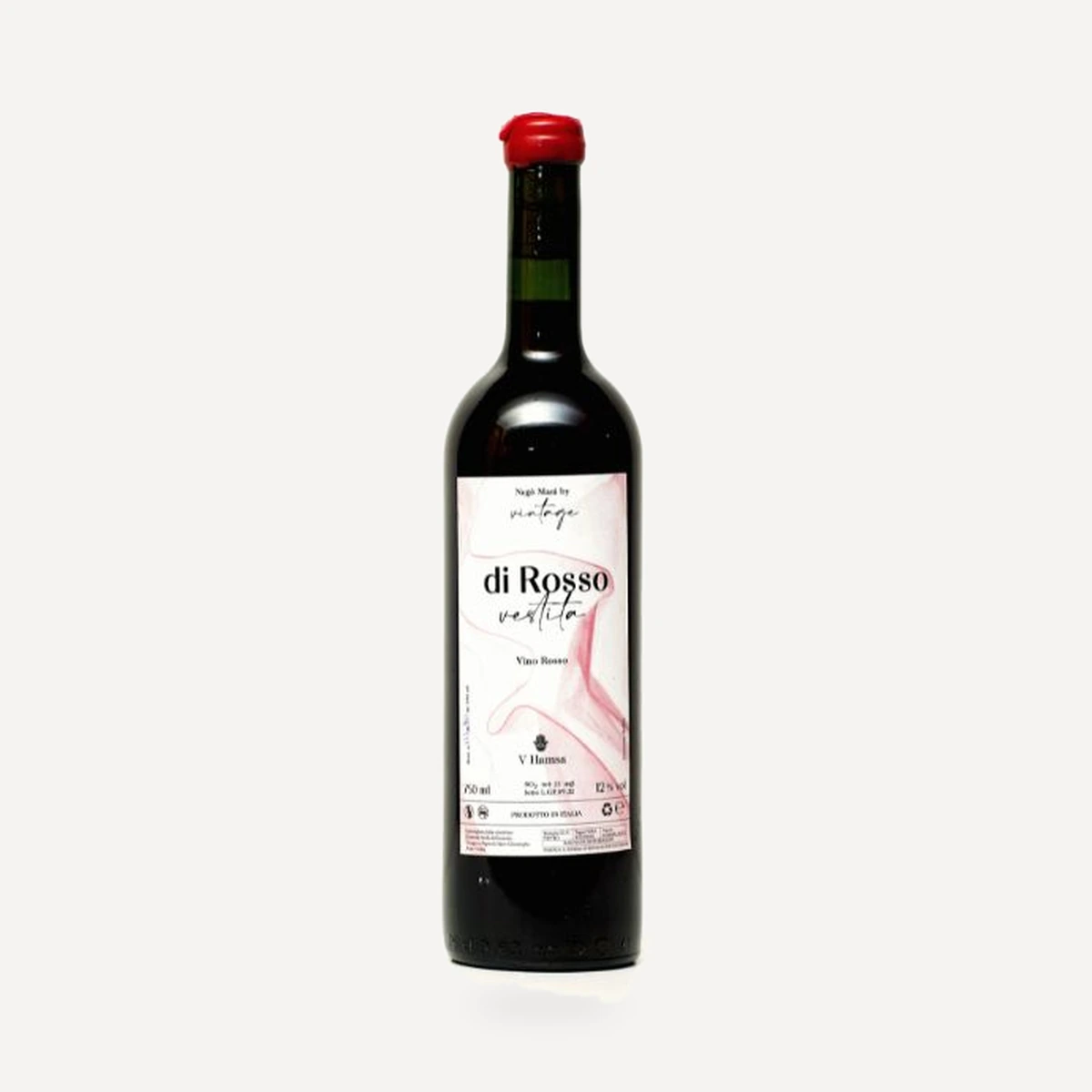
Di Rosso Vestita