Storia
Ancient antecedents
The estate traces its physical history back more than 700 years and also attributes Roman origins to the property. In 1273, the noble Torre Tasso family arrived in Friuli and became one of the earliest ruling families associated with the land on which Russiz Superiore now stands. The estate’s double-headed eagle derives from the Torre Tasso coat of arms and remains its emblem.
The name Russiz comes from the toponym of the hills occupied by the vineyards. A documented division in 1648 distinguished Russiz Disôre, or Russiz Superiore—the older, predominantly hillside part of the feudal settlement—from Russiz di Sott, or Russiz Inferiore, on the plain.
Between 1558 and 1770, the Orzoni family was among the noble owners of the property. It identified a particular site for red-wine production. That site appears on cadastral maps prepared during the eighteenth-century reign of Maria Theresa and subsequently completed under the Napoleonic administration. Its name survives in the historic Barricaia degli Orzoni and Rosso Riserva degli Orzoni.
The Felluga family’s Istrian origins
The Felluga family’s relationship with wine began in the second half of the nineteenth century, more than 150 years ago, at Isola in Istria. Michele Felluga, the first documented generation, principally produced Malvasia and Refosco. His successor Marco, representing the second generation, extended the family’s trade across the Gulf of Trieste, initially to Grado and subsequently throughout Friuli Venezia Giulia.
Following the First World War, Giovanni Felluga, the third generation, moved with his mother Elisa and his children from Isola—then part of Italy—to Grado to develop the wine trade further. A later family account dates the move to 1921. Marco Felluga, one of Giovanni’s seven children, was born in Grado in 1927.
Settlement in the Collio and wartime loss
In 1938, Giovanni recognized the potential of the lands around Gorizia, before the area was known as the Collio, and moved the family again, this time to Gradisca d’Isonzo. He opened a production cellar there. During the Second World War, the family lost all its remaining possessions in Istria.
Marco Felluga and the acquisition of Russiz Superiore
After taking over the family activity, Marco Felluga—the penultimate of Giovanni’s seven children and the family’s fourth winegrowing generation—founded the company bearing his name in 1956. His approach joined innovation to inherited practice and helped advance modern viticulture in the Collio.
In 1967, Marco acquired Russiz Superiore at Capriva del Friuli. He regarded the centuries-old hillside property as a distinctive cru, and it became the second estate associated with the family. The acquisition joined the estate’s feudal and viticultural history to the Felluga family’s own multigenerational wine enterprise.
Fifth and sixth generations
Roberto Felluga, Marco’s son and the fifth generation, followed his father in directing both Russiz Superiore and Marco Felluga. He placed sustainability, scientific research, innovation, reduced environmental impact and respect for local history and tradition at the center of the two estates’ development. He also pursued age-worthy white wines intended to retain interest both when young and after bottle maturation.
In 2017, the family marked two milestones together: Marco Felluga’s 90th birthday and the 50th anniversary of Russiz Superiore under Felluga stewardship. By then Marco and Roberto had directed a combined 60 harvests.
Ilaria Felluga, born in Udine in 1995, spent time abroad before returning to study viticulture and oenology. She entered the business alongside her father Roberto and grandfather Marco and has led Russiz Superiore and Marco Felluga since 2021 as the family’s sixth generation.
Sustainability, research and the present structure
In February 2021, a photovoltaic installation made the Russiz Superiore winery energy self-sufficient. That year the estate also joined the group of 13 producers certified under SQNPI through Consorzio Collio, formalizing its integrated-production practices.
Scientific vineyard assessment has accompanied this work. Sauvignon Lungo Strada received 92/100 under the nine-parameter Bigot Index. In 2022, Tocai Friulano Centralina and Cabernet Franc Pietra each received 90/100 and were placed among the assessment’s 38 leading Italian vineyards.
The agricultural company issued the second revision of its ethical code on 1 September 2023. Since 2024, the business has been supported by a partnership with Tommasi Family Estates, while Ilaria Felluga continues to lead the two Felluga estates.
Terroir
Russiz Superiore lies at Capriva del Friuli in the heart of the Collio. The estate covers 100 ha, with 50 ha planted to vines, and its vineyards occupy the hills from which the Russiz name derives.
The terrain was formed during the Eocene. Its alternating layers of sandstone and loam rock—limestone and clay—originated as material on the ocean floor. The resulting soils are impermeable: rainwater moves across the surface rather than stagnating, while the current technical descriptions characterize erosion as limited.
The division documented in 1648 distinguishes the predominantly hillside, older Russiz Disôre sector from Russiz di Sott on the plain. This historic topographic distinction survives in the estate’s name and in Col Disôre.
Planting density across the estate is 6,000 vines per hectare. White-wine production predominates, although the property also has a centuries-old association with sites selected for structured red wines.
Vinificazione
Russiz Superiore follows certified sustainable and integrated production. Its practices include integrated pest management, ozone treatments and natural fertilizers, with the stated purpose of caring for the vineyards while protecting the Collio ecosystem.
The estate holds VIVA sustainability certification. In 2021 it became one of 13 Consorzio Collio members covered by SQNPI certification, the Italian National Quality System for Integrated Production. The standard addresses ecological, economic and toxicological principles. Integrated production is used to minimize chemical inputs, water consumption and energy use while maintaining product quality.
All grapes represented in the current Russiz Superiore range are harvested by hand. Guyot is used for the white varieties and Col Disôre plantings; spurred cordon is used for the red varieties and the Orzoni blend. A planting density of 6,000 vines per hectare applies across the estate.
Scientific monitoring includes the Bigot Index, which evaluates vineyard potential through nine viticultural parameters. Sauvignon Lungo Strada scored 92/100, while Tocai Friulano Centralina and Cabernet Franc Pietra each scored 90/100 in 2022.
Environmental management is directed toward preserving natural balance and ultimately developing a circular economy. The estate also commits to responsible use of natural resources, assessment of the environmental effects of new activities and processes, cooperation with local institutions and effective environmental and safety-management systems.
Russiz Superiore bottles principally Collio DOC wines from estate-grown grapes at Capriva del Friuli. White wines form the majority of production, while the estate also maintains a historic red-wine tradition centered on the Orzoni sector and its barrel cellar.
Across the principal white varieties, grapes are destemmed, subjected to temperature-controlled cold maceration and gently pressed to separate juice from skins. Fermentation may combine stainless steel and oak, followed by maturation on the lees and further bottle aging. Proportions and duration vary by cuvée. The age-worthy Col Disôre is fermented in oak, remains approximately 12 months on its lees and receives another 12 months in bottle. Ribolla Gialla is harvested late, macerated for one day and slowly pressed; most fermentation takes place in steel, with 20% transferred after three to four days to 3 hl Slavonian-oak barrels. Frequent bâtonnage keeps solids in suspension.
For the varietal red wines, destemmed grapes enter tanks equipped for red vinification. Alcoholic fermentation begins immediately, with skin contact averaging 10–15 days according to vintage and extraction. Maturation then lasts 12 months in oak, where malolactic fermentation also occurs, followed by approximately six months in bottle. Rosso Riserva degli Orzoni follows a longer regime: destemming and temperature-controlled tank maceration are followed by two years in oak and one year in bottle.
The historic Barricaia degli Orzoni remains the dedicated aging space for the estate’s red wines. The production cellar and barrel cellar both form part of the estate visit route.
Filosofia
Russiz Superiore’s approach joins family continuity to scientific and technical development. Roberto Felluga defined its principal commitments as sustainability, innovative processes supported by Italian and international research, reduced environmental impact and respect for the territory, its history and its traditions.
The production philosophy gives particular weight to longevity. Its white wines are intended to be appreciated when young but also to develop through bottle aging, gaining mature-fruit character while retaining mineral complexity. This concern led to dedicated age-worthy whites, including Col Disôre.
Environmental decisions are guided by the intention to preserve natural equilibrium and move toward a circular economy. In Roberto Felluga’s formulation, caring for the surrounding environment is essential to securing a future for both present and coming generations.
The estate’s ethical framework extends this philosophy beyond farming. It defines legality, integrity, truthful and evidence-based communication, equality, privacy, professional collaboration, product authenticity, worker safety and environmental compatibility as operating principles. Economic, social and environmental sustainability are treated as connected responsibilities.
Vini
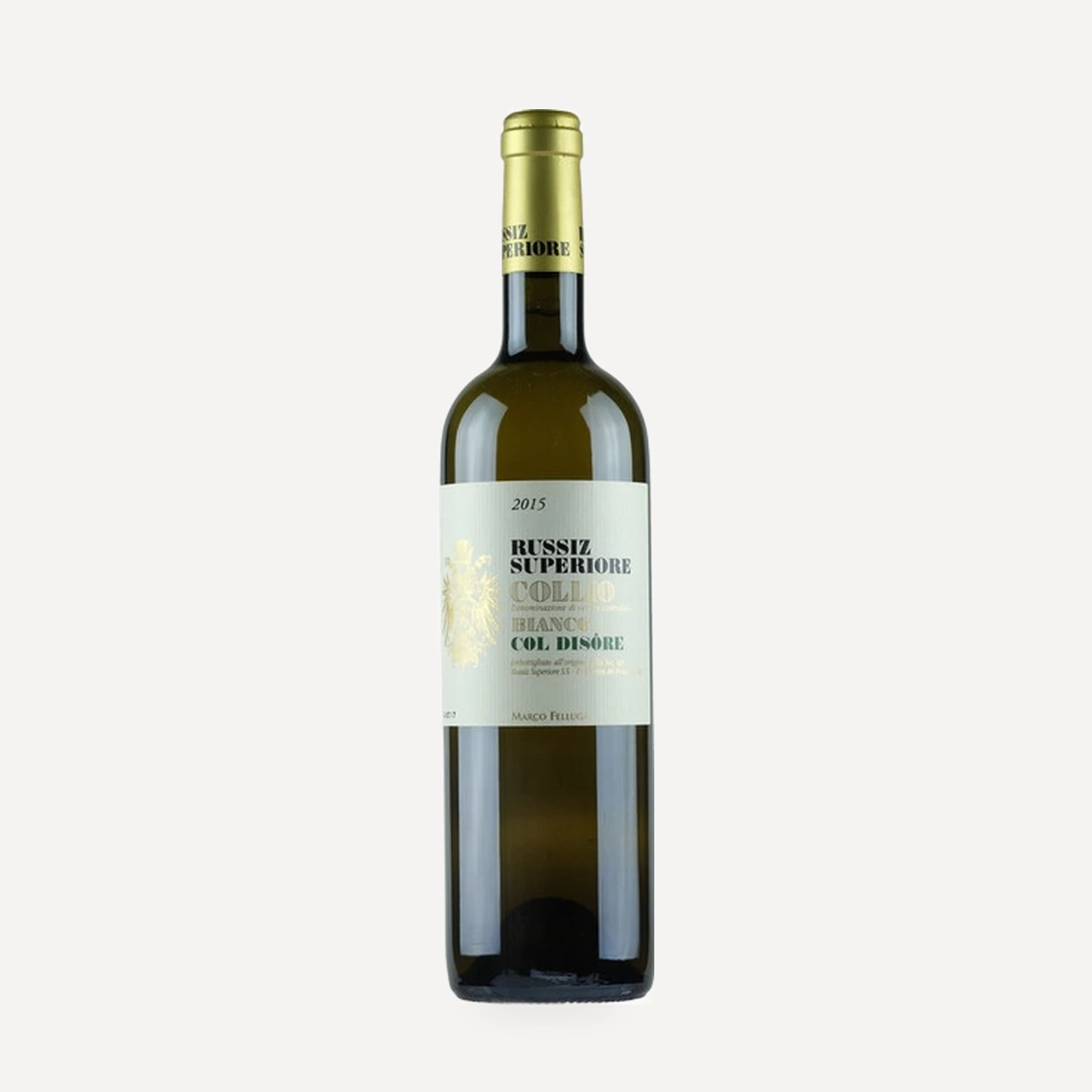
COL DISÔRE BIANCO Collio Russiz Superiore DOC
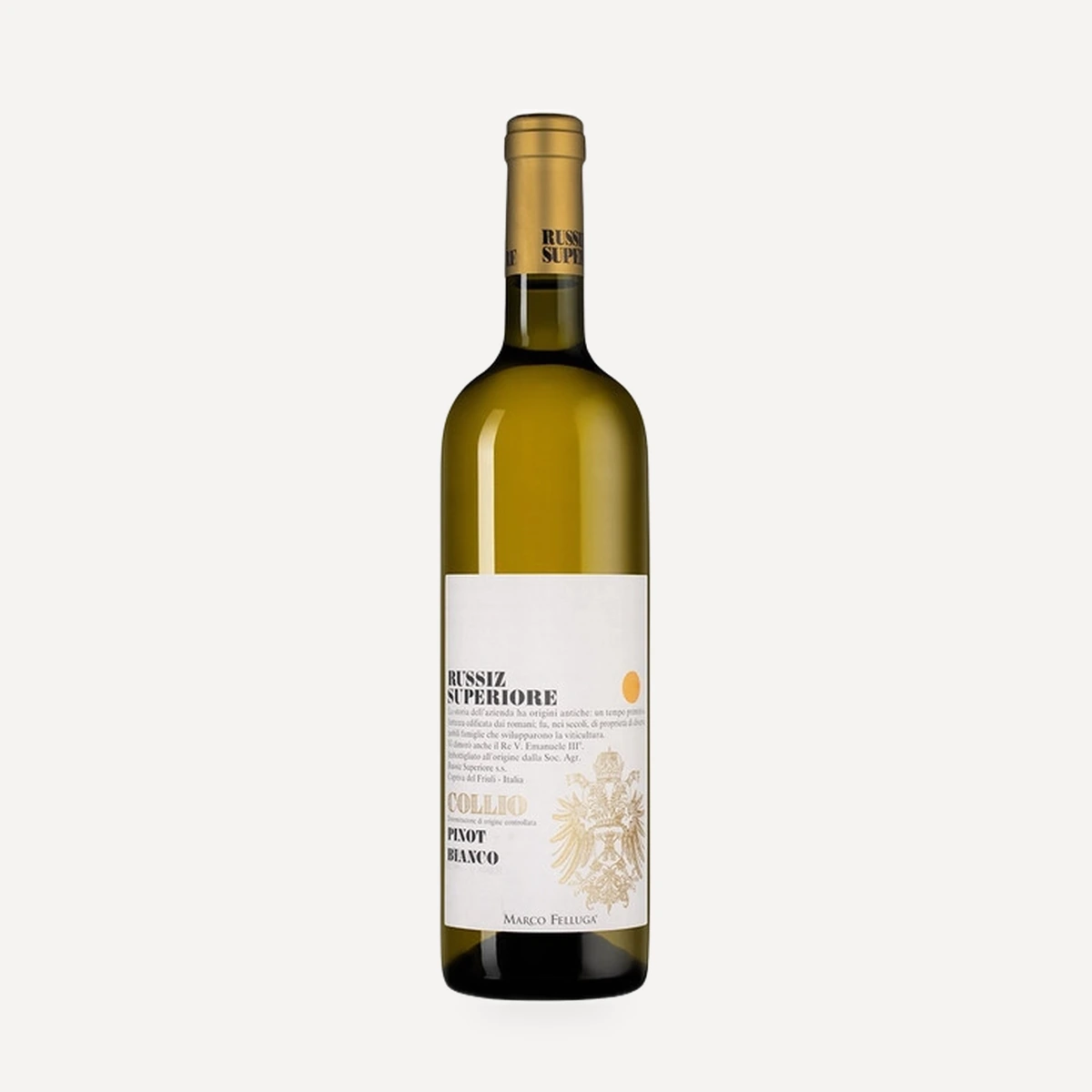
PINOT BIANCO Collio Russiz Superiore DOC
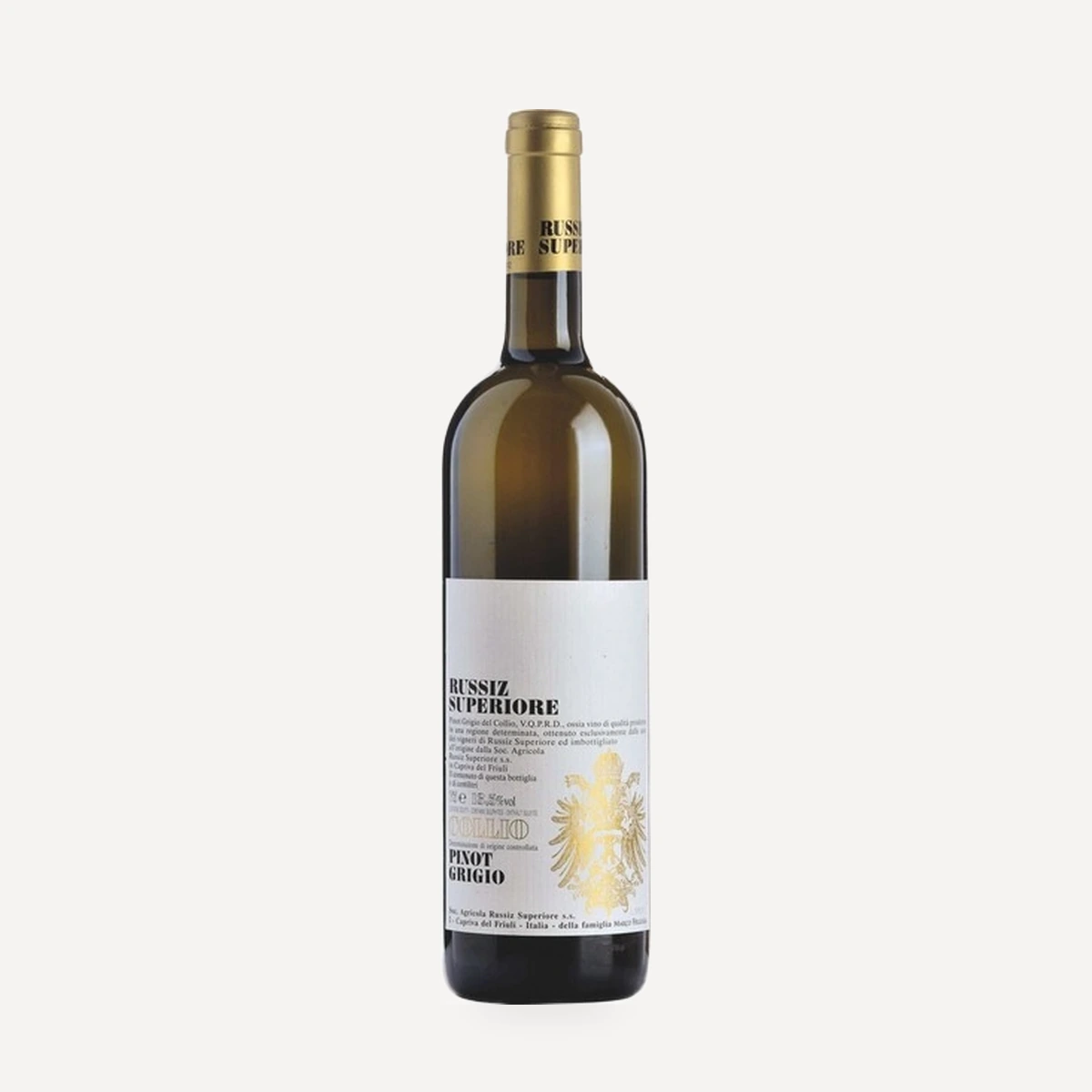
PINOT GRIGIO Collio Russiz Superiore DOC