Storia
Centuries of Umbrian agriculture
The Farchioni family’s relationship with Umbrian agriculture extends back for centuries. Its identity was formed around cultivating the land, gathering its produce and transforming it into food and drink, with knowledge passed between generations.
Creation of Terre de la Custodia
Pompeo Farchioni and his wife, Tosca, initiated the family project that includes Terre de la Custodia. The undertaking represented a return to the direct cultivation and interpretation of the family’s Umbrian land, with wine at the centre of the project.
The winery was established among the hills of Gualdo Cattaneo, 5 km from Montefalco’s historic centre. This location became the production heart of Terre de la Custodia, joining vineyard work with a cellar philosophy that combines established practice and contemporary wine technology.
The succeeding generation
Pompeo and Tosca’s children—Giampaolo, Marco and Cecilia—subsequently continued the project. Giampaolo Farchioni became proprietor and the principal creative figure associated with the winery. His approach retains the family’s agricultural inheritance while pursuing technical innovation, particularly in the interpretation of Sagrantino.
Terre de la Custodia forms the wine-producing part of the present-day Farchioni Group, alongside Farchioni Olii and Mastri Birrai Umbri.
Product and packaging development
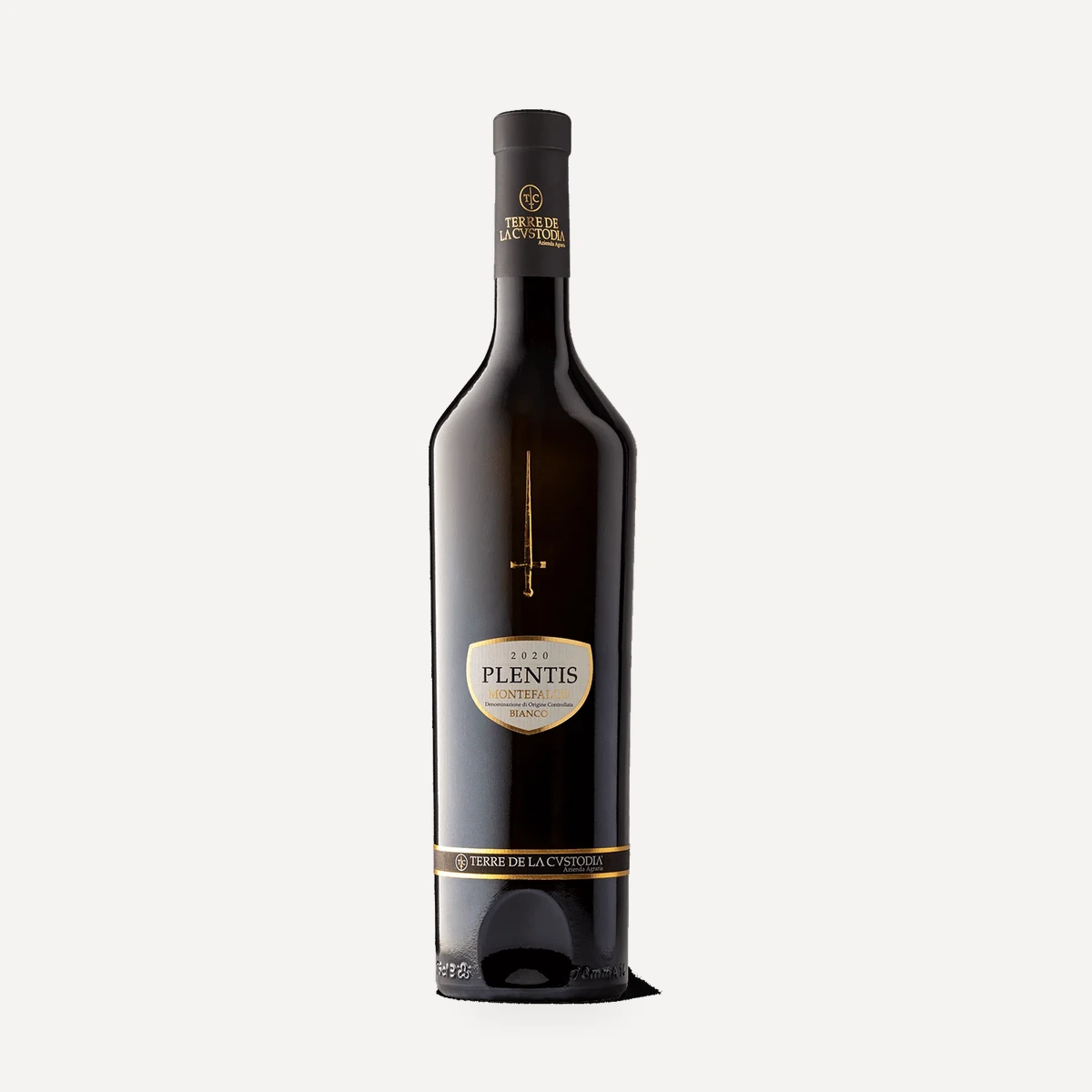
Tosca Sibella Farchioni designed a patented bottle for the estate’s wines in collaboration with a local glassmaker. Named Sibella, the bottle connects function with the Farchioni family’s interest in fencing: its shape and grip evoke the position of a fencer’s hand and wrist when holding a foil.
Terroir
Terre de la Custodia is based in the hills of Gualdo Cattaneo, 5 km from the historic centre of Montefalco. Its viticultural footprint also reaches Giano dell’Umbria, Torrececcona di Todi and the wider Todi area.
The vineyard holdings represented in production are generally situated between 300 and 400 m above sea level. The principal combinations of site and soil are varied:
- La Palombara at Gualdo Cattaneo is a gently sloping, south-facing site with strong clay soils containing lignite.
- The Giano dell’Umbria–Gualdo Cattaneo vineyards lie at 300–350 m and have lighter soils tending toward limestone.
- Montefalco Grechetto grows at approximately 400 m on medium-textured soils tending toward clay.
- Torrececcona di Todi has medium-textured, clay-influenced soils at approximately 350–400 m.
- Other Gualdo Cattaneo white-wine vineyards occupy medium-textured soils at 300–350 m.
- The vineyards supplying rosé across Montefalco, Gualdo Cattaneo and Todi include calcareous, medium-textured soils at around 300 m.
Recent seasons demonstrate the area’s climatic variability. The 2017 season brought low winter temperatures, declining water reserves from February, an April frost, summer temperatures above 40°C and an early harvest under mild water stress. In 2018, rainfall from February replenished soils after the previous drought; low March temperatures and snow were followed by a warm, dry April that returned vine development to a normal rhythm. The 2022 season was dry and generally warmer than average, accelerating vine development until late-summer rain helped rebalance ripening. In 2023, spring frost and heavy May–June rain increased fungal pressure and reduced production, while stable conditions from the second half of August supported recovery. In 2024, a mild, wet period from autumn through late spring advanced budbreak and flowering and built soil-water reserves; temperatures then exceeded 40°C after mid-July, with early varieties ripening about ten days ahead of recent years.
Vinificazione
Vineyard management is adjusted to the conditions of each growing season. During the hot, dry 2022 season, canopy work kept clusters shaded against sunburn while maintaining enough ventilation to prevent pockets of humidity and disease. Soil management limited cracking and reduced the rapid loss of water through evapotranspiration. Sugar and acidity were monitored to determine the appropriate picking time under accelerated ripening conditions.
Cluster thinning is used for selected reds before harvest, removing less-ripe fruit and clusters with health problems. Selection for cru whites begins in the vineyard. Harvest methods vary by parcel and intended style: selected white and rosé grapes are picked by hand during the coolest early-morning hours, while mechanical harvesting is also used for some Montefalco red production to optimize the interval between picking and processing.
Early-picked grapes are cooled immediately on arrival to limit oxidation and prevent unwanted fermentation. Sagrantino destined for passito is selected cluster by cluster at the end of September, handled gently and laid on racks for more than 30 days of drying in controlled temperature and humidity.
The estate’s environmental philosophy focuses on efficient use of natural resources, preservation of soil health and biodiversity, and balancing product quality with the welfare of people and the surrounding environment.
The winery stands among the hills of Gualdo Cattaneo, 5 km from Montefalco. Its production approach combines family practice with contemporary cellar technology.
White and rosé processing
Selected white and rosé grapes are harvested during the coolest early-morning hours and chilled on arrival. White pressing takes place gently in an oxygen-free environment to slow enzymatic oxidation. The must is clarified by 24 hours of static settling, then inoculated with selected yeast. Fermentation generally takes place at controlled low temperature in stainless steel for 12–14 days.
For rosé, a brief skin maceration extracts colour and aroma before gentle oxygen-protected pressing. Fermentation takes place in steel for about 12 days, followed by approximately five months on the lees in steel, blending and a further two months in bottle.
Some selected whites divide the fermenting must between stainless steel and barriques. One approach transfers a portion to barrique after fermentation begins; the separate lots then mature on their lees in steel and wood for about four months, are blended, rested again in steel and bottled for another two months. Another approach ferments a portion of Chardonnay entirely in barrique and keeps it there for at least six further months sur lie, with frequent stirring, before a spring assemblage, additional steel maturation and 12 months in bottle.
Red-wine processing
Red grapes are destemmed and crushed or lightly crushed, depending on the fruit. Selected lots are cooled to approximately 18°C and inoculated with selected yeast in stainless-steel fermenters equipped with cooling and automated pumping-over systems. Pumping over begins once sufficient alcohol has developed to extract tannin and promote stable binding between tannin and colour compounds. Alcoholic fermentation lasts approximately 8–12 days. Délestage is also used for some Sangiovese fermentations.
After separation from the skins, malolactic fermentation takes place in temperature-controlled stainless steel. Maturation ranges from steel and bottle for fresher styles to wood for more structured wines. Examples include around six months in wood for Sangiovese, 12 months in barrique and large cask plus four months in bottle for Sagrantino, and 30 months of total maturation, including 14 months in barrique and three months in bottle, for a Montefalco Rosso Riserva.
Passito processing
Selected Sagrantino clusters dry on racks for more than 30 days under controlled temperature and humidity. Once the desired sugar concentration is reached, the grapes are destemmed, pressed and fermented in dedicated tanks with punch-downs and pumping over. At the intended balance of alcohol and residual sugar, the wine is drawn off and filtered to stop further fermentation and remove plant material, then matured in barriques for 12 months.
Sparkling production
The range includes both Metodo Classico Gladius and Blanchus, the latter made by a long Charmat process with nine months on the lees.
Filosofia
Terre de la Custodia presents wine as the continuation of a family relationship with Umbrian agriculture. Its stated objective is to preserve the authenticity and integrity of an inheritance renewed with every harvest, while treating each wine as an expression of its place of origin.
Tradition and technology are treated as complementary. Established agricultural and cellar knowledge provides the foundation, while current winemaking technology is used to improve precision and reveal the aromatic character of the grapes. Giampaolo Farchioni’s direction follows the same principle: firmly rooted in family practice but open to innovation, particularly in the development of Sagrantino.
Sustainability is framed as both an ethical commitment and a condition of quality. The estate seeks to meet present needs without compromising those of the future, use natural resources efficiently, preserve biodiversity and soil health, and place product quality alongside the well-being of people and the surrounding environment.
The broader family philosophy emphasizes pride in Umbria and the continuation of the region’s food-and-drink traditions across generations. Wine is conceived as something to be shared rather than solely as a technical product.
Vini